Who Repairs Chimneys in Massachusetts? 7 Pros Compared
It usually starts with a brown ring on the ceiling next to the chimney. You call a roofer, who says the flashing looks fine and it is probably the brick. You call a mason, who says the brick is fine and it is probably the flashing. A chimney sweep comes out for a cleaning and tells you the flue needs a liner. Three visits later, the ceiling is still wet and you have three different answers.
That happens because a chimney sits where four trades meet: masonry, roofing, fire safety and heating. Each one sees the part of the chimney it knows best.
The short version: a chimney mason repairs brick, mortar, crowns and rebuilds. A chimney sweep or certified inspector cleans and inspects the inside of the flue. A roofer handles the roof side of flashing. A liner installer relines damaged flues, a heating contractor handles the appliance and its venting, a structural engineer gets involved when a chimney is moving or being altered, and the building department answers permit questions. When you do not know what is wrong, pay for a diagnosis before you pay for a repair.
A fair note: this guide is written by a mason, so read it with that in mind. It tries to be clear about where each trade stops, including masonry, because no single trade handles every chimney problem well.
Before you call anyone: a 10-minute look from the ground
You can narrow the problem a lot without climbing a ladder, and you should not go up on the roof yourself. Take a pair of binoculars or a phone with a good zoom, and walk around the house on a dry day.
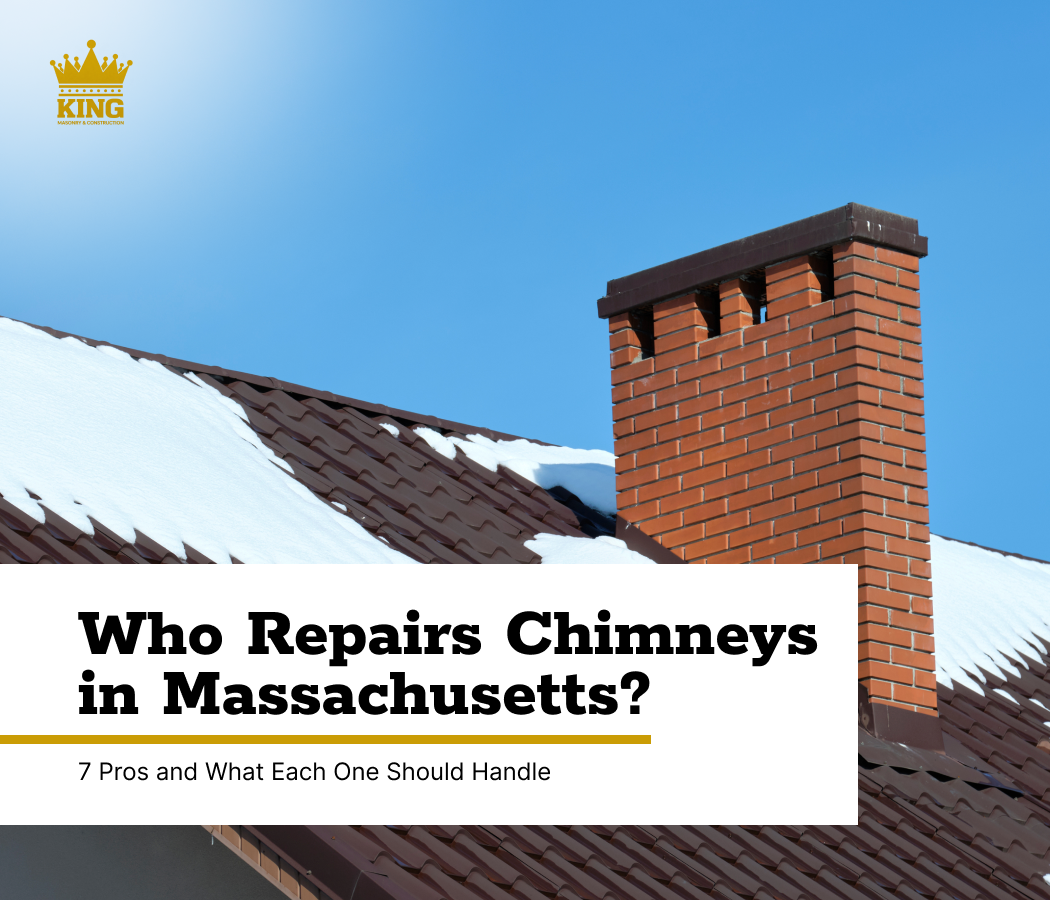
At the very top, look for:
A cap. Is there a metal cover over the flue opening? No cap means rain, animals and leaves go straight down the flue.
The crown. The sloped concrete or mortar slab around the flue. Look for cracks, chunks missing, or a crown that sits flush with the brick instead of overhanging it.
The flue tile. The clay pipe sticking up through the crown. Cracked or broken tile at the top usually means more damage below.
On the brick, look for:
Joints that are recessed, sandy or missing.
Brick faces that are flaking or broken.
White staining, which usually means water or flue gases are moving through the masonry.
A dark, damp-looking patch on one side that dries much slower than the rest.
Any visible lean, or a gap where the chimney meets the house.
At the roof line, look for:
Metal flashing that is bent, lifted, rusted or missing.
Thick black roof cement smeared over the flashing and brick. That is usually a sign someone has already tried a quick patch.
On a wide chimney, a small peaked "roof" called a cricket on the uphill side. Without one, snow and water pile up against the chimney.
Inside, look for:
Stains on the ceiling or walls around the chimney, and whether they appear after every rain or only wind-driven storms.
Water or debris in the firebox or at the base of the flue.
Small flakes of tile at the cleanout door in the basement.
A smoky smell in the house, especially in humid weather.
Take photos of everything. Every pro you call will give you a better answer with them, and you will be able to compare what each one says against what you already saw.
The 7 pros, and where each one stops
1. The chimney mason
Call them for: repointing, replacing damaged brick, rebuilding the top of a chimney above the roof, full rebuilds, crowns, and masonry work on the smoke chamber and firebox.
Do not expect them to: clean the flue, run a camera down it, or diagnose a draft problem. Some masons do all of that, many do not.
Ask them: how they will build the crown, and how it will be separated from the flue.
This is the person who should be laying the brick, and the crown is where their skill shows most. Two details separate a good crown from a bad one. First, the flue tile has to be able to move. The ASTM standard for masonry chimneys says flue liners should not be bonded to the surrounding masonry, because the liner heats up and expands at a different rate than the brick. A crown poured tight against the tile cracks within a few winters. Second, a good crown overhangs the brick with a drip edge, so water falls clear of the chimney instead of running down its face.
Ask specifically about chimney experience. A mason who mostly builds patios and retaining walls may not be used to working safely on a steep roof, setting counterflashing, or building a crown that lasts. Look at photos of chimney tops they have finished, not just front steps.
In Massachusetts, the state offers a masonry-only Construction Supervisor License that covers supervising masonry work including fireplaces and chimneys. That license is not enough to construct a masonry building, which needs a broader license.
What a chimney mason does in practice is covered on our pages about chimney rebuilding, chimney tuckpointing and crown, cap and flashing work.
2. The chimney sweep or certified inspector
Call them for: cleaning, annual inspections, camera inspections, caps, dampers, smoke and draft problems, and pre-purchase inspections.
Do not expect them to: rebuild masonry, unless their company has its own masons.
Ask them: what level of inspection they are doing, and to show you the camera footage.
Certification from the Chimney Safety Institute of America is the most common credential to look for. NFPA 211, the national standard for chimneys and fireplaces, defines three inspection levels:
Level 1 is a routine check of the parts you can readily reach, for a chimney that has not changed and is used the same way as before.
Level 2 goes further, usually with a video scan of the whole flue and a look at accessible areas such as the attic. NFPA 211 calls for a Level 2 when an appliance is added or changed, before relining, when a property is sold or transferred, and after a malfunction or an event likely to have caused damage, such as a chimney fire.
Level 3 is for when serious hidden damage is suspected and parts of the chimney or the house may have to be opened.
For a chimney in regular use, NFPA guidance recommends an inspection at least once a year, with cleaning as needed. Our guide to how often to inspect a chimney explains the schedule.
The sweep is also often the first person to find a damaged flue. Cracked clay tile at the bottom of a flue, sometimes from a chimney fire the owner never noticed, is a common discovery during a routine cleaning. If a sweep tells you the flue is unsafe, take it seriously, ask to see the footage, and do not use the appliance until it is resolved.
3. The roofer
Call them for: shingles, underlayment, and the step flashing that ties the roof to the chimney.
Do not expect them to: repoint the chimney, rebuild brick, or fix a crown properly.
Ask them: how the counterflashing will be attached to the chimney.
A properly flashed chimney has two layers of metal. Step flashing is woven in with the shingles along the sides, one piece per course. Counterflashing is set into the chimney itself and folded down over the step flashing, so water running down the brick is shed over the top of it. On the uphill side, a chimney more than 30 inches wide also needs a cricket under building codes based on the International Residential Code.
Counterflashing is where roofing and masonry collide. Traditionally, it is set into a mortar joint, either by raking out the joint or cutting a groove with a masonry blade, then sealed in. If the mortar joints at that height are soft or crumbling, the new metal has nothing sound to hold on to.
A few problems that turn up often:
One piece of aluminum cut to look like step flashing, with its top edge tucked into a groove cut straight across the brick and sealed only with black roof cement.
Counterflashing with no groove at all, just glued to the brick face with sealant.
A mason who leaves grooves "for the roofer" and a roofer who never comes back to use them, or uses them wrong.
None of these mean the roofer is bad. They mean nobody was in charge of the joint between the two trades. On a flashing job, either get the mason and the roofer talking before work starts, or hire one crew that can do both. Our guide to chimney flashing in Boston goes into what a full flashing job involves.
4. The chimney liner installer
Call them for: stainless steel relining, cast-in-place liners, and repairing damaged clay flues.
Do not expect them to: fix leaks or masonry outside the flue.
Ask them: how the liner is sized to your appliance, whether it will be insulated, and what the liner manufacturer requires.
This could be a sweep, a chimney company or a masonry contractor. A stainless steel liner is the most common fix for a cracked or deteriorated clay flue, but it has to suit the appliance. A liner sized for an open fireplace may be wrong for a wood stove insert you add later, so think ahead about how you plan to use the chimney.
A cracked flue is a safety problem, not a cosmetic one. It can let heat reach framing and let flue gases leak into the house.
5. The heating contractor or licensed gas fitter
Call them for: venting for furnaces, boilers and water heaters, and any change of heating appliance.
Do not expect them to: repair masonry.
Ask them: whether your chimney is suitable for the new appliance, or whether it needs a liner or a different vent.
Many Boston-area chimneys were built for coal or wood and now vent a modern gas or oil appliance. Cooler exhaust from high-efficiency equipment can condense inside an old clay flue and break down the tile and mortar from the inside. The signs often show up outside first: crumbling joints near the top, white staining on the brick, or tile flakes at the base. A missing rain cap makes it worse, because rainwater running down the flue mixes with that acidic condensation.
Some new appliances vent sideways through a wall and do not use the chimney at all. That can leave an unused chimney that still needs a cap and maintenance, or a decision about whether to keep it.
If you smell gas or a carbon monoxide alarm goes off, leave the house and call 911 or your gas company from outside.
6. The structural engineer
Call them for: a leaning chimney, a chimney separating from the house, cracks that run through the bricks, settled footings, and any plan to remove part of a chimney inside the house.
Do not expect them to: lay brick or give you a quote for the repair.
Ask them: what is causing the movement, and whether the repair needs an engineered design.
An engineer gives you an independent answer about what is holding what up. It is worth bringing one in whenever a chimney has visibly moved, when the gap between chimney and house keeps growing, or when someone proposes removing the lower part of a chimney inside the house and leaving the top in place on the roof. See our page on fixing a leaning chimney for how those repairs usually go.
7. The local building department
Call them for: whether your job needs a permit, and what your town requires.
Do not expect them to: recommend a contractor.
Ask them: whether a permit is required for the specific work you are planning.
Massachusetts tells homeowners and contractors to check with the municipal building official for any local requirements beyond the state rules. One phone call can save you a stop-work order, or trouble when you sell the house.
Four common jobs, and who should be on each
The ceiling stain next to the chimney
This is the classic one, and the first guess is often wrong, because water travels before it shows up. A stain beside the chimney can come from the cap, the crown, porous brick, open mortar joints, the flashing, damaged shingles nearby, ice dams, or condensation inside the flue.
Who should be on it: a chimney mason or chimney repair contractor who will check the cap, crown, brick and flashing together. If the flashing is the problem, a roofer may join.
How to find the source: test before replacing anything. The most reliable method is slow. With a hose, wet one area at a time, starting low at the flashing and working up to the brick and then the crown, giving each section time to show a leak inside. A simpler test some owners use: before a forecast rain, wrap the brick above the flashing in plastic sheeting, leaving the flashing exposed. If it still leaks, look at the flashing and roof. If it stops, the water is coming through the masonry.
It is not unusual for owners to replace the flashing, then the crown, then add waterproofing, one after another, when the actual source was something else entirely, such as a cracked flue tile at the top letting rain run down inside. A careful test first can avoid that. Our chimney leak and water damage page and our article on water seeping through a chimney wall go into the detail.
The crumbling top of the chimney
Loose brick, open joints and a cracked crown near the top are among the most common chimney problems in New England, because that part of the chimney is soaked and frozen from every side.
Who should be on it: a chimney mason. Ask for a sweep or inspector too if the chimney is in use, because damage at the top often means the flue has been taking water as well.
What decides repair or rebuild: how far down the damage goes. If the brick is sound and only the joints and crown have failed, repointing and a new crown are usually enough. If the brick itself is spalling and loose for several courses, taking the top down and relaying it is usually the better repair. Either way, you should be shown the damage, in photos, before you agree. See our page on crumbling chimney mortar.
Buying a house with a chimney
Who should be on it: a qualified chimney inspector for a Level 2 inspection, before your inspection contingency runs out. A general home inspection looks at the chimney from the outside and the firebox from the front. It does not look inside the flue.
What to ask for: the video, a written report, and a clear note of anything that should not be used until repaired.
A new boiler, furnace or water heater
Who should be on it: the heating contractor first, then a sweep or liner installer if the chimney needs work to suit the new appliance.
What to ask for: confirmation that the venting suits the new appliance, and a Level 2 inspection, which NFPA 211 calls for when an appliance is changed.
When a second opinion is worth it
Most chimney professionals are honest. But chimneys are an easy place to sell work, because homeowners cannot see the top of their own chimney or the inside of the flue. Consumer investigations have caught chimney companies, on hidden camera, telling homeowners after a five-minute look that their chimney was in terrible shape and needed a liner. Experienced sweeps say the same thing themselves: get a second opinion, because some companies upsell work that is not needed.
Get a second opinion when:
A full rebuild is recommended over a few damaged bricks, without photos showing why. Sometimes a rebuild really is the answer. Often, replacing the damaged brick, repointing and adding a proper crown is enough.
A coating or sealer is sold before anyone has explained the cause. Crown coatings can help a sound crown. They do not fix one that has already cracked through, and some sealers on brick trap moisture.
You are told the flue is unsafe but not shown the footage.
The pressure is to sign today. Unless something is about to fall, you have time.
The advice changes depending on what is being sold.
The flip side matters too. If two independent inspectors both tell you a flue is cracked and unsafe, believe them and stop using it. A second opinion is for checking, not for shopping until someone tells you what you want to hear.
Checking a contractor in Massachusetts
The state's Home Improvement Contractor program gives homeowners real protection, but only if you hire someone registered. These steps summarize the state's homeowner guidance as of November 2026. Rules change, so check the current requirements on mass.gov before you hire. This is a general summary, not legal advice.
Look up the HIC registration on the MA Contractor Hub. Registration is required for contracting work on existing, owner-occupied homes with one to four units.
Ask to see the HIC identification card, and look for the HIC number on the contractor's website and advertising.
Check the Construction Supervisor License if the work requires one. A CSL is generally needed for work involving structural elements, and license holders have passed an exam on the state building code.
Ask for proof of insurance, including liability and, where it applies, workers' compensation. A fall from a roof is the kind of accident you do not want landing on your homeowner's policy.
Get written estimates from at least three contractors, and references from their recent jobs.
Check for complaints with the state and the Better Business Bureau.
The contract itself should be in writing and spell out the work, the schedule and the payment terms. By law, a contractor generally cannot collect more than one-third of the job up front, unless special-order materials are involved. The registered contractor should pull any required permit, and the permit card should be posted at the job. Do not accept financing arranged by the contractor and secured by your home, which state law prohibits.
Why it matters: if you hire an unregistered contractor and something goes wrong, you lose access to the state's arbitration program and its Guaranty Fund. Two more points worth knowing: the HIC law does not cover rental, vacation or investment properties, and Massachusetts does not recognize out-of-state contractor licenses.
What a thorough chimney visit usually includes
Whoever you hire, a thorough visit generally covers these steps:
Questions first. What are you seeing, since when, in every rain or only wind-driven storms, and what uses the chimney?
A look from the roof, done safely, at the cap, crown, flue tile, brick, joints and flashing.
A look inside where possible, including the attic around the chimney, the firebox and the base of the flue.
Photos of what was found, shown to you.
An explanation of the cause and the options, including smaller repairs where they would solve the problem.
A written scope, including the mortar to be used, how any crown will be built, and what is not included.
If a contractor skips most of those steps, it is reasonable to ask why.
Quick questions homeowners ask
Should I call a mason or a roofer for a chimney leak? Start with a chimney mason or chimney repair contractor who will check the crown, brick, cap and flashing together. Bring in a roofer if the problem is in the roof itself or the step flashing.
Does a chimney sweep fix brick? Some chimney companies have masons on staff. Many sweeps subcontract masonry. Ask who will do the brickwork and look at their finished chimney repairs.
Who inspects a chimney before I buy a house? A qualified chimney inspector, doing a Level 2 inspection with a camera. NFPA 211 calls for that level when a property is sold.
How often should my chimney be inspected? At least once a year if you use it, and after any chimney fire, storm damage or appliance change.
Do chimney contractors need a license in Massachusetts? Contractors working on existing owner-occupied homes with one to four units generally need HIC registration, and structural work generally needs a Construction Supervisor License.
Should I repair or rebuild my chimney? Repair when the damage is limited to joints, a few bricks, the crown or flashing. Rebuild the top when the brick itself has failed for several courses, the chimney is leaning, or earlier repairs keep failing.
Is roof cement over the flashing a real repair? No. It can slow a leak for a season, but it traps water, hides the problem and makes the proper repair harder later.
If you remember one thing
Hire for the problem you actually have, not the symptom you can see. Get the chimney looked at from the top, the inside and the roof line, see the evidence in photos, and make sure the person you hire is registered, insured, and clear about where their work stops and someone else's begins.
Kings Masonry handles chimney repair, repointing, rebuilding and relining across Greater Boston, the South Shore and Plymouth. For a broader look at what goes wrong, see our guide to common chimney problems. When you are ready, send us your photos.