
Winter Foundation Repair: How Cold Weather Breaks a Boston Foundation (and What to Do About It)
The first hard freeze always brings the same phone calls. A door that closed fine in October suddenly sticks, a hairline crack in the basement wall looks a little wider, or there's a new gap where the floor meets the wall. If you're staring at something like that right now, you're not imagining it — winter foundation repair is one of the most common jobs we handle once the ground freezes across Boston and the South Shore. The good news: not every winter crack is an emergency. The trick is knowing which ones are.
Key Takeaways
The main culprit is frost heave. When wet soil freezes it expands and pushes up on footings and slabs, then drops again during a thaw — that repeated shove is what cracks foundations in winter.
Freeze-thaw cycling is the real damage engine, not the cold itself. Boston's swings above and below 32°F all season are harder on concrete than a steady deep freeze.
Waiting is the expensive mistake. A small crack that leaks meltwater in January can widen every freeze until it becomes a structural repair by spring.
Monitor vs. call: a stable hairline you can mark and watch is usually a monitor situation; new horizontal cracks, stair-step cracks in block, bowing walls, or doors that suddenly won't latch mean call a pro.
Yes, repairs can be done in winter — crack injection and interior work continue year-round; some exterior excavation waits for a thaw.
Quick Answer
Winter foundation damage is almost always caused by frost heave and freeze-thaw cycling: water in the soil freezes, expands, and lifts or cracks the foundation, then settles unevenly on thaw. Most crack-injection and interior structural repairs can be done in winter; major exterior waterproofing may wait for warmer ground. If you see new horizontal cracks, bowing walls, or sudden sticking doors, have it inspected before the next freeze.
How Cold Weather Affects Home Foundations
To understand a winter repair, it helps to picture what's happening under your house. Around Boston the frost line — the depth to which the ground reliably freezes — sits roughly three to four feet down, which is why footings here are poured below that line. When soil holds water and temperatures drop, that water turns to ice and expands about nine percent. Multiply that across the volume of soil around your footings and you get real, foundation-moving force.
That upward push is frost heave. It rarely lifts a house evenly. One corner sitting on wetter, clay-heavy fill heaves more than a corner on well-drained gravel, and that difference is exactly what tears concrete. Then the thaw arrives, the ice melts, the soil loses volume, and everything settles back down — not always to where it started. Do that a dozen times over a single Boston winter and you've described freeze thaw foundation damage in a sentence.
Older homes have their own version of this story. Plenty of houses in Boston, Brookline, and the streetcar suburbs still stand on fieldstone or rubble foundations laid in lime mortar. Those walls were never poured monolithically, so frost pressure tends to push individual stones and open mortar joints rather than crack a slab. The fix is different, but the driver — water plus freezing — is the same.
Most Common Causes of Foundation Damage in Winter
Ordered roughly from what we see most to least:
Poor drainage feeding frost heave. Gutters dumping at the foundation, negative grading, or a dead sump pump keeps soil saturated right where it will freeze. This is the number-one avoidable cause.
Existing cracks that meltwater exploits. A crack that was cosmetic in summer becomes a freeze-thaw wedge in winter — water seeps in, freezes, and pries it wider.
Expansive clay and mixed fill soils. Common in parts of the region, these hold water and move more than sandy or gravel soils.
Frozen soil pressure against basement walls. Saturated soil that freezes against a wall can add lateral load, contributing to bowing in block or older walls.
Deferred maintenance. Small issues left from fall — an open joint, a hairline crack, a clogged drain — almost always get worse, not better, over winter.
Signs of Foundation Damage in Winter
Winter has a distinct set of tells — a seasonal subset of the broader signs of a foundation problem — and they often show up indoors before you'd ever spot them outside under the snow:
Doors and windows that latched fine in fall but now stick or won't close — a classic sign the frame has shifted with the foundation.
New or widening cracks in drywall, especially running diagonally from door and window corners.
A gap opening between the floor and the baseboard, or between the top of a basement wall and the sill above it.
Fresh cracks in the foundation itself, or old ones that now weep meltwater during a thaw.
A floor that feels like it's developed a slope or bounce since the cold set in.
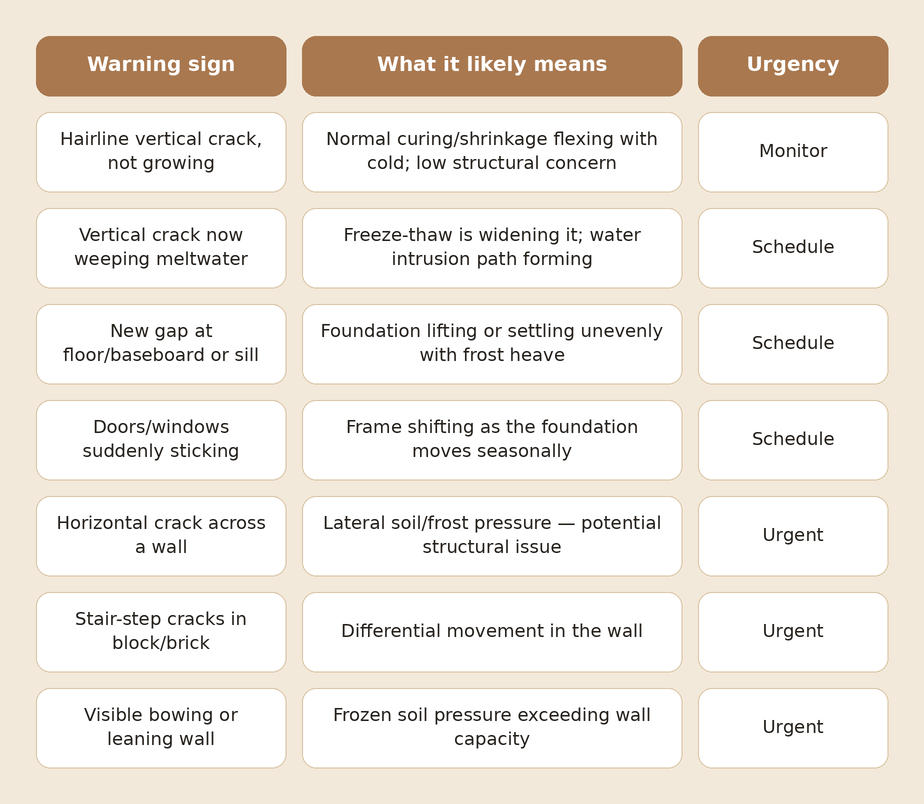
If you want to go deeper on reading a crack, our guide to the different types of foundation cracks breaks down vertical, horizontal, and stair-step patterns. Otherwise, use the checker below to translate what you're seeing into a rough urgency level — a starting point for triage, not a substitute for an on-site look.
What You Can Safely Check vs. What Needs a Pro
Homeowners can do more than they think — as long as it stays in the observation lane. Here's the honest line between the two.
Safe to check yourself
Mark the end of any crack with a pencil and write the date. If it grows past the mark over a few thaws, it's moving.
Measure crack width with a coin or a slip of paper; note whether it's hairline or wider than a nickel's thickness.
Confirm gutters and downspouts carry water several feet away from the wall, and clear ice dams that redirect meltwater to the foundation.
Check that your sump pump actually runs — a lot of winter leaks trace back to a pump that quietly died in the fall.
Call a pro when you see
A horizontal crack, or one wider than about a quarter inch — these point to pressure or structural movement, not just curing shrinkage.
Stair-step cracking through block or brick, or any wall that's visibly bowing inward.
Multiple doors or windows that all started sticking at once.
Water entering at the floor-wall joint every time snow melts.
For structural questions specifically — bowing walls, differential settlement — the right foundation repair might be carbon-fiber straps, wall anchors, or helical or push piers, and that's a call for someone who can actually load-read the wall on site.
Winter Warning Signs: What They Mean and How Urgent
Can You Repair a Foundation in Winter? (And Should You Wait?)
Yes and often you shouldn't wait. Interior foundation crack repair using epoxy or polyurethane injection happens indoors and isn't stopped by cold; epoxy is chosen for structural cracks where you want to weld the concrete back together, polyurethane for active leaks where you need a flexible, water-chasing seal. Carbon-fiber strapping and interior structural reinforcement are year-round too. Hydraulic cement can patch a leaking joint fast in a pinch.
What sometimes waits is major exterior work — digging down to waterproof a basement wall from outside is harder when the ground is frozen solid, so we'll often stabilize now and schedule exterior excavation for a thaw or spring. The point is that the diagnosis and the urgent stabilization don't have to wait, even if one phase of the job does.
On prevention: the cheapest winter repair is the one you avoid by keeping water away from the foundation before the freeze. Extend downspouts, fix grading that slopes toward the house, keep the sump pump alive, and address open mortar joints or hairline cracks in fall rather than letting freeze-thaw work on them all season.
Frequently Asked Questions
What are the signs of foundation damage in winter?
Watch for doors or windows that suddenly stick, new or widening cracks in walls, gaps opening between the floor and baseboard, and foundation cracks that weep water during a thaw. These often point to frost heave moving the foundation. Indoors is usually where you'll notice it first, since snow hides the exterior.
Can you repair a foundation in winter?
Yes. Interior crack injection, carbon-fiber reinforcement, and most structural stabilization continue year-round regardless of temperature. Some exterior waterproofing that requires excavation may be scheduled for a thaw because frozen ground is hard to dig. In Boston and across the South Shore, we handle winter foundation repair throughout the cold months.
How does cold weather affect home foundations?
Water in the soil freezes and expands, pushing up on footings — that's frost heave. Because it lifts unevenly, it stresses and cracks concrete. Repeated freeze-thaw cycling then works those cracks wider all season. This freeze thaw foundation damage is why winter is such an active period for foundation issues.
Should I fix foundation cracks before winter?
Ideally, yes. A crack that's merely cosmetic in fall can become a freeze-thaw wedge once meltwater gets in, freezes, and pries it open — turning an easy seal into a bigger repair by spring. Sealing cracks and correcting drainage before the first hard freeze is far cheaper than repairing the aftermath.
Is a hairline crack in winter something to worry about?
A stable hairline vertical crack that isn't growing is usually a monitor situation. Mark the end with a dated pencil line and watch it through a few thaws. If it widens, starts leaking, turns horizontal, or new cracks appear, move up to a professional inspection rather than waiting for spring.
Worried About a Crack This Winter? Get It Looked At.
If something's shifted since the cold set in, don't guess your way through the freeze. King's Masonry & Construction offers free foundation and basement inspections and honest estimates across Boston, the South Shore, and the South Coast from Brookline and Newton to Plymouth, New Bedford, and Dartmouth. We'll tell you plainly whether it's a monitor-it or a fix-it, and handle the repair either way.