
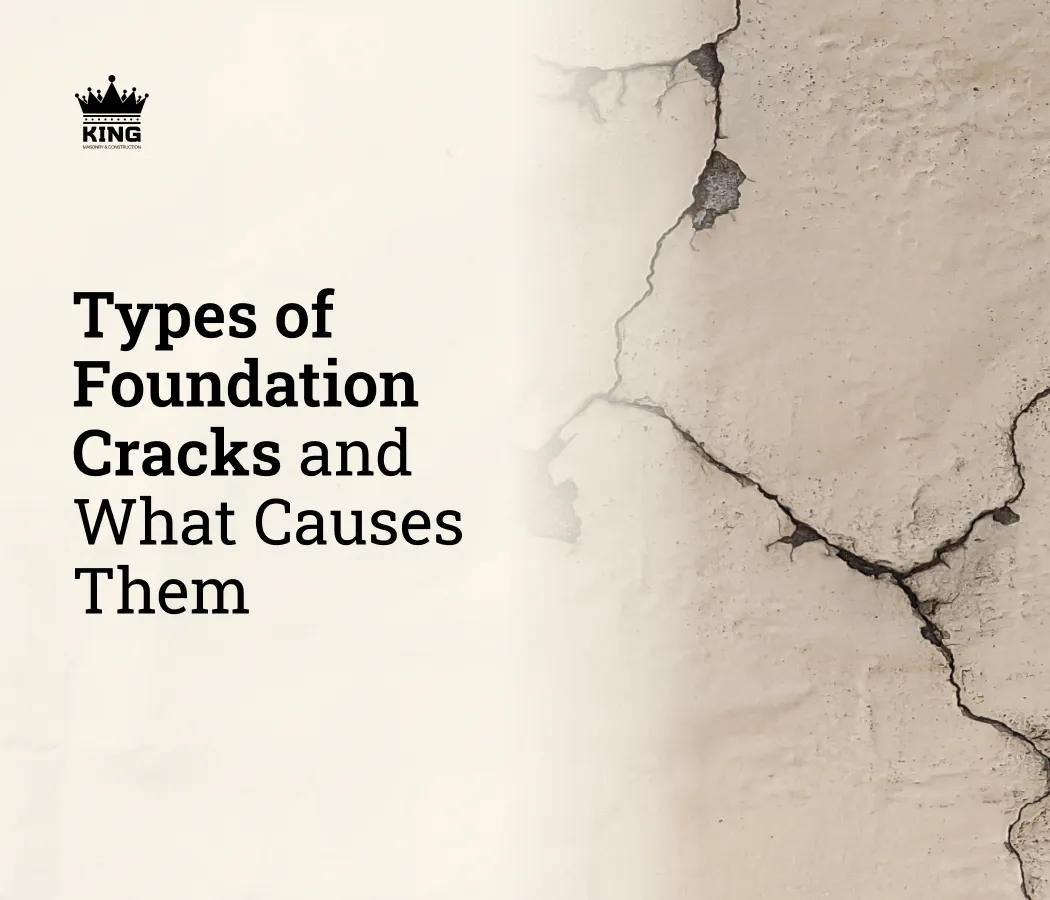
Types of Foundation Cracks & What Causes Them | MA Guide
Foundation cracks fall into five main types: hairline shrinkage, vertical, diagonal, stair-step, and horizontal. Hairline and vertical cracks are usually cosmetic results of normal concrete curing or minor settlement. Horizontal and stair-step cracks signal lateral pressure or active movement and need professional evaluation. In Massachusetts, freeze-thaw cycles, clay-rich soils, and high water tables drive most foundation cracking.
The five main types of foundation cracks
Foundation cracks are categorized by their shape, direction, and width. Each pattern points to a different underlying cause, which is why a crack inspection starts with reading the geometry before measuring anything else.
1. Hairline shrinkage cracks
These are thin, often map-like or random cracks less than 1/16 inch wide. They appear in the first year or two after concrete is poured as the slab or wall releases moisture and contracts. They are almost always cosmetic and do not affect structural integrity. The American Concrete Institute addresses shrinkage cracking in ACI 224R as a normal product of concrete curing.
2. Vertical cracks
Vertical cracks run straight up and down, typically narrower at the top than at the bottom. Most are caused by minor settlement during the first few years after construction, or by concrete shrinkage along a weak point. A vertical crack under 1/8 inch wide that is dry and stable is rarely structural and is usually addressed with polyurethane or epoxy injection for waterproofing.
3. Diagonal cracks
Diagonal cracks angle 30 to 75 degrees from horizontal, often starting at a corner of a window or door opening, or at the corner of the foundation wall. They usually indicate differential settlement, meaning one part of the foundation is sinking faster than another. The wider the crack and the more it tapers, the more active the settlement.
4. Stair-step cracks
Stair-step cracks appear in concrete block, brick, or stone foundations and follow the mortar joints in a stepped pattern. They almost always point to soil movement under the footing, either settlement or heave, or to lateral pressure pushing the wall. Stair-step cracks in older Massachusetts homes with rubble foundations are particularly common, and they often indicate both mortar deterioration and ongoing movement.
5. Horizontal cracks
A horizontal crack runs parallel to the floor along the foundation wall. It is the most serious crack type. Horizontal cracks are caused by lateral pressure from saturated soil, frost, or expansive clay pushing against the wall from outside. Left untreated, they progress to wall bowing and structural failure.
What causes foundation cracks
Foundation cracks have six primary causes, and most cracks are the result of two or three working together over time. Knowing the cause matters because the foundation repair has to address the cause, not just the crack itself.
Concrete shrinkage during curing
Fresh concrete shrinks as water evaporates from the mix. If the wall or slab is restrained at the edges (which it always is in a foundation), tension builds up and the concrete cracks at its weakest point. Shrinkage cracks are usually fine, vertical or random, and stabilize within the first 12 to 24 months.
Hydrostatic pressure
Water in the soil around a foundation exerts pressure against the wall. When grading slopes toward the house, when gutters and downspouts discharge near the foundation, or when the water table rises seasonally, hydrostatic pressure can exceed the wall's resistance. This is the most common cause of horizontal cracks and basement seepage in coastal South Shore communities like Cohasset and Marshfield, where high water tables sit closer to the surface than inland.
Freeze-thaw cycles
When water in the soil or in existing micro-cracks freezes, it expands by roughly 9 percent. In a Massachusetts winter, the freeze-thaw cycle repeats dozens of times. Each cycle widens existing cracks and creates new ones, particularly at the top of the foundation where frost penetration is greatest.
Soil movement
Soils expand when wet and contract when dry. Clay-rich soils, common in southeastern Massachusetts towns like Brockton, Taunton, and Mansfield, are especially active. The footing rides on this moving soil, and uneven movement causes diagonal or stair-step cracking. Sandy and gravelly soils, more typical along the coast, are more stable but can wash out under poor drainage.
Frost heave
Below the frost line, soil stays unfrozen. Above it, freezing water lifts the soil upward. If a footing is placed too shallow, frost heave lifts the foundation seasonally, cracking the wall above. The Massachusetts State Building Code (780 CMR) requires footings to be set below the frost line, which is generally 4 feet in eastern Massachusetts.
Tree roots and adjacent excavation
Large trees within 20 feet of a foundation draw moisture out of the soil during the growing season, causing localized shrinkage. Construction next door, utility trenching, or a poorly compacted backfill from the original build can also remove lateral support and trigger cracking years later.
When to worry about foundation cracks
Worry about a foundation crack when it is horizontal, wider than 1/4 inch, growing over time, leaking water, or accompanied by sticking doors, sloping floors, or visible wall bowing. Vertical hairline cracks under 1/16 inch in concrete foundations are normal and rarely require action.
The clearest warning signs that a crack is structural, not cosmetic:
Direction: Horizontal cracks and long diagonal cracks are higher risk than vertical ones.
Width: Anything wider than 1/4 inch warrants evaluation. Structural engineers typically flag anything over 1/8 inch in residential foundations.
Movement: A crack that has widened, lengthened, or shifted in alignment in the past 6 to 12 months is active. Mark the ends with a pencil and date, then re-check in 30 days.
Water: Active seepage, efflorescence (the white mineral deposit left by water carrying salts through concrete), or rust staining inside the crack indicates the crack penetrates the full wall thickness and is admitting water.
Pattern: Multiple cracks in the same wall, especially radiating from a corner, suggest the foundation is moving rather than shrinking.
Companion symptoms: Doors that no longer close square, gaps between trim and floors, drywall cracks above doors and windows, or visible tilt in the basement wall.
If two or more of these apply, the crack is no longer something to monitor. It needs an in-person assessment by a foundation contractor or structural engineer.
Horizontal vs vertical foundation cracks
A vertical foundation crack runs straight up and down and is most often caused by normal settlement or concrete shrinkage, making it the least serious crack type when narrow and dry. A horizontal foundation crack runs sideways along the wall and is caused by lateral pressure pushing inward, making it the most serious crack type regardless of width.
The geometric difference points to mechanically different problems.
A vertical crack is the foundation responding to vertical forces, either its own curing stress or the weight of the structure settling onto the soil below. The crack relieves the tension and usually stabilizes once the soil compacts. Repairs are typically limited to injection sealing for waterproofing.
A horizontal crack is the foundation responding to horizontal forces from outside, almost always soil and water pressure pushing the wall toward the basement. The wall is acting as a retaining structure that is being overloaded. Repair requires addressing the external pressure first (drainage, regrading, sometimes excavation) and then reinforcing the wall with carbon fiber straps, steel I-beams, or in severe cases, wall replacement. This is also where basement waterproofing and exterior drainage work intersect with structural repair.
Mid-wall horizontal cracks at about the height of grade outside are the most common pattern and the most dangerous. They typically begin as a hairline and progress with each wet season. Because horizontal cracks behave so differently from vertical ones, we cover the distinction in depth in our guide on horizontal vs vertical foundation cracks.
Why Massachusetts foundations crack differently
Massachusetts foundations face a combination of conditions that few other regions share. A foundation that performs fine in Virginia or North Carolina can crack quickly under the same construction practices in Hingham or Plymouth, and understanding why is the difference between a repair that lasts and one that fails in three winters.
Freeze-thaw is constant. The eastern Massachusetts winter typically delivers dozens of freeze-thaw cycles between December and March. Every cycle drives water deeper into existing cracks and widens them. Foundations in milder climates do not see this kind of repeated mechanical wedging.
Frost line is deep. Eastern Massachusetts uses a 4-foot frost depth for footing design under 780 CMR, the state's adopted version of the International Residential Code. Older homes, especially those built before the mid-20th century, often have footings well above this depth, which is why pre-1900 foundations in towns like Hingham, Plymouth, and New Bedford frequently show frost-related cracking that newer construction does not.
Soils vary block by block. The South Shore sits on a mix of glacial till, marine clay, sandy outwash, and exposed granite ledge, often within the same neighborhood. A house on ledge in one part of Cohasset behaves very differently from a house on clay-rich till in the same town. This is why crack patterns are not predictable from regional rules of thumb. Each foundation needs to be read against its specific soil.
Coastal influence matters. Salt air accelerates corrosion of any exposed rebar in cracked concrete, which is why crack repair on properties in Marshfield, Cohasset, and Wareham needs to be more thorough than the same crack inland. Once chloride reaches the reinforcing steel, the rust expansion alone can keep the crack opening.
Older housing stock is rubble or fieldstone. A significant share of homes on the South Shore and in Boston's older neighborhoods sit on rubble or fieldstone foundations laid with lime mortar, not modern poured concrete or block. These foundations crack and fail differently. Stair-step movement, mortar loss, and bulging are far more common than clean linear cracks, and the repair approach is different.
How to choose a foundation contractor
Foundation repair is one of the few home repairs where a wrong diagnosis is worse than no repair. A contractor who patches a horizontal crack without addressing drainage and lateral pressure has hidden the symptom while the underlying failure continues. When evaluating a contractor, focus on diagnostic process and licensing, not price.
Check Massachusetts licensing. Any contractor doing structural work on a one-or-two-family home in Massachusetts must hold an active Home Improvement Contractor (HIC) registration and, for structural elements, a Construction Supervisor License (CSL). Both are searchable on Mass.gov's licensing portal. Ask for the license numbers and verify them yourself before signing anything.
Require a written diagnosis. A real estimate explains what is causing the crack, not just what will be done about it. If the proposal jumps straight to "epoxy injection" or "carbon fiber straps" without explaining why, the contractor is selling a method rather than fixing a problem.
Verify insurance. General liability of at least $1 million and active workers' compensation coverage are minimums. Ask for a certificate of insurance sent directly from the insurer, not a PDF the contractor emails you.
Get the scope in writing. The estimate should list materials by brand and specification, the surface preparation steps, the warranty terms (transferable or not, length, what voids it), and the cleanup and disposal scope. Vague scopes lead to vague repairs.
Red flags: Door-to-door solicitation after a storm, requests for large up-front deposits beyond Massachusetts' Chapter 142A deposit limits, refusal to provide license numbers, or pressure to sign the day of inspection.
For homeowners on the South Shore weighing whether a crack is cosmetic or structural, an in-person assessment from a local masonry and foundation contractor is the cleanest starting point. A 30-minute visit with a moisture meter, crack gauge, and a flashlight is usually enough to separate "monitor it" from "address it now."
Frequently asked questions
Are all foundation cracks bad?
No. Most foundation cracks are not structural. Hairline vertical cracks in poured concrete walls are a normal result of curing shrinkage and rarely indicate a problem. The cracks that matter are horizontal cracks, cracks wider than 1/4 inch, cracks that are actively growing, and cracks that leak water. A crack inspection focuses on geometry and behavior, not just appearance.
How wide does a foundation crack have to be before I should worry?
Anything wider than 1/4 inch should be evaluated by a professional. Most residential foundation engineers flag cracks over 1/4 inch as potentially structural, and cracks above 1/8 inch are likely to admit moisture even if not structural. Width is only one factor though. A 1/16 inch horizontal crack across an entire wall is more concerning than a wider isolated vertical crack.
Can foundation cracks fix themselves?
No. Concrete does not heal. A crack that appears to "close" has usually only seasonally narrowed because the surrounding soil or wall has shifted with moisture or temperature, and it will reopen. Even hairline cracks that are not structural should be sealed eventually to prevent water entry, freeze-thaw widening, and rebar corrosion.
Why are foundation cracks worse in Massachusetts winters?
Massachusetts winters cycle through freezing and thawing many times per season. Each cycle drives water into existing cracks, which expands by about 9 percent when it freezes, mechanically widening the crack. Repeated for 90 days every year, this freeze-thaw wedging is the single largest reason cracks that appear stable in summer grow noticeably each spring.
What is the difference between a settlement crack and a structural crack?
A settlement crack appears as the building's weight compacts the soil under the footing during the first few years after construction. These cracks are typically vertical or diagonal, narrow, and stabilize on their own. A structural crack indicates ongoing movement, lateral pressure, or load failure. Horizontal cracks, wide diagonal cracks, and any crack that grows over time fall into the structural category and require engineering review.
Should I call a foundation contractor or a structural engineer first?
For most cracks, a qualified foundation contractor can assess whether the crack is structural and recommend next steps, including bringing in a structural engineer if needed. Call a structural engineer first if the wall is visibly bowing, if there are multiple wide cracks with companion symptoms (sloping floors, sticking doors), or if a recent inspection report flagged the foundation. In Massachusetts, the engineer's stamped report is what permitting authorities accept for major repairs.
Foundation crack assessment on the South Shore
Kings Masonry and Construction inspects, diagnoses, and repairs foundation cracks across Hingham and the South Shore, including concrete, block, and historic rubble foundations. Call 857-249-5127 for an in-person assessment.