
Winter Basement Waterproofing: Stopping Snow-Melt Leaks Before They Start
Most people think of a wet basement as a spring or heavy-rain problem. Then the January thaw hits, a foot of snow melts over frozen ground in two days, and the water has nowhere to go but toward the house. That's the winter version, and it catches homeowners off guard every year. Winter basement waterproofing is really about getting ahead of that thaw knowing where water will try to enter and closing those paths before the melt arrives.
The reason this catches so many people off guard is that "waterproofing" tends to conjure images of a rainy spring afternoon, not a snowbank in January. But the physics of a winter leak are arguably more predictable than a summer one, once you understand them — which is actually good news. A rainstorm's intensity and duration are hard to plan around. A thaw, on the other hand, follows a fairly consistent pattern every single year: snow accumulates, temperatures rise for a few days, and a large volume of water is released all at once over ground that's too frozen to absorb it. That predictability means the prevention side of this problem is genuinely within a homeowner's control, if you know what to look for and act before the thaw rather than during it.
Key Takeaways
Snow melt over frozen ground is the winter culprit. Frozen soil can't absorb meltwater, so it runs along the surface straight to your foundation.
Where the water shows up tells you the fix. Floor-wall joint, wall cracks, windows, and the floor itself each point to a different cause and solution.
Interior systems work all winter. Interior drainage and sump systems are installed inside and don't wait for a thaw; exterior excavation often does.
Prevention beats reaction. Clearing snow away from the foundation and keeping meltwater moving is free and stops most winter intrusion.
A dead sump pump is a common surprise. Many winter floods trace back to a pump that failed quietly in the fall.
Quick Answer
Basements leak in winter mainly from snow melt: frozen ground can't absorb the water, so it pools against the foundation and finds cracks, the floor-wall joint, or window wells. To waterproof a basement for winter, keep snow and meltwater away from the walls, seal cracks, confirm the sump pump works, and address the entry point — interior drainage for joint leaks, exterior work for outside-face issues (often scheduled for a thaw).
Why Basements Leak in Winter
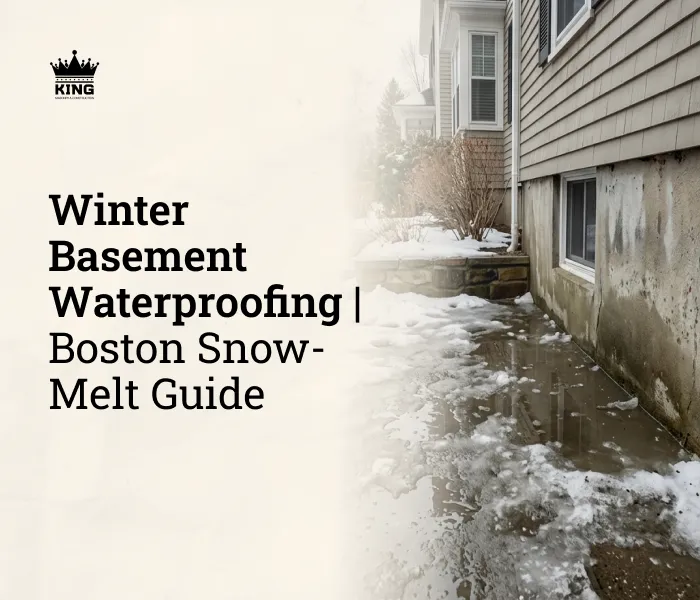
Summer leaks and winter leaks don't share the same mechanics. In warm months, rain soaks into the ground and raises the water table, and hydrostatic pressure pushes moisture through the foundation. In winter, the ground itself is frozen — often to the frost line, three to four feet down around Boston — so it behaves like pavement. When snow melts during a thaw or a warm rain falls on that frozen surface, the water can't percolate down. It sheets across the top of the frozen soil and collects wherever the grade sends it. If your grade sends it toward the house, you have a basement leaking from melting snow problem waiting to happen.
Once meltwater ponds against the foundation, it exploits whatever opening it can find: a shrinkage crack, the cove joint where the floor slab meets the wall, a leaky window well, or a tie-rod hole in a poured wall. Freeze-thaw makes this worse by widening those cracks as the season goes on. And frozen basement drainage can compound everything — if your exterior drains or downspout lines are iced up, water that should be carried away instead backs up right where you don't want it.
There's also the quieter cousin of flooding: winter basement moisture. Warm indoor air meeting cold foundation walls causes condensation, which can look like a leak but is really a humidity-and-temperature issue. Telling the two apart matters, because the fix is completely different.
Why the Volume Problem Is Worse Than People Expect
It's easy to underestimate just how much water a thaw can produce. A foot of settled snow across a typical roof and yard represents a substantial volume of water once it melts — and unlike rain, which falls gradually, a two- or three-day thaw can release most of that volume in a short, concentrated window. Layer onto that the fact that the ground underneath is frozen solid and effectively waterproof itself, and you get a scenario where a large amount of water is trying to move somewhere in a short amount of time, with nowhere to go but sideways across the surface. If your roof's downspouts dump water at the base of the foundation, or your yard slopes even gently toward the house instead of away from it, that thaw volume becomes concentrated exactly where you don't want it.
This is also why so many "surprise" basement floods happen during a January or February warm spell rather than during a heavy fall rain — even though the fall rain might have delivered more total water. It's not really about how much water falls; it's about how much of it the ground can absorb versus how much runs straight at your foundation.
Where Is Your Water Getting In? Locate It Below
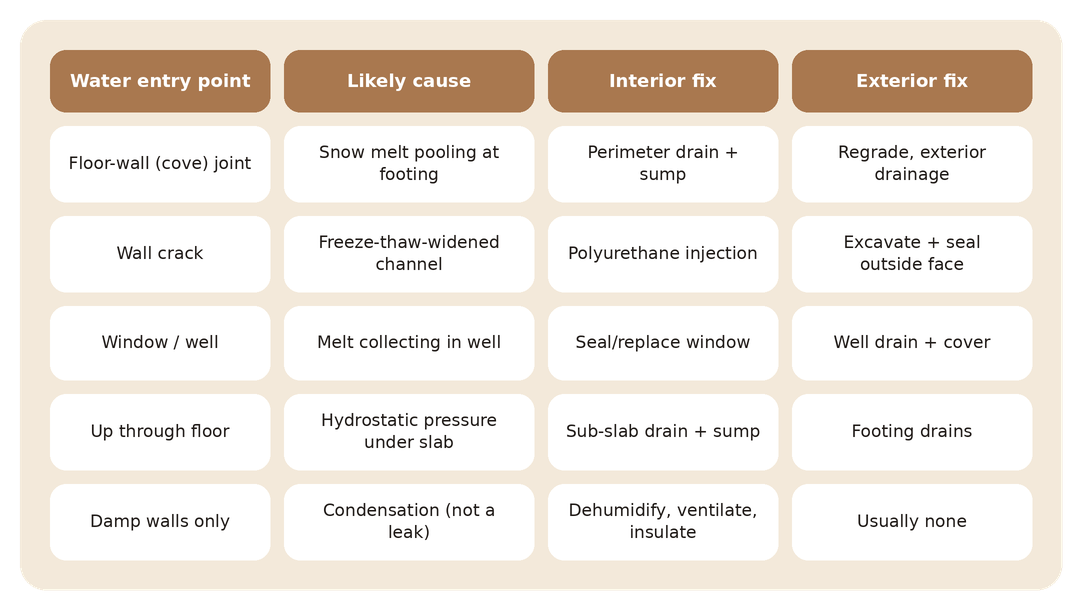
The single most useful thing you can do is pinpoint where water or dampness appears. Different entry points mean different causes and different fixes. Use the locator to match your situation to the likely cause and whether it's an interior or exterior job.
Water Entry Points, Causes, and Fixes
The same logic in table form, so you can scan it fast.
A Closer Look at Interior vs. Exterior Systems
Interior perimeter drains run along the inside edge of the basement floor, just beneath the slab, collecting water before it can rise into the living space and channeling it to a sump pit. Because the whole system lives inside the basement, installation doesn't depend on the ground outside being thawed or diggable, which is exactly why this is the workhorse winter fix for a floor-wall joint or floor-pressure leak.
Sump pumps are the other half of that system — the pit collects water, and the pump ejects it outside, away from the house, whenever the water level rises. A sump system is only as good as the pump inside it, and pumps do fail: a stuck float switch, a worn motor, or a check valve that's lost its seal can all mean the system looks fine right up until the moment it's actually needed. This is why testing the pump before winter, not during a flood, matters so much.
Polyurethane crack injection, covered in more detail in our guide on foundation crack repair, is the interior fix for an active leak coming through a specific crack rather than the floor-wall joint generally. It's fast, doesn't require excavation, and — like the drain system — works regardless of outside temperature.
Exterior drainage and regrading address the water before it ever reaches the foundation: correcting the slope of the yard so it slopes away from the house, adding or repairing footing drains, and directing downspout discharge well clear of the walls. Some of this — especially regrading with topsoil, or footing-drain work that requires digging — is easier and sometimes only practical once the ground has thawed, which is why we often frame it as the "spring half" of a two-phase winter waterproofing plan: interior system now, exterior correction when the ground cooperates. If you want the full comparison, our guide on interior vs. exterior basement waterproofing breaks down when each makes sense.
How to Waterproof a Basement for Winter
Think of it in two layers: keep water away from the house, and manage the water that still gets close. For preventing basement water in winter, the away-from-the-house layer is mostly free — shovel snow away from the foundation instead of piling it against the wall, keep downspout extensions carrying roof melt several feet out, and clear ice from window wells and exterior drains so frozen basement drainage doesn't send water backward. The manage-it layer is the system side: a properly sized interior perimeter drain and a tested sump pump so that when the thaw comes, water is captured and ejected instead of rising through the slab.
If you're planning ahead and want to waterproof basement before winter, fall is the ideal window — you can still do exterior work before the ground freezes, seal cracks while they're dry, and confirm the pump before you actually need it.
A Simple Pre-Winter Checklist
If you're doing this yourself before the first hard freeze, a short walk-around covers most of the free, high-value prevention steps:
Clear gutters so meltwater from the roof actually reaches the downspouts instead of overflowing along the eaves and dropping right next to the foundation.
Extend downspouts at least four to six feet away from the house, further if the yard is flat.
Check the grade around the foundation — soil and mulch should slope away from the house, not toward it, for at least the first several feet.
Clear window wells of leaves and debris so they can drain, and consider a well cover to keep snow from accumulating directly in the well.
Test the sump pump by pouring a few gallons of water into the pit and confirming the float triggers the pump and it ejects the water outside.
Have a battery backup for the sump pump if you don't already, since power outages during winter storms are exactly when you're most likely to need the pump running.
Walk the basement perimeter looking for any new cracks, damp spots, or efflorescence since last season, and note anything that needs sealing before the ground freezes.
None of these take more than an afternoon, and together they prevent a large share of the winter leaks we get called about.
What You Can Do vs. What Needs a Pro
Homeowners can handle the whole prevention layer: snow management, downspouts, grading tweaks, clearing wells, and testing the sump pump by pouring a bucket of water into the pit to confirm it kicks on. Where you'll want us is the system and diagnosis side — installing interior drainage, injecting a leaking crack correctly, sizing and adding a sump system, or doing exterior waterproofing. And if you can't tell whether you've got a true leak or condensation, that's worth a professional eye before you spend money on the wrong fix.
Frequently Asked Questions
Why is my basement leaking from melting snow?
Frozen ground can't absorb meltwater, so when snow melts it runs across the surface and pools against your foundation. From there it enters through cracks, the floor-wall joint, or window wells. Because the soil is frozen, even a modest thaw can send a lot of water at the house quickly, which is why snow-melt leaks appear suddenly.
Can you waterproof a basement in winter?
Interior waterproofing — perimeter drains, sump systems, crack injection — is done inside and works all winter regardless of temperature. Exterior waterproofing that requires excavation is harder in frozen ground and is often scheduled for a thaw or spring. Across Boston and the South Shore, we do interior winter basement waterproofing throughout the cold season.
How do I keep water out of my basement in winter?
Keep snow and meltwater away from the walls: shovel snow away from the foundation, extend downspouts, clear ice from window wells and drains, and confirm your sump pump works. Sealing known cracks before the freeze helps too. These steps handle most snow-melt intrusion; persistent water usually needs an interior drainage system.
Is it a leak or just condensation on my basement walls?
Tape a square of foil tightly to the wall for a day. Moisture on the room-facing side means condensation — warm humid air hitting cold masonry — solved with ventilation, a dehumidifier, and insulation. Moisture behind the foil means water is coming through the wall, which is intrusion and needs waterproofing.
Should I waterproof my basement before winter or wait?
Before winter is better. Fall lets you complete exterior work before the ground freezes, seal cracks while dry, and test the sump pump ahead of the first thaw. Waiting means any exterior fix may have to wait for spring, and you risk a snow-melt event finding the entry points first.
How can I tell if my sump pump will actually work when I need it?
Pour several gallons of water directly into the sump pit and watch the process from start to finish: the float switch should rise and trigger the pump, the pump should engage audibly, and water should visibly discharge outside through the exit line. Do this test in the fall, not during a storm, and repeat it once or twice through the winter. If the pump doesn't trigger, doesn't discharge, or sounds labored, have it serviced before the next thaw rather than after a flood reveals the problem.
Does a French drain or interior drainage system need much maintenance?
Generally not much, but it's worth an annual check. Confirm the sump pump is functioning (see above), make sure the discharge line outside isn't blocked or frozen shut at the point it exits the house, and keep an eye out for any new dampness at the floor-wall joint that might suggest the drain has become clogged with sediment over time.