
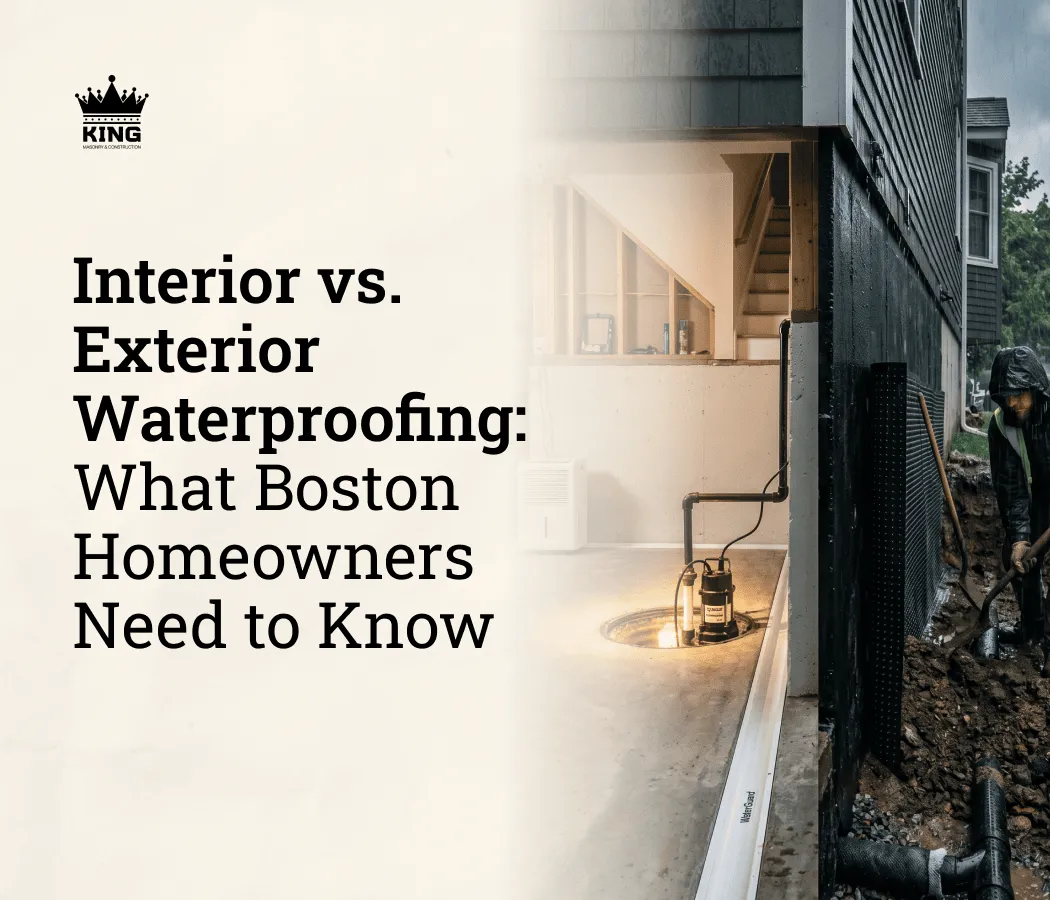
Interior vs. Exterior Waterproofing in Boston, MA: Which Is Better?
A wet basement is one of the most common — and most frustrating — problems Boston homeowners face. But when it comes to fixing it, you'll quickly run into a fundamental question: should you go with interior basement waterproofing or exterior basement waterproofing?
Both approaches work. Both are legitimate wet basement solutions. But they work in completely different ways, suit different types of water problems, and come with very different price tags. Choosing the wrong one doesn't just waste money — it can leave your basement just as wet as before.
This guide breaks down exactly how each method works, what it costs in the Boston market, and how to decide which one is right for your home.
Important: There is no single "best" waterproofing method — only the best method for your specific situation. A proper diagnosis of where and how water is entering your basement is the essential first step before any work begins.
Key Takeaways
Interior waterproofing manages water after it enters; exterior waterproofing stops it before it gets in — both are valid, but for different situations.
Interior systems are less disruptive and more affordable, making them the most common solution for Boston homeowners.
Exterior waterproofing offers the most complete protection but requires full excavation and significantly higher cost.
Boston's clay soil and older housing stock mean many homes need a combined approach rather than a single method.
The right choice depends on the source of water entry, your foundation type, your budget, and your long-term plans for the space.
The Core Difference Between the Two Methods
At the most basic level, the two approaches differ in where they intervene in the water's journey into your basement.
Interior basement waterproofing intercepts water that has already entered — or is about to enter — the basement structure. It doesn't stop water from reaching the foundation wall; instead, it collects and redirects that water before it can pool or cause damage.
Exterior basement waterproofing addresses the problem at the source, creating a physical barrier between the surrounding soil and your foundation wall so water never reaches the interior in the first place.
A useful analogy: interior waterproofing is like placing a drain under a leaky roof. Exterior waterproofing is like replacing the roof entirely. One manages the problem; the other eliminates it at the source. Which approach is more appropriate depends entirely on the severity, source, and pattern of your water intrusion — and what your foundation can realistically support.
"After inspecting hundreds of Boston basements, the most important thing I can tell a homeowner is this: the right method depends on where and how the water is getting in — not on what sounds most thorough. A correct interior system beats an unnecessary exterior job every time."
— Jonathan Odriscoll, Waterproofing Specialist, Kings Masonry
Interior Basement Waterproofing Explained
Interior basement waterproofing is the most widely installed solution in the Boston area. It involves creating a drainage pathway inside the basement — typically around the perimeter — that captures water as it seeps through walls or up through the floor and channels it to a sump pump for removal.
How it works
A contractor breaks up the concrete floor along the perimeter, installs a perforated drainage channel or pipe in the exposed soil, then covers it with gravel and repours the concrete. Water that enters the wall is intercepted at the footing level before it reaches the floor, routed along the channel, and pumped out of the basement via a sump pump and discharge line.
Modern interior systems also include wall membranes or drainage boards that direct wall seepage downward into the channel rather than allowing it to run across the floor. A battery backup sump pump is standard in Boston given the frequency of nor'easters and power outages.
Best used for
Chronic water seepage through walls or floor joints
Homes where exterior excavation is impractical (attached homes, tight lot lines, landscaping)
Older Boston homes with stone, brick, or block foundations
Homeowners looking for a cost-effective, long-term basement leak repair solution
Cases where the water source is hydrostatic pressure rather than a single crack
At Kings Masonry, we install interior drainage systems across Greater Boston and include battery backup sump pump options on every quote — because a nor'easter doesn't wait for the power to come back on.
Pros
Significantly lower cost than exterior systems
Completed in – days with minimal exterior disruption
Effective for most chronic seepage problems in Boston
Does not require excavation or landscaping repair
Long warranties available (– years) from reputable contractors
Can be installed year-round, including winter
Cons
Does not stop water from reaching the foundation wall
Requires an operational sump pump — power outages are a risk without backup
Does not address exterior soil drainage or grading issues
May not be sufficient for severe structural water damage
Requires access to the basement perimeter during installation
Exterior Basement Waterproofing Explained
Exterior basement waterproofing is the most comprehensive approach to basement water problems. It involves excavating the soil around the entire perimeter of the foundation — typically down to the footing — so the foundation wall can be cleaned, repaired, and coated with a waterproof membrane before the trench is backfilled with drainage gravel and a new drain tile system.
How it works
Excavation equipment digs a trench around the exterior of the foundation, exposing the full height of the wall. Any existing cracks are repaired with hydraulic cement or epoxy injection. A liquid-applied or sheet waterproofing membrane is then applied to the clean, dry wall surface. A new exterior drain tile system is installed at the footing, wrapped in filter fabric, and covered with clean gravel to direct groundwater away from the foundation before it builds hydrostatic pressure.
Proper grading and downspout extensions are addressed at the same time to ensure surface water drains away from the home. This is the method used for new construction foundations in Massachusetts and is the gold standard for a permanent solution.
"Exterior waterproofing is the right call when the wall itself has failed — when you're seeing active deterioration, not just seepage. But I'd say maybe % of the jobs we inspect actually need it. Most Boston homeowners are well-served by a properly designed interior system."
— Jonathan Odriscoll, Waterproofing Specialist, Kings Masonry
Best used for
New construction or homes undergoing major renovations with excavation already planned
Severe water damage where the foundation wall itself has deteriorated
Homes with failed or absent original waterproofing that needs complete replacement
Cases where interior drainage alone has proven insufficient
Homes where the basement will be finished and a true dry space is required
Kings Masonry provides exterior waterproofing assessments across Greater Boston. We serve homeowners in Cambridge, Newton, Brookline, and beyond — and we'll tell you honestly whether exterior work is actually necessary before recommending it.
Pros
Stops water at the source — the most thorough solution available
Addresses foundation wall cracks and deterioration directly
Corrects grading and exterior drainage simultaneously
Does not require a sump pump to be effective
Best long-term protection for a finished basement
Cons
Significantly higher cost — often –x more than interior systems
Requires full excavation, disrupting landscaping and hardscaping
Difficult or impossible on attached homes or tight urban lots
Takes several days to complete; weather-dependent
Not practical for mid-winter installation in Boston
Interior vs. Exterior Waterproofing: Side-by-Side Comparison
Factor | Interior Waterproofing | Exterior Waterproofing |
|---|---|---|
How it works | Collects and redirects water that enters | Blocks water before it reaches the wall |
Average cost (Boston) | $ – $ | $ – $+ |
Installation time | – days | – days |
Excavation required | No | Yes — full perimeter |
Disruption to property | Low — interior work only | High — landscaping, driveways affected |
Works on attached homes | Yes | Often not possible |
Addresses wall cracks | Indirectly | Directly |
Requires sump pump | Yes | No |
Year-round installation | Yes | Spring–Fall preferred |
Best for | Chronic seepage, most Boston homes | Severe damage, new construction, renovations |
Warranty (typical) | – years | – years |
Which One Does Your Boston Home Need?
The right method depends on four key factors: the source and severity of your water problem, the type of foundation you have, the physical constraints of your property, and your budget. Use this decision framework as a starting point — then get a professional inspection to confirm.
Quick Decision Guide
You have chronic seepage through walls or floor joints — INTERIOR French drain + sump pump system
You're in a Boston triple-decker or row house — INTERIOR Exterior excavation usually not feasible on attached properties
You have a single isolated crack leaking water — INTERIOR Crack injection may be sufficient — get assessed first
You're doing a major renovation or addition — EXTERIOR Excavation is already happening — ideal time to waterproof the wall
Your foundation wall is visibly deteriorating — EXTERIOR Wall needs direct repair before any waterproofing membrane can work
Interior drainage has already failed or been tried — EXTERIOR Time to address the source rather than manage the symptom
Water comes in from multiple sources — COMBINED Interior drainage + exterior membrane for comprehensive coverage
Don't skip the inspection. Many Boston homeowners have paid for the wrong system because they — or their contractor — skipped a proper diagnostic. Water stains on a wall don't tell you where the water is actually entering. A thorough inspection includes checking the exterior grade, gutter discharge, window wells, and foundation type before any recommendation is made.
Cost Breakdown: Interior vs. Exterior Waterproofing in Boston
Boston-area pricing reflects the city's dense urban environment, older housing stock, and the specialized labor required to work around existing structures. Expect to pay a premium compared to suburban or rural markets.
Service | Method | Estimated Cost (Boston) |
|---|---|---|
Interior French drain system | Interior | $ – $ |
Sump pump installation | Interior | $ – $ |
Battery backup sump pump | Interior | $ – $ (add-on) |
Interior crack injection | Interior | $ – $ |
Exterior excavation + membrane | Exterior | $ – $+ |
Exterior drain tile system | Exterior | Included in excavation cost |
Combined interior + exterior | Both | $ – $+ |
Costs vary significantly based on basement size, foundation type, severity of water intrusion, and site access. Always obtain at least two written quotes. Verify that both labor and materials are covered under the warranty.
What drives the cost difference?
The primary cost driver for exterior waterproofing is excavation — renting and operating heavy equipment, disposing of excavated soil, and repairing or replacing whatever was above the trench (landscaping, walkways, decks, or driveways). In dense Boston neighborhoods where access is limited and lots are small, that excavation cost climbs further. Interior systems avoid all of that, which is why they represent a fraction of the price for comparable protection against chronic seepage.
Why Boston Is Different: Local Factors That Affect Your Choice
Boston presents a unique set of conditions that influence which waterproofing method makes sense — and in many cases, limit the options available.
Attached and semi-attached housing
A large percentage of Boston's residential stock consists of triple-deckers, row houses, and semi-detached homes where full perimeter excavation is physically impossible. On shared or party walls, exterior waterproofing simply cannot be performed. Interior basement waterproofing is the only viable option for these properties, which represent a significant share of housing in neighborhoods like Dorchester, South Boston, Jamaica Plain, and Roxbury.
Clay-heavy soil and hydrostatic pressure
Boston sits on some of the most moisture-retentive soil in New England. The dense clay common throughout the region doesn't drain well — it holds water against foundation walls for days or weeks after a rain event, generating sustained hydrostatic pressure. This is the primary cause of basement seepage in Boston and is well-managed by a properly designed interior drainage system. Exterior membranes also help, but even the best membrane will be subjected to constant pressure in clay-heavy conditions.
Pre- foundations
Many Boston homes were built with stone rubble, brick, or early poured concrete foundations that were never designed to be waterproofed. These materials are porous by nature and allow moisture migration through the wall rather than through specific cracks. Exterior basement waterproofing is highly effective here when full access is available, but interior drainage paired with a wall membrane is a practical and proven alternative when excavation isn't feasible.
Freeze-thaw cycles
Boston averages around freeze-thaw cycles per year. Each cycle causes soil to expand and contract, which stresses foundation walls and opens new pathways for water entry. Both interior and exterior systems address the consequences of freeze-thaw damage, but exterior membranes applied to clean, repaired walls offer better long-term protection against the physical movement that Boston winters cause.
For homeowners working with a local Boston waterproofing specialist, understanding these local conditions is what separates a well-specified solution from a generic one. An experienced contractor familiar with Boston's soil and housing stock will recommend the right approach — not simply the most expensive one.
Frequently Asked Questions
Is interior waterproofing just a temporary fix?
No. A properly installed interior drainage system with a quality sump pump is a permanent solution for managing basement water intrusion. Most reputable contractors offer warranties of – years. It manages water rather than stopping it at the wall — but for the vast majority of Boston homes, that distinction doesn't matter in practice.
Can I do exterior waterproofing on a Boston triple-decker?
In most cases, no. Attached walls on triple-deckers and row houses cannot be excavated. Interior waterproofing is the standard solution for these properties. For the walls that face the exterior (front and back), exterior waterproofing is technically possible but rarely practical given access constraints and cost.
Do I need both interior and exterior waterproofing?
Some homes benefit from a combined approach — particularly older homes with deteriorating foundations that are undergoing major renovation. But for most Boston homeowners dealing with typical seepage, a well-installed interior system is sufficient. A professional inspection will tell you whether a combined approach is warranted.
What is the best basement leak repair method for a single crack?
For an isolated crack, epoxy or polyurethane crack injection is usually the most appropriate and cost-effective basement leak repair. It fills the crack from the inside and stops water entry at that specific point. If the crack is one of many, or if seepage occurs through the wall face rather than a single crack, a broader drainage solution is needed.
Will exterior waterproofing damage my landscaping?
Yes — excavation requires removing whatever is above the trench, including grass, plantings, patios, and walkways. Reputable contractors will restore the grade and compact the backfill properly, but landscaping replacement is typically the homeowner's responsibility. Factor that cost into your budget when comparing interior and exterior quotes.
Which method adds more value to a Boston home?
Both methods improve home value by resolving a known defect. Buyers and inspectors look for a dry basement, not a specific waterproofing method. A documented, warranted interior system is just as compelling to a buyer as an exterior membrane — and in many cases more practical to verify. The key is having documentation of the work and the warranty transferable to the new owner.
Not Sure Which Method Your Boston Basement Needs?
Get a free inspection from a trusted local specialist and walk away with a clear recommendation — no pressure, no guesswork.