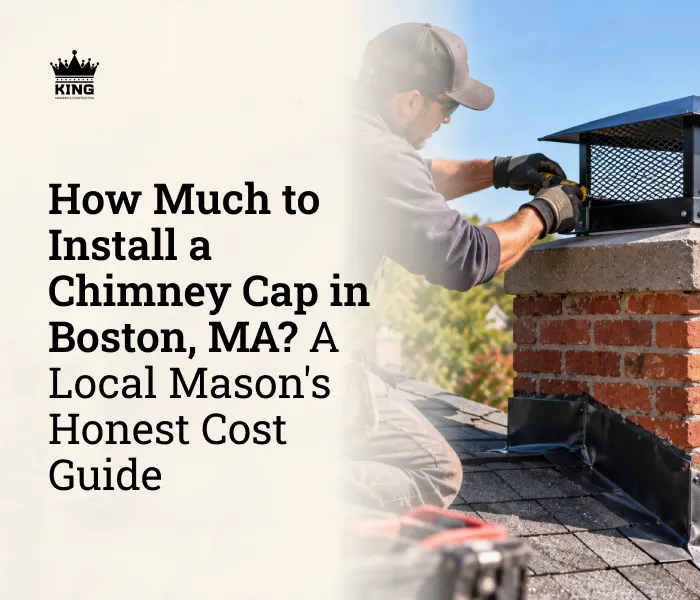
How Much to Install a Chimney Cap in Boston, MA?
Quick answer: In Boston and the South Shore, most chimney cap installations run from the low hundreds to around a thousand dollars, installed.
Low end: A basic single-flue cap in galvanized steel or aluminum.
Upper hundreds or more: A stainless steel multi-flue cap or a custom-built cap.
The price depends mostly on the material, how many flues your chimney has, their size, and how hard your roof is to reach safely. Every chimney is different, so treat these as ranges and get an on-site quote for a real number.
You're probably reading this for 1 of 3 reasons. You spotted a rusted, sagging cap on your roof. You found one lying in the yard after last weekend's storm. Or a chimney sweep told you yours is missing. Either way, the first question is the same: what's this going to cost me?
I install and replace chimney caps every week in Boston, Brookline, Quincy, Weymouth, Hingham, and across the South Shore. You'll get the honest version from me: real ranges, not a made-up number, and what pushes a cap from cheap to not-so-cheap. The goal is to help you spot a fair price and avoid the 2 ways people overpay:
Buying the wrong cap
Paying to fix damage that a good cap should have prevented
Custom HTML/CSS/JavaScript
How much does it cost to install a chimney cap?
Short answer: A simple single-flue cap on an easy-to-reach roof typically runs in the low-to-mid hundreds, materials and labor included. A quality stainless multi-flue cap, or a tall, steep, hard-to-reach chimney, pushes the price into the upper hundreds or around a thousand.
A chimney cap isn't one product. It's a whole category. A cap on a small ranch-house flue and the custom stainless hood I built for a wide old brick chimney in Brookline last month are completely different jobs. So when you see a single "average price" online, treat it as a starting point, not a promise.
Cost driver | Why it matters | Effect on price |
|---|---|---|
Material | The biggest single lever | Galvanized < aluminum < stainless < copper |
Single- vs. multi-flue | More flues need a larger cap or full hood | Scales up |
Size & fit | Odd, oversized, or old flues need a custom cap | Custom costs more |
Roof access & height | Steep, tall, or slate roofs need more setup and safety gear | Moderate to high |
Part of what you're paying for is how hard it is to stand safely next to your chimney. A single-story house with a gentle roof is quick. A 3-story Victorian with a steep slate roof, common in Boston neighborhoods like Dorchester and Jamaica Plain, is not.
How much does a chimney cap cost by material?
Short answer: Material is where most of the price difference comes from.
Galvanized steel is cheapest but rusts here.
Aluminum is an affordable middle option that won't rust.
Stainless steel costs more but lasts, and usually carries a long warranty.
Copper is the premium, architectural choice.
Material | How it holds up in New England | Relative cost | Best for |
|---|---|---|---|
Galvanized steel | Rusts in wet, salty, freeze-thaw conditions | Lowest | Tight budgets — but often the "pay twice" option |
Aluminum | Rust-free; can dent; lower heat tolerance | Low–moderate | An affordable rust-free middle choice |
Stainless steel | Resists rust; handles our winters; long/lifetime warranty | Moderate–high | Most homeowners — best long-term value |
Copper | Extremely durable and architectural | Premium | Historic homes and custom hoods |
"I've pulled galvanized caps off chimneys that were streaking rust down the brick after just a few years. Stainless is what I recommend most, especially in the South Shore's salt air." — Jonathan Odriscoll
Copper is almost always a custom, upper-range job. If you're weighing durability against budget, our chimney top services page explains how the cap and the parts around it work together. Those parts are the concrete top of the chimney and the metal seal where it meets the roof.
How much does it cost to replace a chimney cap?
Short answer: Replacing a cap usually costs about the same as a new install. What changes the total is what we find underneath the old cap. If a failed cap let water in, the concrete top of the chimney or the top rows of brick may need repair too.
When I remove an old cap, I check two things:
The crown. This is the concrete or mortar slab on top of the chimney that the cap sits on.
The top rows of brick. These take the most weather.
If the old cap failed and let water in, there's often hidden damage:
A cracked crown
Brick that's flaking or popping apart
Crumbling mortar
Those aren't cap costs, but they're real. If I find them, I'll show you photos and tell you straight. This is the number-one surprise homeowners hit: they budgeted for a cap and learn the crown needs work too.
The good news is that catching it at cap-replacement time is far cheaper than the alternative. If you're already seeing warning signs, our guide on the signs your chimney cap needs replacing covers what to look for, and where a cap sits inside a larger job, our overview of chimney repair costs in Massachusetts puts it in the bigger picture.
Do I really need a chimney cap?
Short answer: Yes. A cap does 3 jobs:
Keeps water out
Keeps animals and debris out
Keeps sparks in
Water is the expensive one. An uncapped chimney funnels rain inside, where Massachusetts freeze-thaw cycles slowly tear the masonry apart. A cap is one of the cheapest pieces of insurance on your whole house.
I've been called to chimneys where a missing cap led to:
A cracked flue liner
A rotted damper
Serious damage to the masonry inside
All of it traced back to a cap that would have cost a fraction of the repair. To see how that plays out, read our post on water damage inside your chimney. A cracked liner is a hazard of its own, as our piece on cracked chimney flue risks explains. Skipping a cap is the false economy I see most often.
Do storms and nor'easters damage chimney caps?
Short answer: Possibly. Strong wind rips loose or badly fitted caps off, and wind-driven rain pours into any chimney left open. Right after a big storm is one of the most common times we get calls about missing or damaged caps.
Storm update, September 2026. A rare early-season nor'easter hit Boston and New England over the last weekend of September. According to the Boston Globe, Boston recorded about 3 inches of rain. Parts of Southeastern Massachusetts and Cape Cod topped 7 inches, with gusts reaching 70 mph.
Gusts like that tear loose or rusted caps off chimneys and send them into the yard. Every hour the chimney sits open, driving rain goes straight down into the masonry.
What to check after this storm:
Is the cap still there and sitting straight? Look from the ground or use binoculars. Don't climb a wet roof.
Any metal pieces in the yard or gutters? A cap or part of one may have come off.
Water stains or a damp smell near the fireplace. Rain may be getting down the chimney.
Rust streaks on the brick below the cap. The cap is corroding and may be next to fail.
Animal or bird noises in the chimney. An open chimney invites nesting before winter.
That's the real argument for a stainless cap that's properly fitted and fastened, not the cheapest cap loosely set on top. A cap only does its job if it stays put through a New England winter of nor'easters. If the storm left your chimney open, don't wait for the next one. Our recommended chimney maintenance habits start with making sure the top of your chimney is sealed and sound.
Custom vs. standard chimney cap cost
Short answer: A standard stock-size cap is the most affordable and fits most modern chimneys. A custom cap for an unusual, oversized, historic, or multi-flue chimney costs noticeably more. On the wrong chimney, a standard cap won't seal, so fit matters more than price.
Standard cap | Custom cap | |
|---|---|---|
Fits | Common, modern flue sizes | Unusual, oversized, historic, or multi-flue |
Cost | Most affordable | Noticeably higher (fabrication + fitting) |
When it's right | Your flue matches a stock size | A stock cap won't seal the top properly |
My rule of thumb: don't force a standard cap onto a chimney that needs a custom one. A cap that doesn't fit lets water and animals in anyway, so you've paid for a cap and still have the problem. On wide old Boston-area chimneys, a custom stainless or copper hood is often the only thing that actually seals the top.
The mistakes that cost homeowners the most
Short answer: Four mistakes tend to turn a small cap job into a big masonry bill: buying on price alone, ignoring the crown, doing it yourself on a dangerous roof, and waiting.
Buying on price alone. Over 10 years, the cheapest galvanized cap is the most expensive option.
Ignoring the crown. A new cap on a cracked crown still leaks. Fix them together.
DIY on a bad roof. A steep or high roof is genuinely dangerous, and a poorly fitted cap blows off in the first nor'easter. A single-story roof is one thing; 3 stories up is another.
Waiting. Every month an open or failed chimney sits there, water keeps working and the repair bill keeps growing.
That's where hiring the right team pays off. At Kings Masonry & Construction, you get:
A licensed and insured crew with 15-plus years of chimney and masonry work across Boston and the South Shore
A 4.9-star local rating
Free, no-obligation on-site quotes 7 days a week
While the old cap is off, we inspect the top of the chimney and the metal seal at the roof, and we show you photos of anything we find. We won't sell you a custom cap your chimney doesn't need.
Frequently asked questions
How much does it cost to install a chimney cap in Boston, MA?
Most installations in Boston and the South Shore range from the low hundreds to around a thousand dollars, installed. A basic single-flue galvanized or aluminum cap sits at the low end. Stainless multi-flue or custom caps run higher. A local on-site quote is the only way to get a firm number.
How long does a chimney cap last?
It depends on the material. Galvanized caps can start rusting within a few years in our wet, salty climate. A quality stainless or copper cap that's properly fitted can last for decades, and stainless caps often come with a long or lifetime warranty.
Does homeowners insurance cover a chimney cap blown off in a storm?
Wind damage is often covered under a standard homeowners policy, but a cap replacement may cost less than your deductible. If the storm also damaged the chimney or roof, it's worth calling your agent. Check your own policy, since coverage varies.
Do I need a chimney cap if I never use my fireplace?
Yes. Rain, snow, and animals get into an unused chimney just as easily. Water damage to the masonry happens whether you light a fire or not.
How long does it take to install a chimney cap?
A standard cap on an accessible roof is usually installed in under an hour or 2. Custom caps take longer, because the cap has to be measured and built before a second visit to install it.
Can I install a chimney cap myself to save money?
On a low, easy-to-reach single-flue chimney, some homeowners do. On steep, high, or multi-flue roofs, it's genuinely risky. A cap that isn't fitted and fastened correctly can blow off or let water in, undoing the savings. When the roof is difficult, professional installation is the smarter spend.
The bottom line
How much it costs to install a chimney cap comes down to material, the size and number of flues, and how hard your roof is to reach. In Boston and the South Shore, most installs land from the low hundreds to around a thousand dollars. Stainless steel is the best long-term value for most homes. Get the crown checked at the same time, and after a storm like this one, don't leave an open chimney waiting for the next nor'easter.
Get a straight quote on your chimney cap. Kings Masonry & Construction offers free, no-obligation on-site quotes across Boston, the South Shore, and eastern Massachusetts, 7 days a week. We'll check your cap, crown, and roof seal and show you exactly what we find. Book a free quote.