Push Piers vs. Helical Piers: Which Do You Need?
Push Piers vs. Helical Piers: Which Do You Need?
Push piers vs. helical piers is a soil-and-structure decision, not a price-shopping decision. Push piers use the weight of the structure to drive steel sections through the soil to stable deep bearing — they're the workhorse method for full two-story Massachusetts homes settling on predictable soil profiles. Helical piers are essentially giant steel screws turned into the ground by a torque motor — they're the right call for light structures (decks, additions, garages, new construction), layered or unpredictable soils, lateral load resistance, and any situation where the structure isn't heavy enough to drive a push pier. Both run $–$ per pier installed in Massachusetts. The right choice depends on what you're supporting and what's underneath it.
If a contractor has quoted you one of these methods and you're researching the decision, the sections below cover the actual decision factors — soil, structure weight, access, verifiability, lateral loads, and cost — and the red flags to watch for in any contractor's recommendation. By the end you'll know whether the method you've been quoted is the right call, the wrong call, or worth a second opinion.
Push Piers vs. Helical Piers: Side-by-Side Comparison
Factor | Push Piers | Helical Piers |
|---|---|---|
How they install | Hydraulically driven into soil one steel section at a time, using structure weight as the driving force | Hydraulically torqued into soil with a motor — essentially screwed in like a giant fastener |
Structure weight required | Heavy enough to drive the pier — typically -story homes or larger | None — installable before structure exists or under light loads |
Best soil conditions | Predictable bearing layer at known depth (dense till, bedrock) | Layered, mixed, sandy, or unpredictable soils — torque verifies capacity continuously |
Maximum installation depth | Unlimited (add sections until refusal) | Practical limit ~– feet depending on torque and soil |
Per-pier load capacity | – lbs typical residential | –+ lbs depending on shaft and helix configuration |
Capacity verification | Driven to refusal — capacity confirmed by inability to drive further | Real-time torque-to-capacity correlation during installation |
Lateral load resistance | Limited — primarily vertical load transfer | Strong — resists lateral loads and overturning |
Vibration during install | Minimal | Essentially zero |
Cost per pier installed (MA) | $–$ | $–$ |
Typical residential project cost | $–$ (– piers) | $–$ (– piers) |
Common use cases in MA | Settling full-size homes on dense glacial till or bedrock | Coastal new construction, decks, additions, light structures, layered coastal soils |
How a Push Pier Actually Works
A push pier is a hollow steel tube (typically " or " in diameter, depending on the system) driven hydraulically into the ground beneath the foundation footing. The contractor excavates a small pier hole next to the footing, attaches a steel bracket under the footing, and uses a hydraulic ram to push -foot sections of pier into the ground one at a time, joining them as each section disappears.
The driving force comes from the weight of the structure above. The hydraulic ram pushes up against the bracket — Newton's third law means an equal force pushes the pier down. As long as the structure is heavy enough to resist being lifted by the ram, the pier advances downward. When the pier hits dense bearing soil or bedrock, it stops advancing — that's "refusal." Each pier is typically driven to – times the design load to verify capacity.
Once all piers are at refusal, the contractor activates synchronized hydraulic jacks at every bracket and either stabilizes the foundation at current elevation or lifts it back toward original grade. The load transfers from unstable upper soils to the stable strata the piers are bearing on. In many South Shore and South Coast Massachusetts jobs, that bearing layer sits – feet down. In older Boston neighborhoods sitting on or near granite ledge, piers may reach refusal at – feet.
How a Helical Pier Actually Works
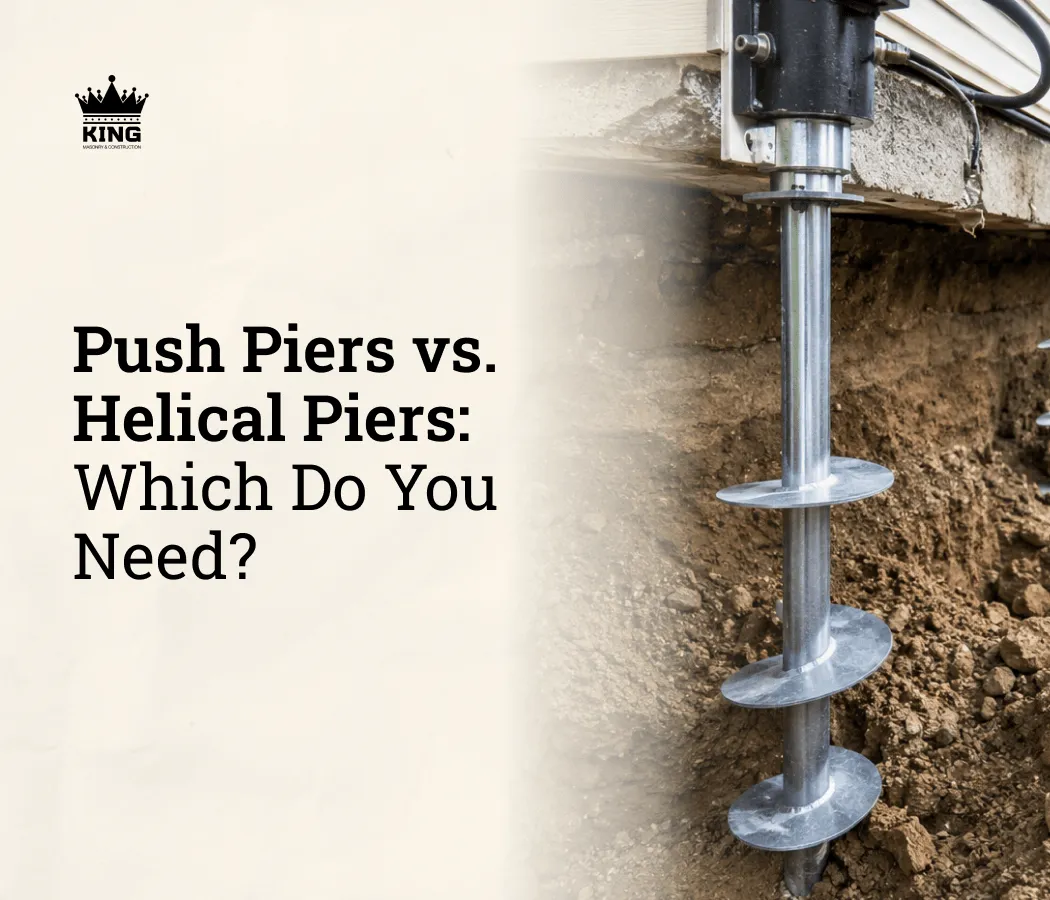
A helical pier is a steel shaft (typically " or " square, or " round pipe) with one to four helical plates welded near the leading end — the plates look like and function as oversized screw threads. A hydraulic torque motor rotates the pier into the ground, advancing it like a screw. As soil resistance increases, the torque required to rotate the pier increases.
The critical difference: helical pier capacity correlates directly to installation torque. A pier installed at ft-lbs of final torque has roughly lbs of capacity (the relationship varies by manufacturer and helix configuration but is consistent and engineered). This means the installer knows exactly what each pier can support before the structure is loaded onto it.
Once the pier reaches design torque (and depth), the torque motor disengages and a bracket or cap connects the pier to the structure. For retrofit underpinning, the bracket attaches to an existing footing similarly to push piers. For new construction, the pier is in the ground before the foundation is poured around or onto it. For more on installation methodology, see our detailed walkthrough of helical pier installation.
Head-to-Head: The Six Decision Factors That Actually Matter
Structure Weight
Push Piers
Require enough structural weight to resist being lifted by the hydraulic ram during installation. Full two-story homes, commercial buildings, and large residential structures work well. Single-story ranches sometimes work depending on soil conditions. Light structures (decks, porches, additions, garages, sunrooms) usually do not.
Helical Piers
No structural weight required for installation — the torque motor does all the work. Installable under any structure regardless of weight, and installable before a structure exists at all. The default choice for new construction, additions, decks, porches, and any light load.
Soil Profile
Push Piers
Best where stable bearing soil or bedrock exists at a known depth, with relatively consistent soil layers above. Standard glacial till common across inland Massachusetts is well-suited. Push piers don't verify capacity until refusal — you find out what's down there as you drive.
Helical Piers
Better in layered, mixed, sandy, or otherwise unpredictable soils because torque-to-capacity correlation provides continuous verification during installation. The right choice for coastal South Shore and South Coast Massachusetts where sand, silt, organic layers, and water table create unpredictable bearing.
Required Installation Depth
Push Piers
No practical depth limit. Sections add up as the pier advances. In Massachusetts, push piers can reach bearing at – feet (granite ledge in older Boston neighborhoods) to –+ feet (deep glacial outwash and coastal soils).
Helical Piers
Practical depth limit of roughly – feet depending on shaft size, soil density, and available torque. Above that, the torque required to advance the pier exceeds what standard residential equipment delivers. Deep bearing applications usually favor push piers for this reason.
Access
Push Piers
Require space to excavate a pier hole next to the footing (typically feet square, – feet deep), and clearance for the hydraulic ram and pier sections. Tight urban lots in Boston, Brookline, and Cambridge can pose problems — sometimes piers must be hand-dug.
Helical Piers
Need access for the torque motor head — typically smaller equipment footprint than push pier installation. Often the practical choice on tight Boston, Brookline, and Newton lots where push pier excavation isn't feasible.
Lateral Load Requirements
Push Piers
Designed primarily for vertical load transfer. Limited lateral resistance — the smooth pier shaft passes through soil without engaging it horizontally. Not appropriate where lateral or overturning loads need to be resisted (retaining walls, tall narrow structures).
Helical Piers
The helical plates engage soil laterally as well as vertically, providing strong resistance to lateral and overturning loads. The standard choice for retaining walls, tall narrow additions, structures on coastal sites with wind loading, and any application where lateral force is a design factor.
Cost
Push Piers
$–$ per pier installed in Massachusetts. Residential settling repairs typically use – piers, totaling $–$. Slightly less expensive per pier than helicals due to simpler equipment, but project totals are dominated by pier count, not per-pier price.
Helical Piers
$–$ per pier installed in Massachusetts. Similar – piers in residential settling jobs, totaling $–$. Higher per-pier cost reflects the equipment (torque motors, more pier configurations) and the engineering value of torque verification.
The Honest Take
Push pier vs. helical pier is rarely a close decision when soil conditions and structure weight are properly analyzed. A contractor who can't explain in two sentences why one method is right for your specific home — referencing soil and structure, not just listing features — hasn't done the analysis.
When Push Piers Are the Right Call
Push piers are the better choice when most of these conditions are present:
The structure is two stories or larger, or commercial
The soil profile is reasonably consistent with a known bearing layer (glacial till, bedrock)
Bearing depth may exceed feet (helicals would max out)
The lot has sufficient access for pier brackets and hydraulic equipment
Loads are primarily vertical (settling correction, not lateral resistance)
The structure has finishes (brick veneer, plaster, tile) that benefit from minimal vibration during installation
Typical Massachusetts use case: a sq ft poured concrete foundation under a two-story colonial in Hingham showing inches of differential settlement across one wing, with a -foot depth to dense till verified by a soil boring.
When Helical Piers Are the Right Call
Helical piers are the better choice when:
The structure is single-story, an addition, a porch, a deck, a sunroom, or new construction
Soil conditions are layered, sandy, organic, or unpredictable (typical coastal MA)
Lateral loads or overturning forces need to be resisted
Access is tight and full-bracket excavation isn't feasible
Real-time torque verification of capacity is desired (often required for engineered designs)
The bearing depth is reasonable (under – feet) given local soil conditions
Installation needs to happen before a structure exists (new construction)
Typical Massachusetts use case: a coastal new construction in Mattapoisett where the soil profile shows feet of sandy organic fill over feet of marine silt over dense sand at feet — installed before the foundation is poured, with capacity verified by torque at each pier location. For more on selecting the right helical configuration, see our guide on how to choose helical piles.
If a contractor has quoted you one method and you want a second opinion before signing, Kings Masonry & Construction provides free on-site foundation evaluations across Greater Boston, the South Shore, and the South Coast. We'll evaluate the structure, walk the site, review any soil information available, and tell you honestly whether the recommended method is right — including telling you when the recommendation is correct and we'd quote the same way. Learn more about our foundation repair and leveling services.
When Neither Push Piers Nor Helical Piers Are the Answer
Sometimes the right answer is no piers at all. A contractor who jumps to pier recommendations without evaluating alternatives is either inexperienced or upselling.
Cosmetic cracks without movement: Single hairline cracks in poured concrete walls that have been stable for years are often addressed with crack injection ($–$ per crack), not piers. Piers solve settlement; crack injection solves leaks.
Bowing walls without settlement: A wall bowing inward from lateral soil pressure is treated with carbon fiber straps ($–$ per strap installed) or wall anchors ($–$ each), not piers. Piers don't push walls back. See our bowing basement wall repair guide for the alternative methods.
Sunken concrete slabs (not foundations): Sunken garage floors, walkways, patios, and slab-on-grade additions are lifted with slabjacking or polyurethane foam injection ($–$ per square foot), not piers. Piers are for structural foundations.
Settlement caused by ongoing water issues: If the underlying cause of settlement is a leaking water main, failed downspout, or chronic drainage problem, piers stabilize the symptom without addressing the cause. The first call is to fix the water; piers may follow if movement has already occurred.
Frost heave (not settlement): A foundation moving upward seasonally with the freeze-thaw cycle is a frost heave problem, not a settlement problem. Piers don't fix frost heave; the fix is insulation, drainage, or below-frost reconstruction.
Red Flags in Pier Recommendations
Six specific patterns that should trigger a second opinion before signing any contract for foundation repair:
Red Flag
A recommendation for one method without any discussion of soil conditions. Pier selection is a soil-driven decision. Any quote that doesn't reference what's underneath your house is guessing.
Red Flag
Refusal to explain why one method over another, or vague answers like "this is what we do." A contractor who can't articulate the technical decision in plain English doesn't understand it well enough to install it correctly.
Red Flag
The same per-pier price regardless of depth, method, or capacity. Pier pricing legitimately varies with installation depth (deeper = more sections, more time) and capacity (heavier loads = larger pier systems, higher cost). A flat price across all conditions is a sales construct, not an engineering estimate.
Red Flag
No mention of the cause of the settlement. Stabilizing a foundation that's settling because of an ongoing water issue is symptom treatment. A reputable contractor identifies and addresses the cause, not just the result.
Red Flag
High-pressure pricing tactics ("sign today for this price"). Foundation repair is a $K–$K decision. Any contractor who needs you to decide on the spot is incentivized in ways that don't align with your interests.
Red Flag
Lifetime warranties on everything. Pier systems legitimately carry transferable lifetime warranties on the steel components. Pumps, dehumidifiers, and other mechanical components do not — they have – year service lives. A "lifetime warranty on everything" is either misrepresented coverage or pricing the failure into the original quote.
What to Ask Before Signing
If you've been quoted push piers or helical piers, the questions that separate a defensible recommendation from a sales pitch:
What's the soil profile at this site? Has a boring been done, or are you working from local knowledge?
What's the design load per pier? How many piers, and why that number?
What depth are you expecting? How confident are you in that estimate?
What's the alternative method, and why isn't it the right choice here?
What's the cause of the settlement? Will piers address it permanently, or will the cause continue?
What's included beyond pier installation — engineering, permits, structural repair, restoration?
What's the warranty, specifically: steel pier system vs. installation labor vs. any future settlement?
Can you provide references from comparable installations within miles in the last months?
A contractor who answers all eight clearly is doing the work right. A contractor who deflects, oversells, or gets defensive on any of these is showing you what working with them will be like once you've signed.
Get a Second Opinion Before You Sign
Foundation repair is a five-figure decision. The cost of a free second opinion is zero. We provide free on-site evaluations across Greater Boston, the South Shore, and the South Coast — and we'll tell you honestly when the method you've been quoted is the right call, including when we'd quote the same job the same way.
Serving Brookline · Newton · Dedham · Braintree · Hingham · Weymouth · Plymouth · New Bedford · Brockton · Wareham · Marshfield · Dartmouth and surrounding Massachusetts communities
Frequently Asked Questions
What is push pier foundation repair cost in Massachusetts?
Push pier foundation repair cost in Massachusetts runs $–$ per pier installed, with typical residential settling repairs requiring – piers for a total of $–$. The per-pier price covers excavation of the pier hole, the bracket, all pier sections required to reach refusal, hydraulic installation, and stabilization or lift. Engineering reports, permits, structural repairs above the foundation, and restoration of disturbed landscape or finishes are typically priced separately. Depth and access conditions affect the price more than any other factor — coastal sites with deeper bearing run higher.
Are helical piers more expensive than push piers?
Slightly. Helical piers run $–$ per pier installed in Massachusetts versus $–$ for push piers. The price difference reflects equipment costs (hydraulic torque motors, varied pier configurations) and the engineering value of torque-to-capacity verification during installation. For typical residential projects requiring – piers, total project costs differ by $–$ between the two methods — usually a smaller factor than choosing the right method for the soil and structure conditions.
What is foundation leveling cost in Massachusetts?
Foundation leveling cost in Massachusetts runs $–$ for typical residential settling repairs using push piers or helical piers, with cost driven primarily by the number of piers required (typically –) and depth to stable bearing soil. "Leveling" specifically means activating the hydraulic jacks at each pier after installation to lift the foundation back toward its original elevation. How much lift is safely achievable depends on the structure's brittle finishes (drywall, tile, brick veneer) — some homes lift back to original grade; others can only be stabilized in place because lifting would crack everything above.
How long do push piers and helical piers last?
Both push piers and helical piers carry transferable lifetime warranties on the steel components when properly installed and protected from corrosion. The steel itself has a structural service life measured in many decades — the engineering loads are well below the steel's fatigue thresholds. The bracket connection to the footing and the installation workmanship are the more relevant longevity factors. Reputable contractors warranty the installation work for transferable lifetime against settlement of the supported area, with carve-outs for new movement caused by undocumented soil changes.
Can I use helical piers under an existing two-story home?
Yes — helical piers are routinely used to underpin existing two-story homes. The choice between push piers and helicals for heavy structures depends primarily on soil conditions and access, not weight. Layered or unpredictable soils, sites where torque verification is desired, and tight-access lots in older Boston, Brookline, and Newton neighborhoods often favor helicals even on heavy structures. Push piers leverage the structure's weight during installation but are not the only option for heavy buildings.
Does foundation lifting cost more than stabilization alone?
Slightly, but typically only marginally. The same piers, brackets, and labor are used for both — the difference is whether the contractor activates the hydraulic jacks after installation to lift the foundation back toward original elevation. Foundation lifting cost is usually included in the per-pier price ($–$) or adds a modest line item for the lift operation. The bigger cost factor is restoration: lifting often cracks finishes and requires drywall, tile, or trim repair afterward that stabilization alone avoids.