
How to Choose the Right Helical Piles for Your Construction Needs
Most construction decisions come with a margin for error. Pile selection is not one of them. Choose the wrong helical piles for your site conditions, and you are looking at failed installations, costly redesigns, or — in the worst case a structure that continues to settle after the work is done. Choose correctly, and you get a deep foundation system that outperforms alternatives in speed, versatility, and long-term stability.
This guide breaks down every major factor that should drive your helical pile selection from soil conditions and load requirements to shaft size, site constraints, and contractor qualifications. Whether you are a homeowner tackling a foundation repair project or a contractor evaluating deep foundation options for new construction, this framework will help you make an informed decision before a single piece of steel goes into the ground.
Quick Decision Checklist: 5 Questions to Answer Before Selecting Helical Piles
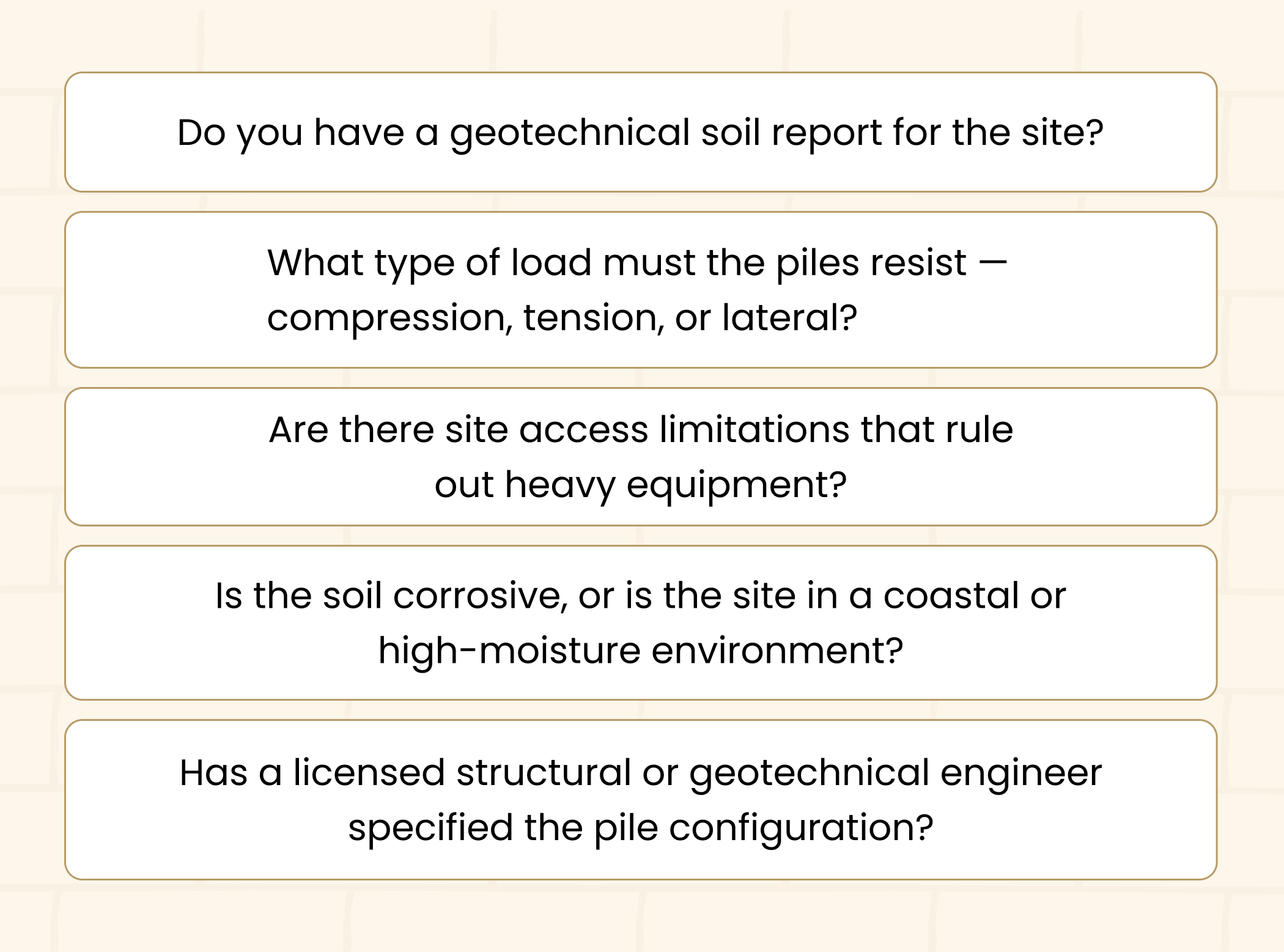
If you cannot confidently answer all five, stop and consult a foundation specialist before purchasing or installing anything.
What Are Helical Piles?
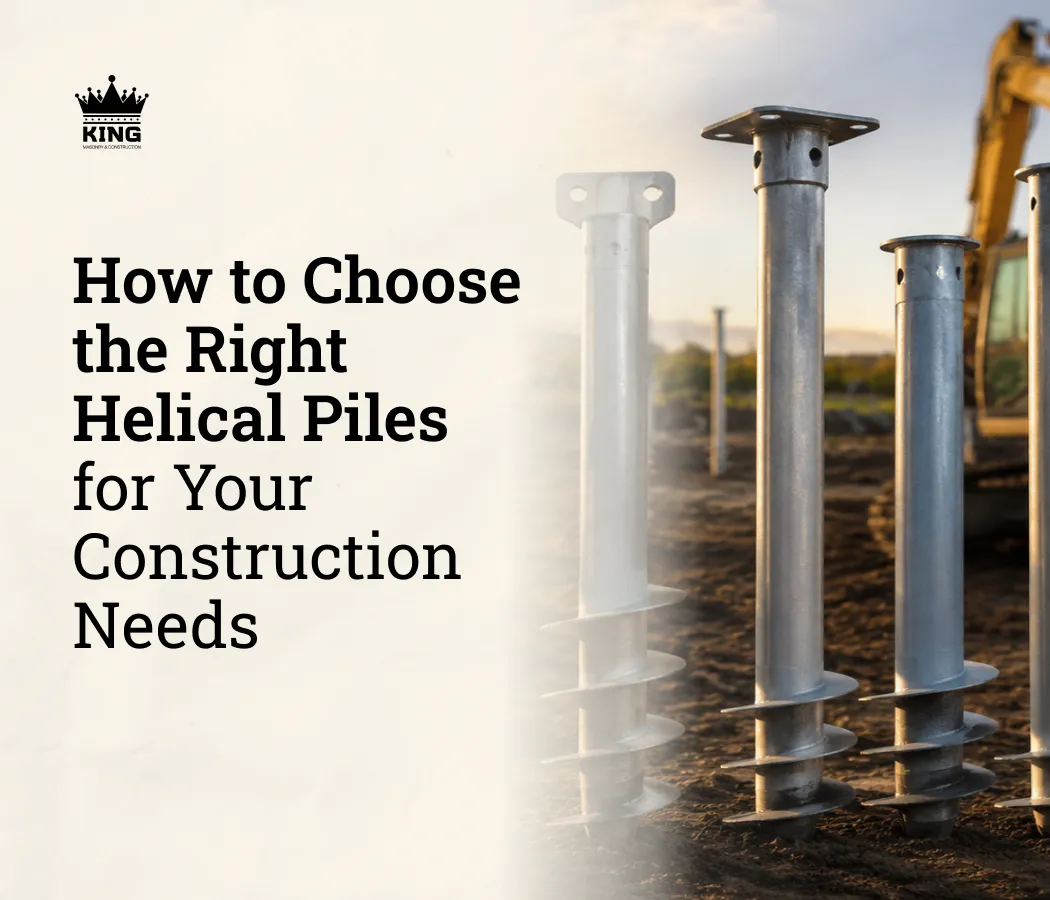
A helical pile — also called a helical pier, screw pile, or helix anchor — is a steel shaft with one or more helical (spiral) bearing plates welded along its length. A hydraulic torque motor rotates the pile into the ground, advancing the helical plates through the soil much like a screw through wood. Once the pile reaches stable bearing material, it is connected to the structure above via a steel bracket, transferring the structural load deep into competent soil or rock.
Helical piles are used across a wide range of applications: new construction on poor soils, foundation repair and underpinning of existing structures, tie-back anchoring, boardwalks, solar installations, and more. Their versatility is one of their greatest strengths — but it also means that the selection process requires careful thought.
Key Factor #1 — Soil Conditions
Soil is the single most important variable in helical pile design. No two sites are identical, and the wrong pile specification for a given soil profile can result in under-capacity installations or piles that cannot be advanced to the required depth.
Soil Type and Bearing Capacity
Soil bearing capacity — the ability of soil to support an applied load — varies dramatically by type. Dense sand and gravel offer high bearing capacity and predictable behavior. Soft clay and silt compress under load and drain slowly, requiring piles to be driven deeper to reach stable material. Organic soils and fill are often highly compressible and unpredictable. The pile's helix plates must be sized and spaced to mobilize adequate capacity in whatever material they encounter.
Corrosivity and Water Table
Soil chemistry matters too. Highly acidic or saline soils — common near coastlines, industrial sites, and wetlands — accelerate steel corrosion. In these environments, galvanized or epoxy-coated helical piles are essential, not optional. Similarly, a high water table affects both installation behavior and long-term pile performance and must be accounted for in the design.
The Geotechnical Soil Report
A geotechnical soil report (also called a soils investigation or boring report) is non-negotiable for any project where pile performance is critical. This document provides soil boring logs, laboratory test results, and bearing capacity estimates at various depths. Without it, pile specifications are educated guesses at best. For significant construction projects, this report should be in hand before any foundation system is selected.
Key Factor #2 — Load Requirements
Not all loads are created equal, and helical piles must be configured to resist the specific forces your project demands.
Compression, Tension, and Lateral Loads
Compression loads push downward — the weight of the structure bearing down on the pile. This is the most common load type in foundation support applications. Tension loads (also called uplift loads) pull upward — relevant in tie-back anchors, wind uplift scenarios, and structures subject to buoyancy. Lateral loads act horizontally — relevant in retaining walls, bridge abutments, and structures in high-wind or seismic zones.
Each load type influences how a pile must be configured. Compression-dominant applications typically use piles with helices near the tip to mobilize end bearing. Tension applications need helices distributed along the shaft to maximize pullout resistance. Combined loading scenarios require careful engineering to ensure the pile can handle all forces simultaneously.
Single-Helix vs. Multi-Helix Configurations
A single-helix pile has one bearing plate and is typically used in lighter applications or where soil conditions are highly uniform. Multi-helix configurations — two, three, or more plates spaced along the shaft — distribute load across a greater soil volume, increasing capacity significantly. For most residential and light commercial applications, a two- or three-helix configuration provides a reliable balance of capacity and installation efficiency.
Key Factor #3 — Pile Shaft Size and Material
Shaft size directly determines how much load a helical pile can carry and how difficult it is to install.
Standard Shaft Sizes
Round shaft helical piles are available in standard diameters: 1.5", 1.75", 2.375", 2.875", and 3.5" are the most common in residential and light commercial work. Square shaft piles — typically 1.25" or 1.5" — are used in lighter-duty applications like boardwalks, solar arrays, and sign foundations. Larger shaft diameters offer significantly higher load capacity but require more powerful installation equipment and cost more per unit.
The Capacity vs. Cost Trade-Off
A 1.75" round shaft pile might handle 50–70 kips of compression in good soil. A 3.5" shaft can carry several times that. The larger the shaft, the higher the installation torque required — which dictates what kind of equipment can do the job. For constrained sites or smaller structures, over-specifying shaft size adds unnecessary cost. For heavy structures or poor soil conditions, undersizing the shaft is a serious engineering mistake.
Corrosion Protection
For standard sites, bare steel or lightly galvanized piles are typically sufficient. For aggressive environments — coastal zones, acidic soils, high-chloride conditions — hot-dip galvanized or fusion-bonded epoxy coated helical piles dramatically extend service life. This is an upfront investment that pays back over decades of reduced maintenance and structural integrity.
Key Factor #4 — Project Type and Site Constraints
The nature of your project and the physical realities of your site can narrow your options quickly.
New Construction vs. Foundation Repair
In new construction, pile specifications can be designed from scratch with full engineering input before breaking ground. In foundation repair and underpinning, the pile system must work around an existing structure — often with limited access, unknown footing conditions, and the need to minimize disruption to the occupied building. Retrofit applications often favor smaller-diameter piles installed with compact equipment for this reason.
Tight Access and Low Headroom
This is where helical piles consistently outperform alternatives like driven piles or drilled shafts. Driven piles require large hammers and cranes. Drilled shafts generate significant spoil and require open access for drilling rigs. Helical piles can be installed with mini-excavators, skid-steers, or even hand-held hydraulic units in spaces where no other method is practical — interior basements, narrow side yards, and environmentally sensitive sites where ground disturbance must be minimized.
Environmentally Sensitive Sites
Because helical pile installation produces virtually no vibration and minimal soil spoil, it is one of the only deep foundation systems approved for use near existing structures, utilities, and sensitive ecosystems. This makes them a preferred choice for waterfront projects, urban infill construction, and work near historic buildings.
Key Factor #5 — Installation Torque and Load Capacity Verification
One of the most significant advantages of helical piles over other foundation methods is the ability to verify load capacity in real time during installation.
The Torque-to-Capacity Relationship
As a helical pile is advanced into the ground, the hydraulic torque motor records how much rotational force (torque) is required to turn the pile. There is a well-established engineering relationship between installation torque and pile load capacity — higher torque readings generally indicate denser, stronger soil and higher pile capacity. This means every pile installation generates a real-time capacity log without waiting for concrete to cure or relying on assumed soil values.
Why Torque Monitoring Matters
A qualified helical pile contractor will monitor and record torque readings continuously throughout installation. This data confirms that each pile has reached the required capacity before the crew moves on. Without torque monitoring, there is no reliable way to know whether a pile is performing as designed — and no documentation to support the installation if questions arise later.
Load Testing for Critical Projects
For larger or higher-risk projects, load testing provides an additional layer of verification. A compression or tension load test applies a measured force to an installed pile and records deflection, confirming actual capacity matches the engineering specification. While not required on every project, load testing is worth the investment when stakes are high.
Working With a Qualified Helical Pile Contractor
Look for contractors who monitor and log installation torque on every pile, hold manufacturer certifications (CHANCE, Magnum Piering, or GoToPiers), and work alongside a licensed structural or geotechnical engineer. Always get a written pile specification — covering shaft diameter, helix configuration, and minimum torque — before signing any contract.
A Trusted Boston-Area Contractor: Kings Masonry
Kings Masonry serves homeowners and contractors across Greater Boston including Cambridge, Somerville, Newton, Quincy, and the North and South Shore. Their team knows the region's soil firsthand, from the marine clay beneath Back Bay to the glacial till common throughout the suburbs. They coordinate with licensed engineers, provide torque logs for every installation, and are fully licensed and insured in Massachusetts.
Make the Right Call Before the First Pile Goes In
The right helical piles for your project depend on your soil, your load requirements, and your site conditions — not just what is cheapest or fastest to install. Use the five factors in this guide as your decision framework, and always have a licensed engineer review the specification before work begins.
Contact Kings Masonry today for a free consultation — and get the foundation your project deserves, built right the first time.