
Foundation Crack Repair in Winter: Why Cracks Spread in the Cold and How We Seal Them
Here's the misconception we clear up almost weekly: a lot of homeowners assume a foundation crack should be left alone until spring. In reality, winter is when a quiet crack turns into a leaking, spreading problem — which is exactly why foundation crack repair in winter is worth understanding before the next thaw, not after. If you've got a line in your basement wall you've been eyeing since the temperature dropped, this is for you.
Most people's instinct is to treat a foundation crack the way they'd treat a scuff on drywall — something cosmetic that can wait. That instinct makes sense for drywall. It doesn't hold up for concrete sitting below grade, surrounded by soil that's constantly taking on and losing water, and subject to a New England winter that swings above and below freezing dozens of times between November and April. A crack that looks stable on Thanksgiving can look very different by the time the crocuses come up. Understanding why that happens — and what your options actually are while the ground is frozen — is the difference between a fifteen-minute injection job now and a structural repair, a wet basement, and a mold remediation bill later.
This guide walks through the mechanics of freeze-thaw cracking, how to tell a cosmetic crack from a structural one, what repair methods actually work in cold weather, and what we see go wrong when homeowners wait. We'll also give you a quick interactive tool partway down the page so you can get a preliminary read on your own crack before you ever pick up the phone.
Key Takeaways
Cold doesn't create most cracks — it exposes and widens them. Water gets into an existing crack, freezes, expands, and wedges it open a little more with each freeze-thaw cycle.
Direction tells you almost everything. Vertical and diagonal hairlines are usually cosmetic; horizontal and stair-step cracks signal pressure and are structural until proven otherwise.
Yes, cracks can be sealed in winter. Interior epoxy and polyurethane injection are indoor jobs that don't care about the outside temperature.
Sealing before the freeze is cheapest. A small-scale injection in fall beats a structural repair after a crack has spread all winter.
A leaking crack is a clock. Every thaw that pushes water through it accelerates both widening and interior moisture damage.
Quick Answer
Foundation cracks can absolutely be repaired in winter. Interior foundation crack repair by injection — epoxy for structural cracks, polyurethane for active leaks — is done from inside and works year-round. Cracks get worse in winter because meltwater enters, freezes, and expands, prying them wider through repeated freeze-thaw cycling. Vertical hairlines are usually cosmetic; horizontal or stair-step cracks are structural and need a professional evaluation.
Why Foundation Cracks Get Worse in Winter
Concrete cracks for a dozen reasons, but winter has a specific, mechanical way of making a small one grow. A crack is just a channel. When snow melts or groundwater rises, water finds that channel and sits in it. When the temperature drops below freezing — which around Boston it does, thaws, and does again, over and over — that trapped water turns to ice and expands roughly nine percent. Ice is a wedge, and it pushes the crack faces apart. Come the thaw, the crack doesn't close all the way back. Repeat that across a full New England winter and you've turned a hairline into something you can slip a coin into.
That's the freeze-thaw story, and it's why freeze thaw foundation cracks behave so differently from a crack that simply appeared during curing. It's also why foundation cracks cold weather complaints spike in January and February rather than in a steady deep freeze — it's the cycling, not the raw cold, that does the damage.
Older Boston and South Shore homes add a wrinkle. On a poured wall, a crack is a clean line. On a block wall, freeze pressure tends to follow the mortar joints in a stair-step pattern. And on a fieldstone foundation, you don't get a "crack" so much as opening joints and shifting stones. Reading which type of crack you have is the first real step.
The Physics, in a Bit More Detail
It helps to picture what's actually happening below your feet. Soil isn't inert — it holds moisture, and in winter that moisture doesn't just sit still. As the frost line pushes down into the ground, water in the soil migrates toward the coldest zone and freezes there, forming ice lenses. Those lenses grow, and as they grow they push outward against anything in their way — including your foundation wall. This is called frost heave, and it's a separate (though related) mechanism from the water-in-the-crack story above. Frost heave explains a lot of the lateral, horizontal pressure that shows up as bowing walls or horizontal cracking, while direct freeze-thaw inside an existing crack explains why a simple vertical hairline widens season over season.
Both mechanisms are amplified by a few local conditions that are extremely common around Boston: heavy clay soils that hold water rather than draining it, older homes with grading that slopes toward the foundation instead of away from it, and gutters or downspouts that dump water right at the base of the wall. None of those problems are exotic — they're the default condition for a huge share of the housing stock in Brookline, Newton, Quincy, and the South Shore towns we work in every week. That's part of why we see the same pattern of complaints every winter: a crack that was "fine" in October is suddenly damp, whistling with cold air, or visibly wider by February.
Why the Damage Compounds Instead of Staying Flat
One thing homeowners often don't expect is that the process is not linear — it accelerates. A crack that's a sixteenth of an inch wide holds a small amount of water, freezes, and widens a small amount. But a crack that's already an eighth of an inch wide holds more water, which means more ice, which means more force, which means a bigger jump in width with the next freeze. Left alone, a stable-looking hairline in year one can become a leaking, actively growing crack by year three or four, simply because each winter's damage makes the following winter's damage worse. This is exactly why we tell people that "it's been like that for years and hasn't caused a problem" is not the same thing as "it isn't a problem" — it just means you haven't hit the acceleration point yet.
Crack Types, Causes, and the Right Fix
Once you know the direction, the repair path gets clearer. Here's how we sort it in the field.
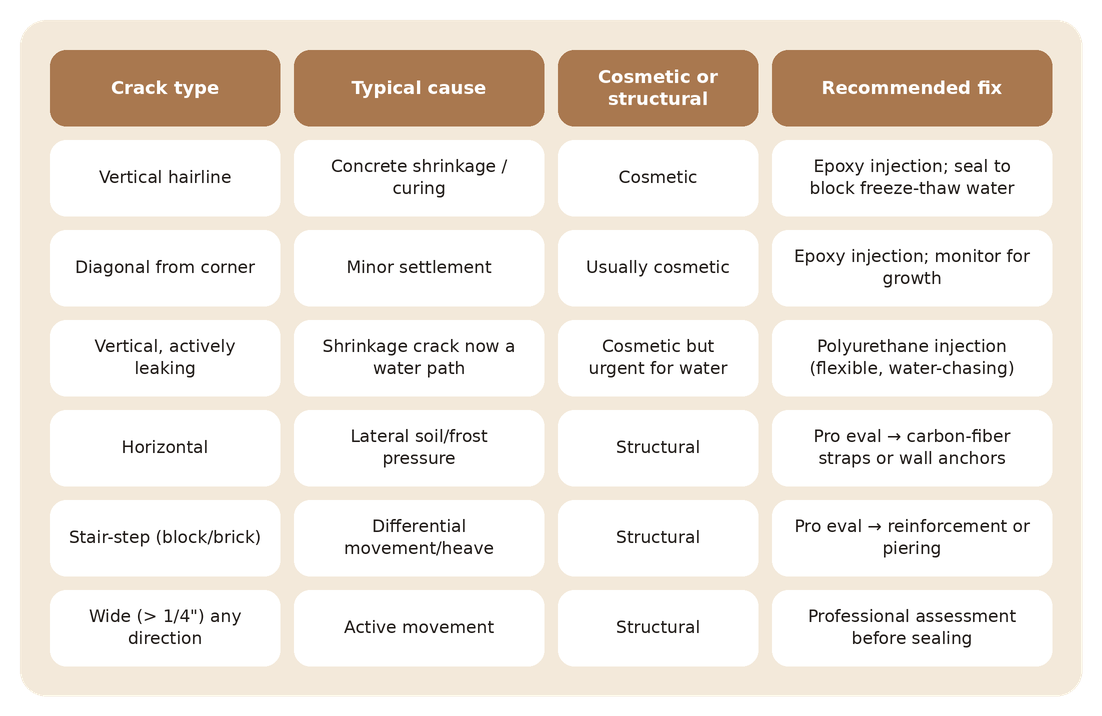
The key distinction: sealing a crack and stabilizing a wall are two different jobs. Injecting a horizontal structural crack without addressing the pressure behind it just hides the symptom. That's the mistake we get called to undo most often.
A Closer Look at Each Repair Method
Epoxy injection is the workhorse for stable, non-leaking structural cracks. Epoxy is rigid once cured — it essentially re-bonds the two faces of the crack into a single, solid piece of concrete again, restoring a meaningful amount of the wall's original strength. Because it's rigid, though, it's the wrong choice for a crack that's still actively moving or actively weeping water, since a rigid material can't flex with the wall or push water out ahead of the injection.
Polyurethane injection is the go-to when water is actively coming through. Unlike epoxy, polyurethane stays flexible after it cures, expands to fill voids as it reacts, and — critically — it chases moisture rather than being repelled by it. That makes it ideal for cracks that are damp, dripping, or seasonal (dry in summer, wet every spring thaw). It won't restore structural strength the way epoxy does, so on a crack that's both leaking and structural, we'll often combine methods or pair injection with exterior reinforcement.
Carbon-fiber straps and wall anchors come into play once a crack (or a bowing section of wall) indicates the foundation is actively fighting soil pressure. These don't seal the crack by themselves — they resist further inward movement, which is what actually stops a horizontal crack or a bowing wall from getting worse. Straps are typically used for moderate bowing; anchors, which extend out into the yard, are used for more significant movement.
Exterior excavation-based waterproofing — digging down to the footing, applying a membrane, and correcting drainage — is the most thorough fix for chronic water problems, but it's also the one method that generally does have to wait for the ground to thaw. It's worth knowing that distinction: almost everything you'd want done from inside the basement can happen in January, but digging up the yard cannot.
Should You Fix Foundation Cracks Before Winter?
If you can, yes — and the reasoning is purely practical. Winter foundation crack sealing is very doable, but a crack sealed in October never spends the winter as an open channel for freezing water. You skip an entire season of freeze-thaw wedging. For a cosmetic vertical crack, a fall epoxy injection is a modest job; letting that same crack drink meltwater until March can turn it into a wider repair plus interior moisture cleanup. Pair the seal with the boring stuff that actually prevents recurrence: downspout extensions, regrading away from the wall, and a working sump pump.
That said, "before winter" is a preference, not a hard requirement. If you're reading this in January with a crack you noticed over the holidays, the right move isn't to wait until spring — it's to book an interior injection now, since that work doesn't care what the thermometer says outside.
What a Neglected Crack Looks Like Season by Season
It's easier to take a crack seriously when you can picture where it's headed. Here's the pattern we typically see play out on an untreated, water-exposed crack over a few winters:
Year one: A hairline crack appears, usually vertical, often near a corner or a window well. No visible water. Homeowner notices it, decides it's not urgent.
Winter one: Meltwater and groundwater find the crack during thaws. A few freeze-thaw cycles nudge it slightly wider — often not enough to notice by eye.
Year two: The crack is now wide enough to hold more water during each freeze event, which means each cycle does more damage than the year before. Efflorescence (the white, chalky mineral deposit left behind by evaporating water) may start to appear along the crack.
Winter two: Active dripping or seeping begins during thaws. What was a dry cosmetic crack is now a seasonal water source.
Year three-plus: The crack is visibly wider, water intrusion is closer to guaranteed every spring, and there's a real chance of secondary damage — mold on nearby framing, damaged flooring or drywall, or a musty basement smell that never fully goes away.
None of this is inevitable. Sealing the crack at year one — cosmetic, vertical, dry — is typically the cheapest possible intervention. The cost and scope only grow the longer the crack is left exposed to the cycle.
What You Can Do vs. What Needs Us
You can safely mark and date a crack, measure its width, watch it across thaws, and keep water away from the wall outside. What you shouldn't DIY is a structural call. Big-box crack kits can seal a stable hairline, but they can't tell you whether a horizontal crack means the wall is under pressure — and they won't stop that pressure. Anything horizontal, stair-step, wide, or paired with a bowing wall is a professional job.
If you do want to track a crack yourself before calling anyone, here's a simple method that works well: mark both ends of the crack with a pencil line and the date, take a photo with a ruler or coin next to it for scale, and repeat that every few weeks through a couple of thaw cycles. If the crack extends past your marks, changes width, or you notice new dampness, that's your signal to stop monitoring and get an inspection.
Frequently Asked Questions
Why do foundation cracks get worse in winter?
Water works into the crack, freezes, and expands about nine percent, wedging the crack wider. Boston's repeated freeze-thaw cycles do this over and over across a season, so a hairline in December can be noticeably wider by March. It's the freezing and thawing cycle, not the cold itself, that spreads the crack.
Can foundation cracks be repaired in winter?
Yes. Interior crack injection is an indoor process, so epoxy and polyurethane sealing work regardless of outdoor temperature. Structural reinforcement like carbon-fiber straps is also year-round. Only exterior excavation-based waterproofing tends to wait for a thaw. We handle foundation crack repair in winter throughout Boston and the South Shore.
Should I fix foundation cracks before winter?
Ideally yes. Sealing a crack in fall keeps freezing meltwater out of it all winter, preventing the freeze-thaw widening that turns a cheap injection into a bigger repair. Fixing foundation cracks cold weather issues proactively is almost always cheaper than dealing with the spread and water damage afterward.
Is epoxy or polyurethane better for a foundation crack?
Epoxy is rigid and structural — it welds a stable crack back into solid concrete. Polyurethane stays flexible and chases water, making it the choice for cracks that are actively leaking or still moving slightly. The right pick depends on whether the crack is structural, leaking, or both, which is why a quick assessment helps.
Do small foundation cracks really need repair?
A stable hairline isn't an emergency, but in winter even a small crack is an open door for water that then freezes and grows it. Sealing small cracks is cheap insurance. Mark and date the ends; if the crack grows, leaks, or turns horizontal, move from monitoring to a professional evaluation.
How much does foundation crack repair typically cost?
Costs vary with the crack's size, whether it's leaking, and whether structural reinforcement is needed on top of sealing, so it's worth getting a specific quote rather than relying on a general number. As a rule of thumb, a straightforward interior injection on a stable crack is one of the least expensive foundation repairs available, while anything involving carbon-fiber straps, wall anchors, or exterior excavation costs meaningfully more — which is exactly why catching a crack early, before it becomes structural, tends to save money.
Will sealing a crack stop a musty basement smell?
Sometimes, but not always. If the smell is coming specifically from moisture entering through that crack, sealing it can resolve the issue. If there's a broader moisture problem — poor ventilation, a high water table, or multiple entry points — you may need a combination of crack sealing, drainage correction, and interior humidity control to fully clear it up. Our guide on getting rid of a musty basement smell covers the other causes.
Got a Crack That's Been Spreading? Let's Look Before the Next Freeze.
A crack won't fix itself, and winter only speeds it up. King's Masonry & Construction offers free foundation crack inspections and straight answers across Boston, the South Shore, and the South Coast — Brookline, Newton, Quincy, Plymouth, New Bedford, and beyond. We'll tell you whether it's a simple seal or something structural, and handle either one.