
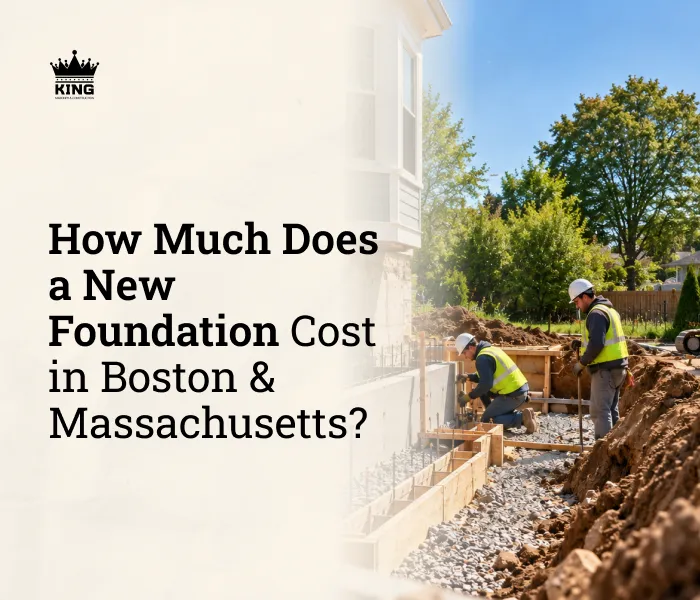
How Much Does a New Foundation Cost in Boston & Massachusetts?
Quick Answer:
A new foundation in Boston and the South Shore runs roughly seven to forty-five dollars per square foot. On a 1,200 sq ft footprint, that's about eight thousand four hundred to nineteen thousand two hundred dollars for a slab, fourteen thousand four hundred to thirty thousand dollars for a crawl space, and twenty-four thousand to fifty-four thousand dollars for a full basement. Your real number depends on foundation type, soil and site, dig depth, and access, so treat these as planning figures. Only an on-site quote gives you an accurate price.
A foundation is the one part of your build you never see once it's done, and the one part you can't afford to get wrong. If you're planning a new home or an addition in Boston or anywhere in Massachusetts, the foundation is usually the first real number you'll chase, and it's hard to pin down online. National calculators rarely account for our frost depth, our rocky soil, or the coastal storms that test every foundation in the region.
I've spent years on job sites across Boston and the South Shore, including Hingham, Quincy, Weymouth, Braintree, and Plymouth. I've dug footings, broken ledge (bedrock), and fixed the water problems that show up when a foundation was built cheap. Below I break down real cost ranges, the factors that move them, and why the money you put into drainage now is the smartest line in the budget.
How much does a new foundation cost in Boston?
Short answer: Plan on seven to forty-five dollars per square foot, depending mostly on whether you choose a slab, a crawl space, or a full basement.
That spread is wide for a reason. A shallow slab on flat, well-drained ground is a completely different job from a deep basement dug into New England bedrock.
Foundation type | Typical range (per sq ft)* | What you get | Best suited for |
|---|---|---|---|
Concrete slab-on-grade | About seven to sixteen dollars | A poured pad near grade; no basement | Tight budgets, single-level or slab-friendly designs |
Crawl space | About twelve to twenty-five dollars | A few feet of clearance; easy utility access | Sloped lots, moderate budgets |
Full basement | About twenty to forty-five dollars | A full lower level you can finish later | Maximum usable space and resale value |
Additions often cost more per square foot than a whole-house pour, usually landing at the top of these ranges or above. The footprint is small, but setup, access, and tying into the existing foundation don't shrink with it.
"I've watched two houses on the same street come in thousands of dollars apart once we dug test holes. That's why I won't quote an exact figure before seeing the lot." — Jonathan Odriscoll
Example: foundation cost for a 1,200 sq ft home
Foundation type | Per sq ft | Estimated total (1,200 sq ft) |
|---|---|---|
Slab-on-grade | Seven to sixteen dollars | Eight thousand four hundred to nineteen thousand two hundred dollars |
Crawl space | Twelve to twenty-five dollars | Fourteen thousand four hundred to thirty thousand dollars |
Full basement | Twenty to forty-five dollars | Twenty-four thousand to fifty-four thousand dollars |
These totals are before ledge removal, engineering, or a 10–20% contingency. For a first estimate, multiply your own footprint by the per-sq-ft range.
Slab vs. crawl space vs. full basement which is cheapest?
Short answer: A slab is cheapest, a crawl space is mid-range, and a full basement costs the most but adds a full level of usable space.
If your budget is tight and you don't need the space, a slab is almost always the most economical way to get a sound foundation under a build. If you want storage or future living area, a basement costs more up front but returns the most value at resale. That's especially true in Boston's housing market, where finished lower levels are in demand. A crawl space is the sensible middle path on a sloped lot, or when you want utility access without the full basement price.
What drives the price of a new foundation?
Short answer: Soil and site conditions, foundation type, required depth, footprint and access, and the drainage you build in. Any one of these can swing the price significantly.
Cost driver | Why it matters | Effect on price |
|---|---|---|
Soil & ledge (bedrock) | Rock breaking or engineered fill adds days of work | Often the single biggest swing |
Frost-depth footings (~4 ft in MA) | Required by code; more excavation and concrete | Moderate to high |
Size & shape | More concrete; angles and bump-outs add forming labor | Scales with the footprint |
Site access | Tight lots mean pumping or hand-carrying concrete | Moderate |
Drainage & waterproofing | Protects against groundwater and coastal storms | Moderate now, saves thousands later |
Permits & engineering | Town-by-town fees; some sites need a structural stamp | Low to moderate |
Soil, site, and ledge (bedrock)
This is the wild card in New England. Some lots are clean sand and gravel you can dig in an afternoon. Others hide ledge, which is solid bedrock, a few feet down. Soft or poorly draining soil can also force extra footings or engineered fill.
"The first time I hit ledge on a South Shore basement dig, a one-day excavation turned into a week of rock breaking. That shows up on the invoice fast." Jonathan Odriscoll
Frost depth and Massachusetts winters
In most of Massachusetts, footings must sit below the frost line so freeze-thaw cycles don't heave your foundation. The frost line is commonly around four feet deep. This is required under the Massachusetts State Building Code (780 CMR). Deeper footings mean more digging, more concrete, and taller walls than the same house would need in a warm climate.
Size, shape, and access
A bigger footprint needs more concrete. Shape matters too: a simple rectangle is cheap to form, while bump-outs, angles, and stepped footings on a slope add labor. Access is the last factor. If a concrete truck or excavator can't get close, as on a tight Boston lot or a backyard addition, we're pumping or hand-carrying material, and that time is real money.
Why do Massachusetts foundations cost more than the national average?
Short answer: Deep frost-line footings, common ledge (bedrock), older lots with tight access, and regional labor rates push Boston toward the upper end of national ranges.
The online calculators usually undersell our region. When I price a foundation, the concrete pour is only part of it — excavation, hauling spoil, forms, rebar, footings, waterproofing, and backfill each carry their own line items. A quote that looks suspiciously low almost always leaves something out, and you'll meet it again later as a change order. If you want a sense of the concrete and structural side of that work, our concrete and foundation work page walks through what's actually involved.
After Boston's flooding, why does drainage matter so much for a new foundation?
Short answer: Because water — not weight — is what destroys most foundations here. Building in proper footing drains, a waterproofing membrane, and correct grading from day one is far cheaper than retrofitting them after the first wet spring, and it's non-negotiable in a coastal, storm-prone region like ours.
This one isn't theoretical right now. In late September 2026, a rare early-season nor'easter battered Greater Boston and New England, bringing coastal flooding, near-hurricane-force wind gusts, and power outages for tens of thousands of homes. Boston alone recorded close to three inches of rain, while parts of Southeastern Massachusetts and Cape Cod topped seven. High tides near 15 feet pushed harbor water onto Long Wharf and into East Boston, low-lying Dorchester, downtown, Fort Point, and the Seaport.
Here's what that means for anyone about to build. Every inch of that rain and every high tide loads saturated soil against foundation walls — a force called hydrostatic pressure. A foundation built without perimeter footing drains, a proper membrane, and grading that slopes water away from the house is the one that seeps, cracks, and grows mold first. Boston is already ranked among the most flood-vulnerable cities in the country, and the city has been rolling out coastal-resilience projects across all 47 miles of its shoreline — a sign of where the risk is heading, not just where it's been.
So when you're pricing a foundation, don't treat waterproofing as an optional add-on to trim. On a new build, I'd rather see the budget carry proper exterior drainage and waterproofing and, where a basement is involved, real basement waterproofing than a slightly nicer finish upstairs. The homeowners who skipped it are the ones calling us after storms like this one. Building it dry the first time is the cheapest water you'll ever manage.
What's included in a foundation quote?
Short answer: A complete foundation quote should itemize excavation, footings, walls or slab, waterproofing and drainage, backfill and grading, permits, and any required engineering — not just "the concrete."
Line item | What it covers |
|---|---|
Excavation & spoil removal | Digging the hole and hauling soil off-site |
Footings | Concrete bases below the frost line |
Foundation walls / slab | Concrete, forms, and rebar |
Waterproofing & drainage | Membrane, footing drains, sump provisions |
Backfill & grading | Refilling and sloping soil away from the house |
Permits & inspections | Town fees and required sign-offs |
Structural engineering | An engineer's stamp when the site calls for it |
When you compare bids, read them line by line rather than judging by the bottom number. The cheapest total usually means the fewest inclusions — and in Massachusetts, the permit and inspection process varies town to town, so it's worth understanding the local permit requirements before you sign anything.
How do I choose a foundation contractor and budget without surprises?
Short answer: Get the site assessed before you set a budget, keep a 10–20% contingency for what's underground, and choose a licensed, insured local contractor who prices the whole system and explains it, rather than the one with the lowest headline number.
A few things I tell every homeowner:
Assess before you budget. Test holes and a look at your grade and access tell us more than square footage ever will — the difference between a guess and a quote.
Build in a contingency. Ledge and bad soil don't announce themselves until we dig, so hold 10–20% in reserve on new foundation work.
Price the whole system. Waterproofing, drainage, and backfill are part of a foundation that survives our winters and storms — not extras to cut.
Check the fundamentals. Is the contractor licensed and insured? How many years have they actually worked in this climate? Do they inspect and explain, or just quote?
That last point is the standard we hold ourselves to at Kings Masonry & Construction — a licensed and insured team with 15-plus years of foundation and structural work across Greater Boston, a 4.9-star local rating, and free, no-obligation on-site assessments seven days a week. We start every job with a full structural assessment and a drainage-first plan, and we don't upsell work that isn't needed. You can see the full scope of our foundation and basement services if you want to know exactly what we handle.
Frequently Asked Questions
How much does it cost to pour a new foundation in Massachusetts?
A new foundation in Greater Boston generally runs about seven to forty-five dollars per square foot — the low five figures for a simple slab and into the tens of thousands for a full basement on a typical footprint. Because it depends on type, soil, dig depth, and access, an accurate price always requires an on-site quote.
What is the average foundation cost per square foot?
Roughly seven to forty-five dollars per square foot in Massachusetts. Slab-on-grade sits at the low end (about seven to sixteen dollars), crawl spaces in the middle (about twelve to twenty-five dollars), and full basements at the top (about twenty to forty-five dollars). Deep frost-line footings and possible ledge push our region toward the higher side of national figures.
Which is cheaper: a slab, crawl space, or full basement?
A concrete slab is cheapest because it needs the least excavation and material. A crawl space is mid-range. A full basement costs the most but adds a full level of usable space, so many owners view its higher price as buying square footage rather than just a foundation.
What drives the price of a new foundation the most?
Site conditions, soil quality, drainage, and whether we hit ledge are usually the biggest driver. After that: foundation type, footprint size and shape, required frost-line depth, access, permits and engineering, and waterproofing.
Why do foundations cost more in Massachusetts?
Massachusetts code requires footings below the frost line, commonly about four feet deep, so foundations use more excavation and concrete than warm-climate builds. Add common bedrock ledge, older lots with tight access, and regional labor rates, and local foundations price above national averages.
After the recent flooding, is waterproofing really worth the extra cost?
Yes. Storms like the September 2026 nor'easter saturate the soil and drive hydrostatic pressure against foundation walls. Building in footing drains, a waterproofing membrane, and proper grading from day one costs far less than retrofitting them after water gets in — it's the cheapest insurance in the whole project.
Can you give me an exact price without seeing the site?
No responsible contractor should. Two lots on the same street can quote thousands apart once test holes reveal the soil and any ledge. Ranges help you plan, but only an on-site assessment produces an accurate, itemized quote.
The bottom line
"How much to put in a foundation" doesn't have a single answer — it has a range, and where you land depends on your foundation type, your site, and how well you defend it against water. In Greater Boston, budget roughly seven to forty-five dollars per square foot, keep a contingency for what's underground, and price the whole system including the drainage and waterproofing that storms like this September make non-negotiable.
When you're ready for a real number, Kings Masonry & Construction offers free, no-obligation on-site assessments across Greater Boston and the wider Massachusetts area, seven days a week. We'll look at your soil, access, and plans and give you a quote you can actually build a budget on — get in touch here.
About the author Jonathan is a foundation and masonry technician at Kings Masonry & Construction, serving Greater Boston and the South Shore from the company's base in Hingham, MA. He works hands-on across new foundations, concrete, drainage, and masonry, and has spent years learning what New England's freeze-thaw winters, rocky soil, and coastal storms do to a foundation — and what it really costs to build one right the first time. He'd rather give you an honest, itemized quote than a cheap headline number you'll pay for later.