
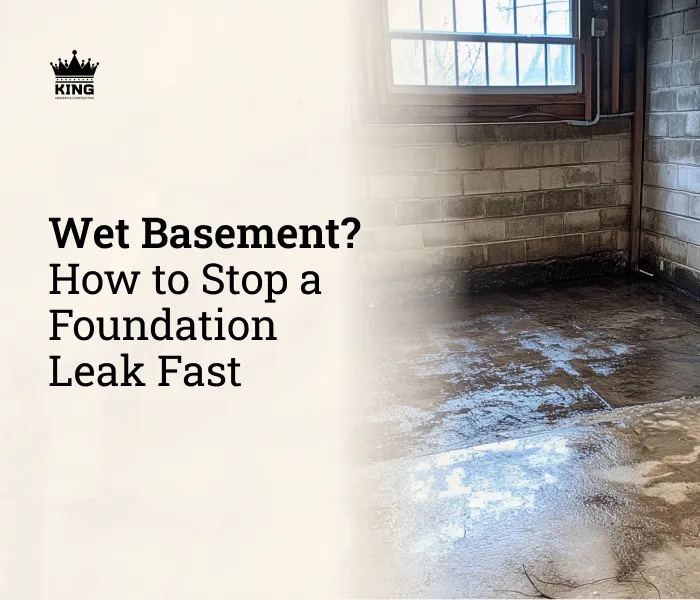
Wet Basement Right Now? How to Stop a Foundation Leak Fast
When water is actively coming into a wet basement, you don't want a lecture on soil mechanics — you want to slow the water down right now and figure out the real fix once things are dry. This guide is built for exactly that moment. First, the immediate steps to reduce the damage while water is still coming in; then, the honest part: what actually stops a foundation leak for good, and what only buys you time. Both matter, but in an emergency, order matters most.
Key Takeaways
Move the water away first. Redirecting the source outside — snow, roof runoff, pooling — slows most active leaks faster than anything you do inside.
Protect belongings and manage the water inside. Get items off the floor and use a wet-vac or pump to stay ahead of it.
Surface patches are temporary. Hydraulic cement can slow an active weep, but it's a stopgap, not a cure, when there's pressure behind it.
The permanent fix addresses pressure and paths. Interior drainage, crack injection, and drainage correction are what actually keep a basement dry.
Document everything. Photos and notes on timing help both a contractor and any insurance conversation later.
Quick Answer
To stop a foundation leak fast in a wet basement: redirect water away from the foundation outside (clear and extend downspouts, shovel snow off the wall, break up surface pooling), then manage the water inside with a wet-vac or pump and get belongings off the floor. Hydraulic cement can temporarily slow an actively weeping crack. These are stopgaps — the permanent fix is interior drainage, proper crack sealing, and drainage correction.
First: Stop Making It Worse (Outside)
The fastest way to slow an active foundation leak is almost always outside, not inside — because most leaks are driven by water collecting against the foundation. Cut off that supply and the leak eases, sometimes dramatically.
Redirect your downspouts. If a downspout is dumping roof runoff right at the foundation, extend it — even a temporary length of flexible pipe pulling water four to six feet away can noticeably reduce what's hitting the wall.
Clear snow and ice off the foundation. In winter, a snowbank piled against the wall becomes a meltwater source the moment it warms. Shovel it away from the house. Break up ice damming exterior drains so water can actually flow away instead of backing up.
Break up surface pooling. If water is standing against the wall, channel it away — a shallow trench, a redirected hose, anything that gets the standing water moving away from the foundation rather than soaking in beside it.
None of this is the permanent fix, but during an active event it's the highest-leverage thing you can do, and it requires no special tools.
Second: Manage the Water Inside
While you're cutting off the source, deal with what's already coming in.
Get belongings up and out. Anything on the floor near the leak — boxes, electronics, anything porous — needs to come up onto shelves or out of the room. This is often the difference between a scare and a real loss.
Move the water out. A wet/dry vacuum handles a slow leak; a portable utility pump or a functioning sump pump handles a faster one. The goal is simply to stay ahead of the incoming water so it doesn't spread or rise.
Find where it's entering. As you work, note exactly where the water appears — a crack, the floor-wall seam, a row of little holes, a window well. That single observation is what turns a permanent fix from guesswork into a targeted repair, so it's worth a photo even in the chaos.
Can You Patch a Leak While It's Active?
Sometimes, temporarily. Hydraulic cement is designed to set even against moisture and expands slightly as it cures, so it can be packed into an actively weeping crack or hole to slow the flow in the moment. It's genuinely useful in an emergency — but it's important to understand what it is and isn't.
It's a stopgap, not a cure. When a leak is driven by hydrostatic pressure from saturated soil — which most are — that pressure is still there after the patch, and over time it tends to push the patch off or find the next weak point. Think of hydraulic cement as a way to buy yourself a drier week or two until the real repair can happen, not as the repair itself. Relying on it long-term is one of the most common reasons a "fixed" leak comes back.
Immediate vs. Permanent: What Each Step Actually Does
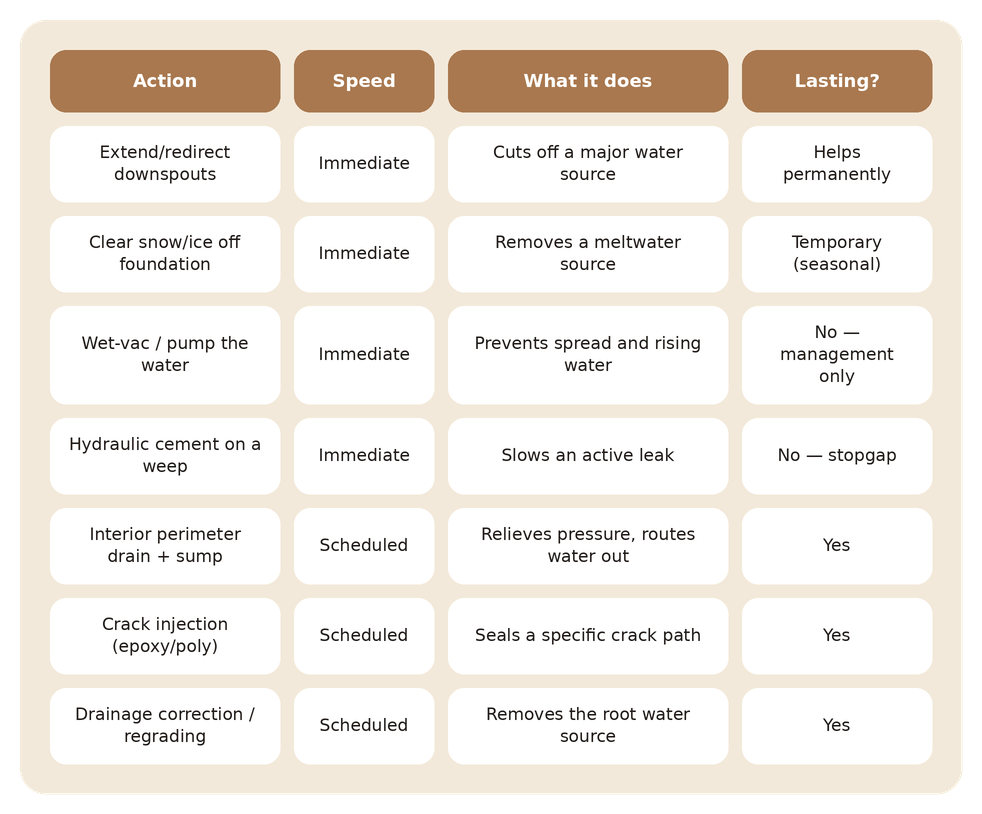
Get a Fast Read on Your Leak Below
Once the immediate scramble is under control, use the tool below to match where the water is entering to the likely permanent fix, so you know what to ask for when you call.
Then: The Fix That Actually Lasts
Once things are dry, the permanent solution depends on where the water was coming in — which is why that note you made during the emergency matters. A leaking crack is sealed with crack injection; the cove joint and under-slab pressure are handled with interior drainage and a sump; tie-rod holes are sealed through their depth. In almost every case, the durable fix also means addressing the cause — the drainage and pressure sending water at the foundation — not just the entry point. That's the whole logic of proper foundation leak repair: stop the active water now, then remove the reason it was getting in. Most of this work happens from inside and doesn't depend on the season, so there's rarely a reason to live with a recurring leak while waiting for "better weather."
Don't Skip: Document It
In the middle of a wet basement it's easy to forget, but a few photos and notes pay off later. Capture where the water is entering, how bad it is, what you did, and when it started relative to the weather. That record helps a contractor diagnose faster, and if you end up filing an insurance claim, contemporaneous documentation of a sudden event is far more useful than a description from memory weeks later. Coverage for water damage varies a lot by policy and cause, so it's worth reviewing your specific policy or asking your insurer — but either way, the documentation only helps.
What You Can Do vs. What Needs a Pro
You can handle the entire emergency response yourself: redirecting water outside, managing it inside, applying a temporary hydraulic-cement patch, and documenting everything. That's real, valuable work and it limits the damage. What needs a professional is the permanent repair — interior drainage, correct crack injection, sump installation, and drainage correction — plus any situation where the water is coming in fast, rising, or you can't locate the source. If it's an active emergency beyond what a wet-vac can keep up with, that's a call to make now, not after the water recedes.
Frequently Asked Questions
How do I stop water coming into my basement fast?
Start outside: extend or redirect downspouts away from the foundation, shovel snow off the wall, and break up any water pooling against the house — cutting off the source slows most leaks quickly. Inside, use a wet-vac or pump to stay ahead of the water and get belongings off the floor. Hydraulic cement can temporarily slow an actively weeping crack.
Will hydraulic cement permanently stop a foundation leak?
No. Hydraulic cement sets against moisture and can slow an active leak in the moment, which makes it useful in an emergency. But when the leak is driven by hydrostatic pressure, that pressure remains after the patch and tends to push it off or find a new path over time. Treat it as a stopgap until a permanent fix — drainage and proper sealing — can be done.
What should I do first when my basement is leaking?
Cut off the water source outside if you safely can — redirect downspouts, clear snow and ice off the foundation, and move standing water away from the wall — since that slows the leak fastest. Then manage the water inside with a pump or wet-vac and protect your belongings. Note exactly where the water is entering; that guides the permanent repair.
Can a foundation leak be fixed while it's still actively leaking?
The permanent repair is usually done once things are dry, but the leak can be controlled immediately. Polyurethane crack injection, for example, is designed to seal an actively wet crack, and interior drainage works regardless of conditions. So while a full fix is typically scheduled, you don't have to simply wait and watch water come in the active flow can be managed and then permanently stopped.
Why does my basement only leak during heavy rain or snow melt?
Because the water source is the weather. Heavy rain and snow melt saturate the soil around your foundation, raising hydrostatic pressure and forcing water through whatever path it can find. When the ground dries out, the pressure drops and the leak stops. A basement that only leaks during wet weather is showing a classic pressure-driven foundation leak pattern.
Water Coming In Right Now? We Can Help Stop It.
If your basement is actively leaking, don't just wait it out. King's Masonry & Construction offers free foundation leak assessments and handles active water problems across Boston, the South Shore, and the South Coast Brookline, Newton, Quincy, Plymouth, New Bedford, Dartmouth, and nearby towns. We'll control the water now and put in the fix that keeps it out for good.