
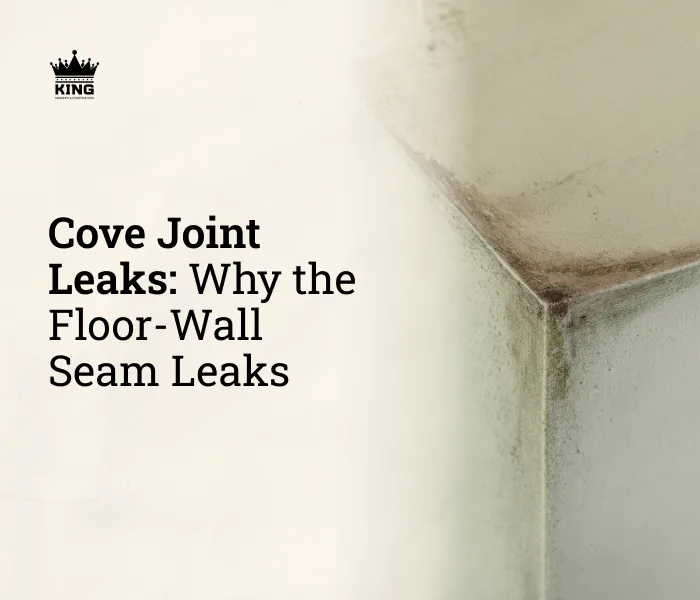
Cove Joint Leaks: Why the Floor-Wall Seam Leaks
Here's a leak that confuses homeowners more than almost any other: water appears in a line right where the basement floor meets the wall, but there's no crack, no obvious hole, nothing you can point at. You wipe it up, it comes back, and you're left wondering how water is getting in through what looks like solid concrete. The answer is the cove joint the seam between your floor slab and your foundation wall — and it's the single most common place water enters a basement. If that's what you're seeing, this guide explains exactly what's happening and what actually stops it.
Key Takeaways
The cove joint is a seam, not a crack. It's the built-in gap where the floor slab meets the wall, and it was never a watertight bond to begin with.
Water comes up under pressure. When soil around the footing saturates, hydrostatic pressure pushes water through this seam from below.
No visible crack is normal. A classic cove-joint leak has water along the floor-wall line with no crack anywhere — that's the tell, not a mystery.
Sealing the surface rarely works. Because the water is under pressure from below, a topical patch usually just gets pushed off or finds the next weak spot.
The real fix is drainage, not caulk. An interior perimeter drain relieves the pressure and routes the water to a sump — the reliable long-term solution.
Quick Answer
A cove joint leak is water entering where the basement floor slab meets the foundation wall. The floor and wall are poured separately, so the seam between them is never watertight. When soil around the footing saturates, hydrostatic pressure pushes water up through this seam — usually with no visible crack. The lasting fix is an interior perimeter drain and sump that relieve the pressure, not a surface sealant.
What the Cove Joint Actually Is
To understand the leak, you have to understand how a basement is built. The foundation walls are poured (or laid) first, sitting on the footing. Then, separately, the concrete floor slab is poured inside those walls, resting on the soil and butting up against the base of the wall. Where the slab meets the wall, there's a seam — the cove joint. It's not a defect and it's not damage; it's simply the natural gap between two pieces of concrete that were poured at different times and were never bonded into a single watertight unit.
That seam is fine as long as there's no water pressure behind it. The problem starts when there is.
Why Water Comes Through It
Under the slab and against the footing is soil, and that soil holds water. During heavy rain, snow melt, or a high water table, the soil around the base of your foundation becomes saturated. Saturated soil creates hydrostatic pressure — the weight of the water pressing in every direction, including up and inward toward the lowest, weakest opening it can find. The cove joint, being an unsealed seam right at the base of the wall, is very often that opening.
So water doesn't leak down into the cove joint from the wall above — it's pushed up and in through the seam from the saturated soil below and beside the footing. This is why cove-joint leaks are so tightly tied to weather and to the water table: no pressure, no leak; enough pressure, and the seam weeps. It's also why the water often appears along a whole stretch of the floor-wall line rather than at one single point.
Why There's No Crack to Find
This is the part that throws people. With most leaks, you look for a crack. With a cove joint leak, there usually isn't one — and that absence is actually the diagnostic clue, not a puzzle. The water is using a seam that's built into every basement, not a fracture in the concrete. If you're seeing water in a line at the base of the wall with no crack above it, you've very likely found a cove joint leak, and you can stop hunting for the crack that isn't there.
How Cove Joint Leaks Are Fixed
Here's where a lot of money gets wasted, so it's worth being clear.
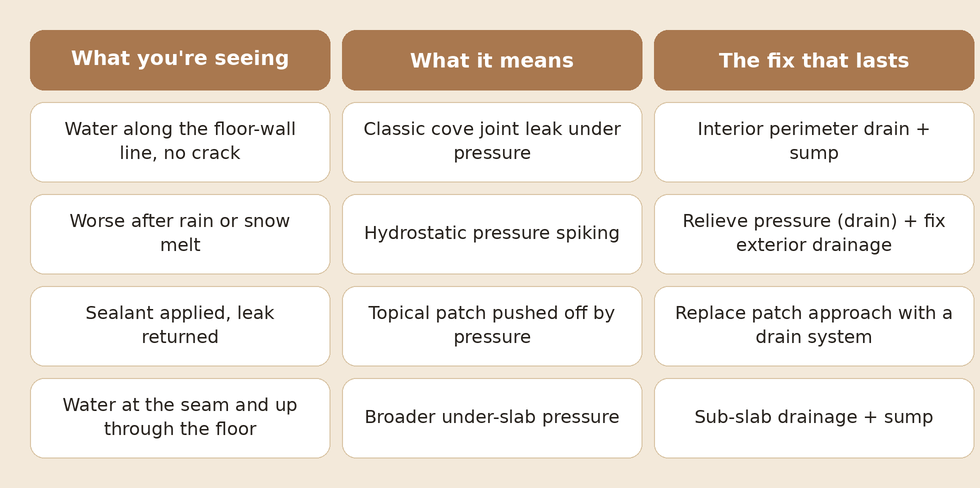
What doesn't work long-term: surface sealants, hydraulic cement smeared along the seam, or paint-on waterproofing coatings. They can slow a minor seep briefly, but because the water is under pressure from below, it simply builds up and pushes the patch off or migrates to the next weak point. Sealing the inside face of a seam that's being pressurized from the outside is fighting physics.
What does work: relieving the pressure and giving the water a controlled path out. The standard, reliable fix is an interior perimeter drain a channel installed just beneath the slab along the base of the wall that catches the water at the cove joint and routes it to a sump pit, where a pump ejects it outside. Instead of fighting the water, you collect and remove it. For a fuller picture of how these systems work, our guide to basement waterproofing covers interior drainage in depth.
On the outside, correcting drainage — regrading, extending downspouts, adding footing drains — reduces the pressure in the first place, and is often paired with the interior system for a complete fix. That exterior work is more weather- and season-dependent, but the interior drain can go in year-round.
Cove Joint Leak: Causes and Fixes at a Glance
Why Homeowners Get Talked Into the Wrong Fix
Because a cove joint leak looks so simple — just a wet seam — it's easy to assume the fix is equally simple, and there's no shortage of quick "seal the joint" products marketed for exactly this. The trap is that they address the symptom (water at the surface) instead of the cause (pressure from below), so they fail, often within a season or two, and the homeowner ends up paying twice. Understanding that a cove joint leak is a pressure problem, not a hole problem, is what keeps you from spending money on a patch that was never going to hold.
What You Can Do vs. What Needs a Pro
You can confirm the pattern yourself: check whether the water follows the floor-wall line, whether there's genuinely no crack, and whether it correlates with rain or snow melt. You can also reduce the pressure feeding it by handling the exterior water — clean gutters, extended downspouts, grading that slopes away from the house, and a working sump pump. What needs a professional is the drainage system itself: an interior perimeter drain and sump are the durable fix, and they need to be sized and installed correctly to actually keep up with the water. This isn't a caulk-gun job, and treating it like one is the most common way people end up with a recurring leak.
Frequently Asked Questions
Why is water coming up where my basement floor meets the wall?
That's the cove joint — the seam between your floor slab and foundation wall, which was never watertight. When soil around the footing saturates after rain or snow melt, hydrostatic pressure pushes water up through that seam. It typically appears as a line of water along the floor-wall junction with no visible crack, which is the classic cove joint leak signature.
Can I just seal the cove joint myself?
Surface sealants and hydraulic cement usually fail on a cove joint because the water is under pressure from below and simply pushes the patch off or finds the next weak point. Sealing the inside of a seam that's being pressurized from outside fights physics. The reliable fix is an interior perimeter drain that relieves the pressure and routes water to a sump.
Is a cove joint leak serious?
It's not usually a structural emergency, but it is a persistent water problem that won't fix itself and tends to worsen as pressure recurs each wet season. Left alone it can lead to chronic dampness, mold, ruined finishes, and a musty basement. It's very fixable — but with drainage, not a surface patch.
Why does my cove joint only leak sometimes?
Because it's driven by pressure, which is driven by weather. When the soil around your footing is dry, there's little pressure and the seam stays dry. After heavy rain, snow melt, or during a high water table, pressure spikes and the seam weeps. A leak that comes and goes with wet weather is a textbook cove joint / hydrostatic pattern.
What's the difference between a cove joint leak and a crack leak?
A crack leak comes through a visible fracture in the wall or floor and can often be sealed with injection. A cove joint leak comes through the built-in floor-wall seam with no crack present, and it's driven by pressure from below so injection isn't the answer. The fix is drainage that relieves the pressure rather than sealing a specific opening.
Water at the Base of Your Wall? Let's Fix It for Good.
A cove joint leak won't respond to a patch, but it responds very well to the right drainage. King's Masonry & Construction offers free basement leak assessments across Boston, the South Shore, and the South Coast — Brookline, Newton, Quincy, Plymouth, New Bedford, Dartmouth, and nearby towns. We'll confirm whether it's the cove joint and recommend a fix that actually holds.