
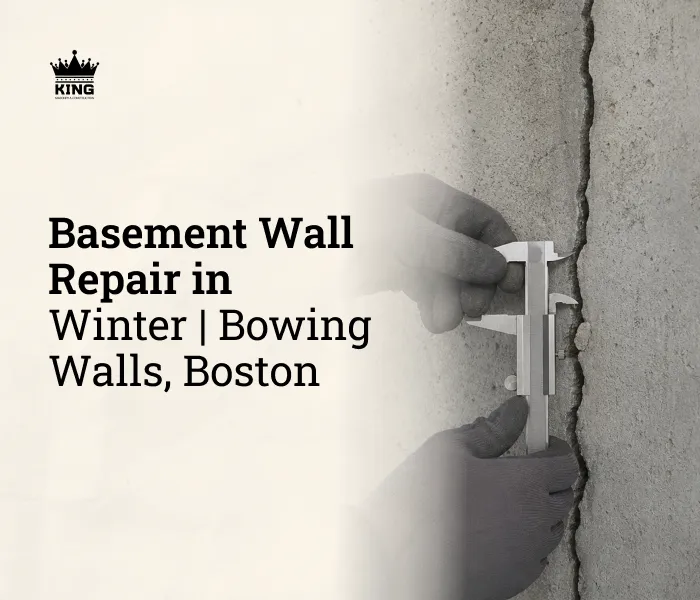
Basement Wall Repair in Winter: When Frozen Soil Starts Pushing Back
A bowing basement wall is the one problem I never tell a homeowner to "keep an eye on until spring." Walls bow because something is pushing on them, and in a Boston winter that push often gets stronger as the ground freezes — not weaker. If your wall has started to curve, lean, or crack horizontally since the cold set in, basement wall repair winter timing matters more than most people realize. Let's talk about what's happening behind that wall and how to judge how worried to be.
It's worth saying up front why this topic deserves more caution than, say, a hairline crack in a slab. A crack is a local failure — it affects a small area and, in most cases, it's a water and cosmetic issue before it's anything else. A bowing wall is different: it means an entire structural element is losing a fight against the soil around it. The wall isn't cracking because concrete shrank while curing decades ago; it's bending, in real time, under a load it wasn't built to carry indefinitely. That distinction is why we treat every report of a bowing or leaning basement wall as something to look at promptly, winter or not — and why, if you're dealing with one right now, this guide is meant to help you understand both the mechanics and the timeline you're actually working with.
Key Takeaways
Bowing means lateral pressure. The soil outside is pushing the wall inward — and frozen, saturated soil can push harder, not softer.
A horizontal crack is the warning shot. It usually appears at the wall's mid-height, where bending stress peaks, before visible bowing.
Severity is about movement, not just looks. A wall that's still moving is more urgent than one that bowed years ago and stopped.
Reinforcement is often a winter-friendly fix. Carbon-fiber straps and interior wall anchors are installed from inside — no waiting for a thaw.
This is not a DIY category. A structural wall under active soil load needs an in-person assessment, full stop.
Quick Answer
Basement walls bow in winter because saturated soil freezes and presses laterally against the wall, adding to the pressure that was already there. Warning signs are a horizontal crack near mid-height, visible inward curve, or a wall leaning at the top or bottom. Interior basement structural repair — carbon-fiber straps, wall anchors, steel I-beams — can be installed in winter. Any bowing wall should be inspected promptly, not deferred to spring.
Why Do Basement Walls Bow in Winter?
A basement wall is a retaining wall. On one side is your finished (or unfinished) space; on the other is several feet of soil that never stops leaning on it. Most of the year that load is manageable. Two winter factors tip the balance.
First, water. Fall rain and early snowmelt saturate the soil around the foundation. Saturated soil is heavier and presses harder than dry soil — that's frost pressure on basement walls in its simplest form, even before anything freezes.
Second, freezing. When that saturated soil freezes, it expands and locks against the wall, and frost heave can drive additional lateral force inward. This is frozen soil pressure basement territory: the wall that held all summer suddenly faces a bigger, stiffer push. Add the freeze-thaw cycle flexing everything back and forth, and a wall that was slowly bowing can accelerate.
The soil type matters enormously. Expansive clay and poorly draining fill — common around older Boston and South Shore properties — hold more water and exert more pressure than clean gravel. Block walls are more vulnerable than poured walls because the mortar joints give the pressure a place to hinge, which is why bowing basement walls winter problems so often show up as horizontal cracking along a mortar course.
The Structural Logic of a Bowing Wall
It helps to think of a basement wall the way an engineer would: as a vertical beam, fixed at the bottom (where it meets the footing) and fixed at the top (where it meets the sill plate or the floor framing above). Soil pressure pushes against the middle of that "beam" the same way your hand pushes against the middle of a yardstick held at both ends. Push hard enough, and the middle bows out before the ends give at all. That's exactly why the classic warning sign is a horizontal crack roughly at mid-height, not at the top or bottom corners — that's where bending stress concentrates first.
This also explains why a wall can look fine from a quick glance and still be in real trouble. A bow of an inch or two over an eight-foot wall isn't always obvious to the eye, especially in a finished basement where furring strips or paneling hide the wall surface. It's why we always recommend an actual measurement — a plumb line or a laser level from the top of the wall down to the base — rather than relying on "it doesn't look that bad."
Why the Problem Rarely Improves on Its Own
Once a wall has bowed even slightly, the geometry works against it. A wall that's already curved inward has less resistance to further bending than a perfectly straight one — the same reason a bent piece of sheet metal is easier to bend further at the same spot than to bend somewhere new. Combine that with a soil load that returns, and often intensifies, every single winter, and you get a problem that tends to progress rather than plateau, especially if nothing is done to relieve the pressure or reinforce the wall. This is different from, say, a settled crack that reached equilibrium years ago and simply hasn't moved since. A wall under ongoing lateral load is a live structural situation, not a historical scar.
How Bad Is It? Gauge the Severity Below
Not every bow is an emergency, but every bow deserves an honest measurement. The gauge below asks how far the wall is deflecting and whether it's cracked, then tells you whether it reads as "watch closely" or "reinforce now." It's triage — a structural wall always gets confirmed in person.
Bowing Signs, Causes, and Repair Methods
Here's how the severity maps to the likely cause and the fix we'd reach for.
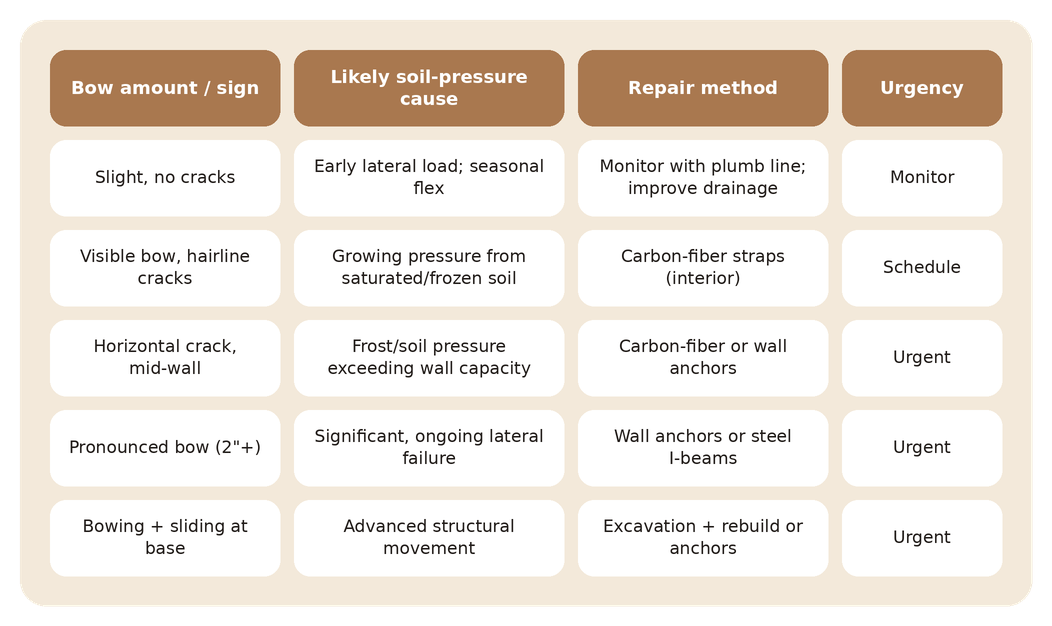
A quick note on methods. Carbon-fiber straps are ideal for walls that have bowed a limited amount and stopped or nearly stopped moving — they lock the wall in place. Wall anchors and steel I-beams handle more significant or still-moving walls, and anchors can sometimes pull a wall back over time. Which one fits is a load-and-movement judgment, not a catalog pick.
A Closer Look at Each Reinforcement Option
Carbon-fiber straps are thin, extremely strong composite strips epoxied vertically along the interior face of the wall, usually spaced every few feet across the bowed area. They work in tension — resisting further inward movement — and because they're bonded directly to the existing concrete or block, installation doesn't require digging outside or removing anything from the yard. They're best suited to walls with limited bow (generally under a couple of inches) that have stabilized or are moving slowly, since straps hold a wall where it is rather than pulling it back to plumb.
Steel I-beams are installed vertically against the interior wall face, anchored top and bottom, and act like a stiff spine that resists bending. They can be tightened over time in some cases to gradually straighten a wall, which makes them a common choice when a wall has bowed enough that "hold it where it is" isn't good enough and some correction is wanted.
Wall anchors take a different approach entirely: a plate on the interior wall face connects via a rod, running out through the wall, to an anchor plate buried in stable soil several feet out in the yard. As the exterior anchor is tightened, it can apply outward-pulling force that counteracts the soil's inward push — sometimes gradually straightening the wall over months. Anchors need enough yard space to place the exterior plate and typically some excavation for that outer anchor, which is the one part of this process most likely to be affected by how frozen the ground is.
Excavation and rebuild is reserved for the most severe cases — walls that have moved so far, or failed so completely, that reinforcement alone can't restore a safe structure. This is a full exterior dig, and unlike interior straps or anchors, it's genuinely weather-dependent.
Basement Wall Reinforcement in Cold Weather: What Can Actually Be Done
Good news for winter: most reinforcement is interior work. Basement wall reinforcement cold weather projects — carbon-fiber, anchors, I-beams — are installed from inside your basement and aren't blocked by frozen ground. That means the urgent part of winter basement structural damage almost never has to wait for spring. What may wait is exterior work: excavating to relieve soil pressure or waterproof the outside face is tougher with frozen ground, so we often reinforce now and schedule any exterior phase for a thaw. The stabilization happens immediately either way.
This two-phase approach — stabilize now, address the exterior cause later — is worth understanding because it's usually the most responsible path forward rather than a compromise. Waiting until spring to do "the real fix all at once" sounds tidy, but it means several more months of freeze-thaw cycling and soil pressure acting on a wall that's already struggling. Reinforcing in winter and finishing drainage or excavation work when the ground cooperates gets the urgent risk handled immediately without making the homeowner choose between "wait for the ideal season" and "do nothing."
Signs You Might Be Missing
Not every warning sign is as obvious as a visible curve in the wall. A few things worth checking, especially in a finished basement where the wall itself may be partly hidden:
Doors or windows near the basement level sticking or misaligning. As a wall bows, it can subtly shift the framing around nearby openings.
Gaps opening up between the wall and the floor slab, sometimes with a bit of white efflorescence residue where water has been seeping through.
A stair-step crack pattern in a block wall rather than one clean line — this is often the first visible sign of bowing before the bow itself is obvious.
New dampness or a musty smell that tracks with the seasons, appearing worse after a thaw — pressure-driven bowing frequently opens small paths for water even before a wall visibly curves.
If any of these show up alongside a wall that "seems fine" to a casual glance, it's worth doing the plumb-line measurement described below rather than assuming everything's okay.
What You Can Check vs. What Needs a Pro
You can hang a plumb line from the top of the wall and measure the gap at the base to quantify the bow, re-measure through the winter to see if it's moving, and reduce the load by fixing drainage — extend downspouts, regrade, keep the sump pump running. What you can't do at the hardware store is stabilize a structural wall. There's no DIY strap or bracket that safely resists real soil pressure, and a wall that's actively moving is a genuine safety issue. That line is bright: measuring is yours, reinforcing is ours.
To measure it yourself: tie a string with a small weight to a nail or screw near the top of the wall, let it hang freely to the floor, and measure the horizontal gap between the string and the wall at a few points down its height — top, middle, and bottom. Write down the numbers and the date. Repeat monthly. A growing gap at the mid-height point, more than at top or bottom, is the classic bowing signature and is exactly the kind of change that should move you from "monitor" to "call someone."
Frequently Asked Questions
Why do basement walls bow in winter?
Saturated soil around the foundation freezes and expands, pressing laterally against the wall and adding to the load it already carries. Frost heave can increase that inward push. Block walls are especially prone because pressure hinges along mortar joints, which is why bowing often shows as a horizontal crack near mid-height.
Can basement walls be reinforced in winter?
Yes. Carbon-fiber straps, wall anchors, and steel I-beams are all installed from inside the basement, so cold weather and frozen ground don't stop them. In Boston and the South Shore we do basement wall repair in winter regularly. Only exterior excavation-based work typically waits for a thaw.
Is a horizontal crack in my basement wall serious?
Usually yes. A horizontal crack, especially near the wall's mid-height, is a classic sign of lateral soil or frost pressure bending the wall inward. It often precedes visible bowing. Treat it as structural and get it evaluated promptly rather than waiting to see if it worsens over the winter.
How much does a bowing wall move before it's dangerous?
There's no single universal number, and it depends on wall type and whether it's still moving. As a rule, a pronounced bow (on the order of two inches) or a wall that's measurably moving each freeze is urgent. The safest approach is to measure with a plumb line and have any active movement assessed in person.
Will fixing my drainage stop a wall from bowing?
Better drainage reduces the water load that drives frost pressure, so it's an important part of prevention and of not making things worse. But once a wall is already bowing, drainage alone won't straighten or stabilize it — you need structural reinforcement plus the drainage correction to address both the symptom and the cause.
How much does basement wall reinforcement typically cost?
It depends heavily on the method and the extent of the bow carbon-fiber straps are generally the least expensive option since they don't require excavation, while wall anchors and steel I-beams cost more due to additional materials and, for anchors, some yard excavation. Severe cases needing a full exterior rebuild are the most involved and costly. Getting an in-person assessment is really the only way to get an accurate number, since the right method (and therefore the price) depends on how far the wall has moved and whether it's still moving.
Can a bowed basement wall be straightened back to plumb, or only stabilized?
It depends on severity and method. Carbon-fiber straps mainly stop further movement rather than pulling the wall back. Wall anchors, and to some degree steel I-beams, can gradually apply corrective force and pull a wall closer to plumb over time in many cases, though a wall that's bowed significantly may not return fully to its original position. An assessment will tell you which outcome is realistic for your specific wall.
Seeing a Bow or a Horizontal Crack? Don't Wait for Spring.
A bowing basement wall is the one call worth making today. King's Masonry & Construction provides free structural assessments across Boston, the South Shore, and the South Coast — Brookline, Newton, Quincy, Plymouth, New Bedford, and the surrounding towns. We'll measure it honestly and tell you whether it's monitor-and-drain or reinforce-now.