
Basement Foundation Repair in Boston: A Homeowner's Complete Guide | Kings Masonry
Your basement foundation is what everything above it depends on. When it starts showing signs of stress cracks in the walls, doors that stick, water seeping in after rain those aren't cosmetic issues. They're structural warnings.
This guide covers everything Boston homeowners need to know about basement foundation repair: what causes problems, how to identify them early, and what each repair method actually involves.
What Causes Basement Foundation Problems?
Most basement foundation issues in the Boston area come down to one of four root causes:
Hydrostatic pressure water-saturated soil pushes against the foundation walls from the outside. New England's freeze-thaw cycles amplify this dramatically, as water expands when it freezes and contracts when it thaws
Soil settlement the ground beneath or around the foundation shifts over time, causing uneven pressure and movement
Poor drainage water that doesn't drain away from the home accumulates against the foundation and eventually finds its way in
Age and material fatigue older Boston homes with stone or brick foundations experience natural deterioration of mortar joints and structural integrity over decades
Understanding the cause matters because it determines the right repair method. Treating the symptom without addressing the root cause leads to recurring problems.
Warning Signs Your Basement Foundation Needs Repair
Catching foundation problems early significantly reduces the scope of repair required. Here's what to watch for:
Cracks in the Foundation Walls
Not all cracks are equal. Here's how to read them:
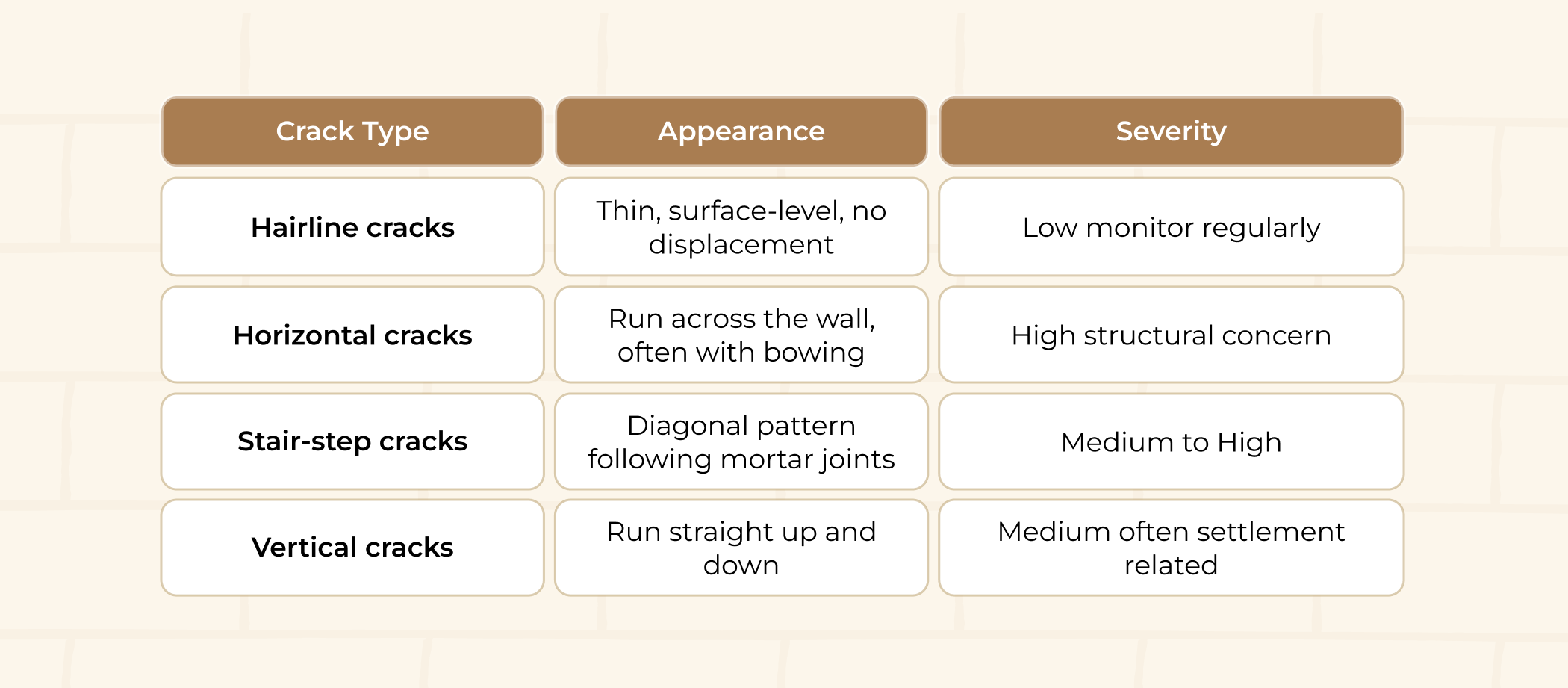
Horizontal cracks are the most serious. They indicate lateral soil pressure pushing the wall inward and require immediate professional assessment.
Bowing or Leaning Walls
A wall that curves inward even slightly is under active pressure. This is not a cosmetic issue and will worsen over time without intervention. For a detailed breakdown of this specific problem, read our Bowing Basement Wall Repair Guide.
Water Intrusion and Dampness
Water stains, efflorescence (white salt deposits on the wall surface), or standing water after rain all indicate that the foundation is allowing moisture in. Left unaddressed, persistent moisture leads to mold, structural degradation, and deteriorating interior air quality.
Sticking Doors and Windows
When the foundation shifts or settles unevenly, it distorts the frame of the house. Doors and windows that suddenly stick, don't close properly, or show visible gaps around the frame are often early indicators of foundation movement.
Uneven or Sloping Floors
Floors that feel noticeably uneven or slope toward one side of the room can indicate settlement beneath the foundation. This is especially common in older Boston homes with rubble stone foundations.
Basement Foundation Repair Methods
The right repair method depends on the type of problem, its severity, and the foundation material. Here's what each approach involves:
Carbon Fiber Straps
Best for: Bowing or bulging walls in early to moderate stages
Carbon fiber straps are anchored vertically to the floor and ceiling joists to stabilize a wall that's moving inward. They prevent further movement without requiring excavation. This is one of the least invasive and most reliable solutions for early-stage wall displacement.
Wall Anchors
Best for: Moderate to severe bowing walls with adequate yard access
Steel anchors are driven into stable soil beyond the zone of pressure and connected to the interior wall with a steel plate and rod. Over time, the anchors can be tightened to gradually straighten the wall. This method requires yard access but is highly effective for more advanced movement.
Helical Piers and Push Piers
Best for: Foundation settlement, sinking footings
Steel piers are driven or screwed deep into the ground until they reach stable load-bearing soil or bedrock. They transfer the weight of the structure away from the compromised soil and can in some cases lift a settled section back toward its original position.
Crack Injection
Best for: Non-structural vertical and diagonal cracks allowing water intrusion
Epoxy or polyurethane foam is injected directly into the crack under pressure. Epoxy creates a rigid bond and restores structural continuity. Polyurethane expands to fill voids and stops water intrusion but does not add structural strength. The right material depends on whether the crack is active or stable.
Parging and Masonry Repair
Best for: Surface deterioration, spalling, eroded mortar joints on older stone or brick foundations
Parging applies a fresh layer of mortar or cementitious coating to the exterior or interior face of the foundation wall. Combined with repointing deteriorated mortar joints, this approach restores surface integrity and provides a baseline of water resistance.
Exterior Waterproofing and Drainage
Best for: Persistent water intrusion with inadequate exterior drainage
Full exterior waterproofing involves excavating around the perimeter of the foundation, applying a waterproof membrane to the exterior wall surface, and installing drainage board and a French drain system to redirect groundwater away from the structure. This is the most comprehensive solution for chronic water problems. For more on drainage solutions, see our Drainage and Waterproofing Services.
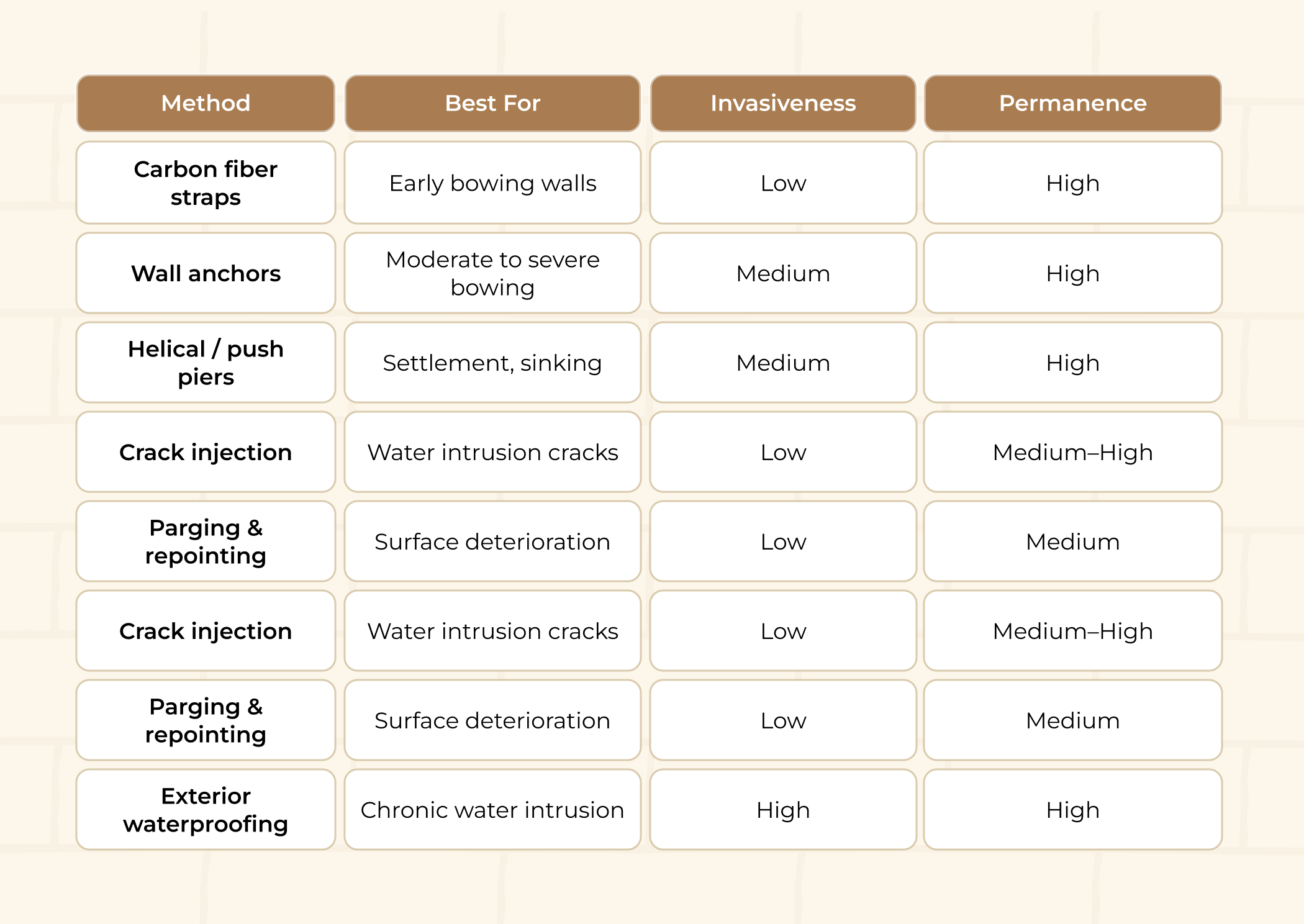
Basement Foundation Repair Methods at a Glance
Boston-Specific Considerations
Foundation repair in Boston presents challenges that don't apply everywhere:
Freeze-thaw cycles Massachusetts experiences significant temperature swings that accelerate crack propagation and hydrostatic pressure. Problems that are minor in autumn can become serious by spring
Older housing stock many Boston-area homes have rubble stone, brick, or early poured concrete foundations that require specialist knowledge and materials
High water table in certain neighborhoods areas near the Charles River, Back Bay, and other low-lying zones face persistent groundwater pressure that requires active drainage solutions
Limited yard access urban and dense suburban properties may restrict excavation-based methods, making interior solutions the more practical approach
When to Call a Professional
Some early-stage foundation maintenance monitoring hairline cracks, improving gutter drainage, sealing minor surface deterioration is within homeowner range. Everything else warrants professional assessment.
Call a foundation repair specialist if:
You notice horizontal cracks in any foundation wall
A wall appears to be bowing, even slightly
Water is entering the basement repeatedly after rain
Floors feel uneven or doors and windows have started sticking recently
You can see visible gaps between the foundation and the sill plate above it
Cracks have grown or changed since you last checked them
Foundation problems don't stabilize on their own. The structural forces causing them continue to act on the building until the source of pressure is addressed.
For a complete picture of what basement waterproofing involves alongside foundation repair, read our Basement Waterproofing Boston Guide.
Kings Masonry & Construction provides expert foundation and basement repair across Boston, Hingham, Newton, and surrounding Massachusetts communities. Our team assesses the full picture structure, drainage, and waterproofing and gives you a clear, honest path forward.
Call us: (857) 249-5127
Frequently Asked Questions
How do I know if my foundation crack is structural or cosmetic?
Horizontal cracks are almost always structural. Hairline vertical cracks that haven't changed in size are usually low concern. Any crack that is wider than 1/4 inch, shows displacement on one side, or has grown since you first noticed it should be evaluated by a professional.
Can basement foundation problems be fixed from the inside?
Many repairs carbon fiber straps, crack injection, interior drainage systems are completed entirely from inside the basement without excavation. Whether an interior solution is sufficient depends on the type and severity of the problem. Chronic exterior water pressure often requires exterior work to fully resolve.
How long does basement foundation repair take?
Simpler repairs like crack injection or carbon fiber strap installation are typically completed in a single day. More extensive work involving wall anchors, pier systems, or exterior excavation and waterproofing may take two to five days depending on the scope.
Does foundation repair affect my home's resale value?
Unaddressed foundation problems significantly reduce resale value and can make a property difficult to finance or insure. Professional repairs with proper documentation especially those backed by a transferable warranty typically preserve or restore value and give buyers confidence in the property's structural integrity.
Do you offer basement foundation repair in Boston?
Yes. Kings Masonry & Construction provides basement foundation assessment and repair across Boston and the surrounding region. Call (857) 249-5127 to schedule an on-site evaluation.
Don't Let Foundation Problems Go Further
Every season that passes without addressing a foundation issue allows the underlying forces to do more damage. The earlier a problem is caught, the simpler and less disruptive the repair.