
Why Is My Foundation Leaking? Top Causes Ranked
You went down to the basement and found water, a damp patch on the floor, a wet streak down the wall, or a puddle that wasn't there yesterday. The first question everyone asks is the same: why is my foundation leaking? The honest answer is that a foundation almost never leaks for a mysterious reason. It leaks because water found a path, and there are only a handful of paths it tends to use. Once you know which one you're dealing with, the fix stops being a guessing game.
This guide ranks the causes we actually see most often across Boston and the South Shore, from the everyday to the rare, and tells you how to tell them apart. The goal isn't to alarm you; most foundation leaks are fixable, and many are preventable; it's to help you point at the real culprit instead of chasing the wrong fix.
Key Takeaways
Water enters through a path, not through solid concrete. Almost every leak traces to a crack, a joint, a penetration, or pressure forcing water through a weak spot.
Drainage is the number-one root cause. Gutters, grading, and downspouts that send water toward the foundation are behind a huge share of leaks.
The location of the water tells you the cause. A wet floor-wall seam, a leaking crack, and a damp wall face each point somewhere different.
Hydrostatic pressure is the invisible driver. When soil around the foundation is saturated, water is actively pushed inward it doesn't just seep.
Most causes are fixable from inside. Crack injection and interior drainage handle the majority; only some need exterior excavation.
Quick Answer
In almost every case, your foundation is leaking because water is collecting in the soil against it and finding the easiest way in usually a crack, the seam where the floor meets the wall, a spot where a pipe or old form tie passes through, or straight through the concrete when the pressure outside gets high enough. Nine times out of ten, the real culprit behind all of that is drainage: gutters, grading, or downspouts quietly steering water toward the house instead of away from it. Figure out where the water shows up and you've usually found your answer and most of these leaks can be sealed from the inside with foundation leak repair.
The Causes, Ranked From Most to Least Common
Here's the order we actually encounter these in the field, roughly most to least common.
1. Poor drainage saturating the soil
This is the root cause behind more leaks than everything else combined. Gutters that overflow or dump at the base of the wall, downspouts that end right at the foundation, and yards graded to slope toward the house all pile water into the soil against your foundation. That saturated soil is what feeds every other leak path on this list. Fix the water management and you often fix the leak — or at least stop it from getting worse.
2. Hydrostatic pressure
When the soil around and under your foundation is saturated, the weight of that water creates pressure — hydrostatic pressure — that actively pushes moisture through any available opening, and even through porous concrete itself. This is why a basement can be bone dry for months and then leak heavily after a wet stretch or a snow melt: the water table rose, the pressure climbed, and the water was forced in.
3. Foundation cracks
A crack is a ready-made channel. Even a hairline shrinkage crack that's harmless structurally becomes a water path once there's pressure behind it, and freeze-thaw cycles widen it over time. Cracks are one of the most common visible leak points, which is why they get blamed first though the drainage and pressure above are usually what's driving water to the crack in the first place. Sealing the crack with foundation crack repair addresses the path; correcting drainage addresses the cause.
4. The cove joint (floor-wall seam)
The cove joint is the seam where the basement floor slab meets the foundation wall. It's not sealed the way a wall is, so when water pools at the footing under pressure, this seam is frequently the first place it appears — often with no visible crack anywhere. Water at the base of the wall, right where it meets the floor, is the classic cove-joint signature.
5. Pipe penetrations and tie-rod holes
Anywhere something passes through the foundation — a water line, a sewer pipe, or the small tie-rod holes left behind when a poured wall was formed — is a potential entry point once the surrounding seal degrades. These are more localized and less common, but they produce stubborn, pinpoint leaks that can be hard to trace without knowing to look for them.
6. Window wells
For basements with below-grade windows, the window well can collect snow, rain, and debris. If its drain is clogged or missing, water rises in the well and comes in around the window frame. It's lower on the list only because not every basement has them — but where they exist, they're a frequent offender.
Where the Water Shows Up — and What It Points To
Because each cause tends to announce itself in a specific place, location is your fastest diagnostic clue.
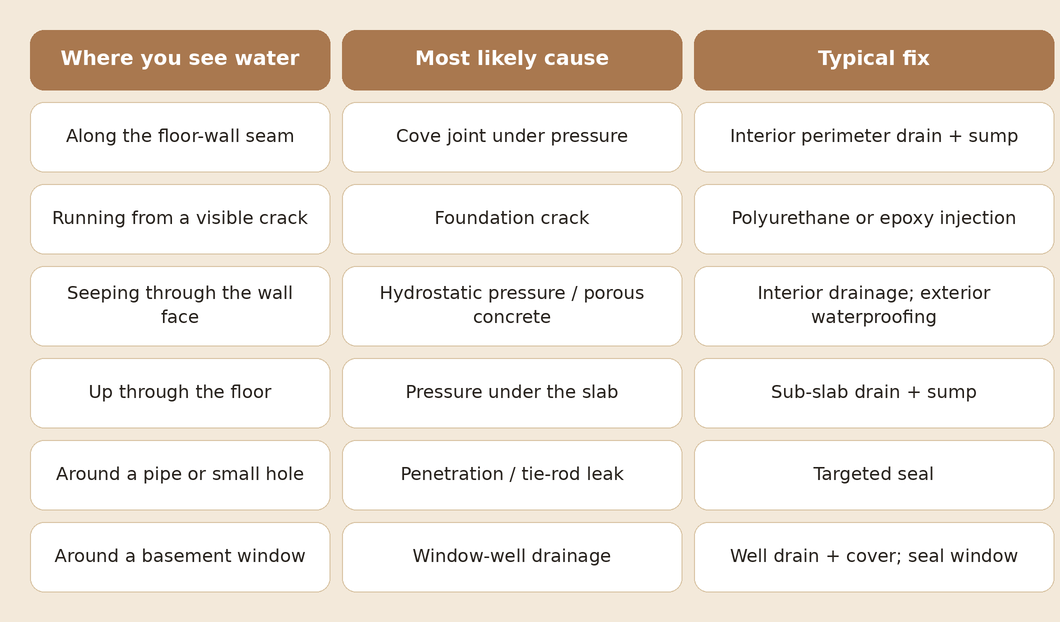
Diagnose Your Likely Cause Below
Since the cause is usually written in where and when the water appears, a couple of quick questions can narrow it down fast. Use the tool below to match your situation to the most probable culprit before you call anyone.
Why "It's Just an Old House" Isn't the Answer
Plenty of homeowners assume a leaking basement is simply the price of an older Boston home, and that there's nothing to be done. That's not true. Age can mean more cracks and older, less-sealed penetrations, but the water still comes from the same manageable sources — drainage, pressure, and specific entry paths — all of which can be addressed. An old foundation doesn't have to be a wet one. What's usually happening is that decades of gradual drainage neglect finally caught up, and correcting it brings the basement back to dry.
What You Can Check vs. What Needs a Pro
You can do real diagnostic work: note exactly where and when the water appears, photograph it, check that your gutters are clear and downspouts extend several feet from the house, look at whether your yard slopes toward or away from the foundation, and confirm the sump pump runs. That information alone often points straight at the cause. What needs a professional is the actual repair — correct crack injection, interior drainage design, sump sizing, or exterior waterproofing — and any case where you genuinely can't locate the source, since a misdiagnosed leak means money spent on the wrong fix.
Frequently Asked Questions
Why is my foundation leaking all of a sudden? A sudden leak usually means the water source or pressure changed, not the foundation. A heavy rain, a rapid snow melt, or a rising water table can spike hydrostatic pressure and force water through a path that stayed dry all year. The opening was likely there already; the water finally had enough pressure behind it to use it.
What is the most common cause of a foundation leak? Poor drainage. Gutters, downspouts, and grading that direct water toward the foundation saturate the surrounding soil, which then feeds every other leak path — cracks, the cove joint, and pressure through the wall. It's also the most fixable root cause, which is why we always look at water management first.
Can a foundation leak fix itself? No. A leak means water has found a path, and that path only widens over time as freeze-thaw and pressure work on it. A leak that seems to "stop" has usually just lost its water source temporarily — a dry spell or a refreeze — and will return when conditions repeat. Leaks need to be addressed, not waited out.
Is a leaking foundation serious? It depends on the cause. Many leaks are water-and-moisture problems that are unpleasant but not structural, and they're straightforward to fix. But persistent water can damage finishes, invite mold, and if it's tied to a horizontal crack or a bowing wall signal a structural issue. Identifying the cause is what tells you which situation you're in.
Does homeowners insurance cover a leaking foundation? Often not. Standard policies frequently exclude damage from gradual seepage, poor maintenance, or groundwater, while sometimes covering sudden, accidental water events. Coverage varies significantly by policy and carrier, so it's worth reading your specific language or asking your insurer directly — this isn't something we can advise on as contractors.
Found Water in Your Basement? Let's Find the Cause.
Guessing at a leak wastes money on the wrong fix. King's Masonry & Construction offers free foundation leak diagnostics across Boston, the South Shore, and the South Coast Brookline, Newton, Quincy, Plymouth, New Bedford, Dartmouth, and the surrounding towns. We'll trace the water to its actual source and tell you exactly what it takes to stop it.