
Mortar Repair Guide: DIY Tips & Repair Mortar Types
Mortar Repair 101: DIY Tips, When to Call a Pro, and the Best Products to Use
A section of mortar between your bricks has turned soft and sandy. You press your thumb against it and a chunk falls out. The gap behind it is deep enough to fit a pencil. That is mortar failure and every rainstorm pushes more water into that opening, accelerating the damage.
Mortar repair is one of the most common maintenance tasks for brick homes and one of the most frequently botched. The wrong mix, poor surface prep, or bad timing can leave you with joints that crack within a single season. This guide covers the full mortar repair process: when you can handle it yourself, which products work, and when to call a licensed mason.
Can I Do Mortar Repair Myself?
Yes, if the damage is limited in scope and easy to reach. Small mortar joint repair projects are well within the range of a capable homeowner. But the margin for error is narrower than most people expect.
Leave it to a pro if you see:
Any mortar damage above the first story.
Structural cracks or stair-step patterns, horizontal cracks, or any crack wider than 1/4 inch.
Historic homes where the original mortar is lime-based.
The most common DIY mistake is skipping surface preparation. You cannot pack new mortar over old, crumbling material. For a deeper dive into common errors, check our guide on common repointing brickwork mistakes.
DIY-appropriate mortar repair:
Repointing a small area (under 10 square feet) at ground level
Filling shallow mortar joints that have eroded less than 3/4 inch deep
Patching isolated spots where mortar has cracked or fallen out
Cosmetic touch-ups on garden walls, planters, or non-structural masonry
Leave it to a pro:
Any mortar damage above the first story (working on ladders with mortar is dangerous and produces poor results)
Widespread deterioration across an entire wall or chimney
Joints that have eroded deeper than 1 inch
Structural cracks stair-step patterns, horizontal cracks, or any crack wider than 1/4 inch
Historic homes where the original mortar is lime-based (Portland cement repairs can damage old brick)
The tools you need for a basic DIY mortar repair job run about $40 to $75: a cold chisel or grout saw, a pointing trowel, a jointing tool, a stiff brush, and a spray bottle. Premixed repair mortar costs $8 to $15 per tube or $10 to $20 per bag. A small repointing project on a garden wall might take a Saturday afternoon and cost under $50 in materials.
The most common DIY mistake is skipping surface preparation. You cannot pack new mortar over old, crumbling material and expect it to hold. The damaged mortar must be removed to a minimum depth of 3/4 inch, and the joint must be cleaned and dampened before you apply anything new.
What Is the Strongest Repair Mortar?
The strongest repair mortar depends on where you are using it. Strength is not always the right priority flexibility and compatibility often matter more.
Here is a comparison of mortar types ranked by compressive strength:
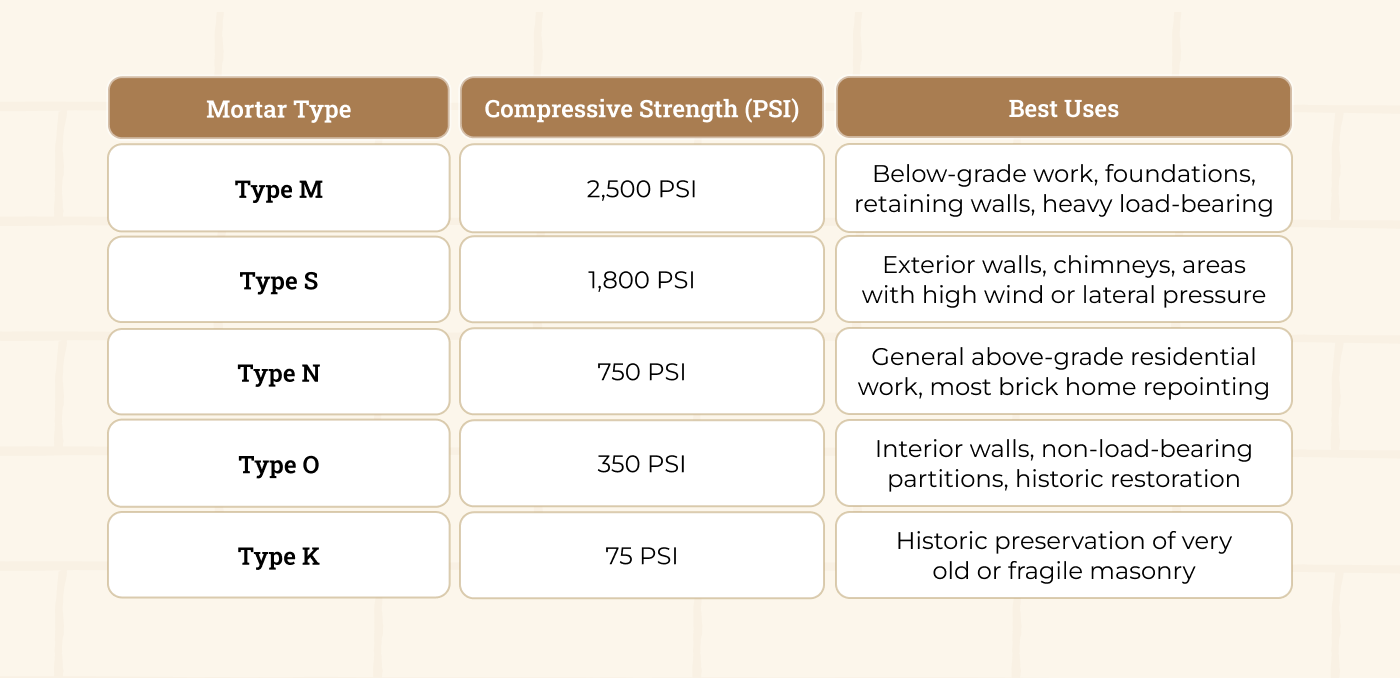
Type M is the strongest repair mortar by raw compressive strength at 2,500 PSI. It is the right choice for foundation walls, retaining walls, and any masonry in contact with soil or groundwater. If you need maximum strength below grade, Type M is the answer.
But here is where homeowners get into trouble: using the strongest mortar on everything. Type M is rigid. On an above-grade brick wall, that rigidity transfers stress into the brick when the wall expands and contracts with temperature changes. The result is cracked and spalling brick a repair that costs far more than repointing.
For most residential brick walls, Type N (750 PSI) is the correct choice. It offers enough strength for above-grade work while remaining flexible enough to accommodate seasonal movement. For chimneys and walls exposed to high winds or significant lateral loads, step up to Type S (1,800 PSI).
For pre-mixed repair products, Quikrete Mortar Repair and Sakrete Mortar Mix are widely available at hardware stores and suitable for small DIY jobs. For larger repointing projects, mixing your own mortar from Portland cement, hydrated lime, and sand gives you more control over color, consistency, and strength.
What Type of Mortar Is Used for Brick Repair?
The mortar you choose for brick repair must match two things: the structural requirements of the wall and the composition of the existing mortar. Getting either wrong leads to premature failure or brick damage. To ensure your home receives the correct material match and expert application, it is best to rely on professional masonry services in Boston, MA, where specialists can analyze your specific brick type and structural needs.
For most brick homes built after 1930: Type N mortar is the standard a blend of Portland cement, hydrated lime, and sand at roughly 1:1:6. It offers good strength (750 PSI), flexibility, and workability for above-grade residential repointing.
For chimneys and exposed walls: Type S mortar provides higher bond strength (1,800 PSI) and better resistance to lateral forces. Boston chimneys take a beating from wind, rain, and freeze-thaw cycles. Type S handles that exposure better than Type N.
For historic brick homes built before 1900: This is where the choice gets critical. Older homes were built with soft, lime-based mortar. Using hard Portland cement mortar on these walls is a common and expensive mistake the cement is harder than the old brick, so stress cracks the brick instead of the mortar. Replacing damaged bricks runs $20 to $50 each, installed.
Historic brick repair requires a lime-based mortar (often Type O or Type K) or a custom lime-sand mix matching the original composition. A qualified mason will analyze the existing mortar and mix a compatible batch. This is not a DIY project.
Color matching matters too. Fresh mortar in the wrong shade stands out immediately. Most repair mortars dry lighter than they appear wet. Dye additives can adjust the color, but getting a close match takes practice. Ask your mason for a small sample area before committing to a full wall.
Mortar vs. Mortar Repair: What Is the Difference?
This is one of the most common questions homeowners search for, and the confusion is understandable. The terms sound interchangeable, but they refer to different products with different formulations.
Traditional mortar is the material used to lay bricks and blocks during original construction. It is mixed on-site from Portland cement (or lime), sand, and water. It requires 24 to 48 hours to reach working strength and up to 28 days for full cure. It is designed to be applied in thick layers between courses of brick or block as a wall goes up.
Mortar repair products (also called repair mortar or repointing mortar) are pre-formulated compounds designed specifically for fixing existing joints. They differ from traditional mortar in several ways:
Polymer additives. Most repair mortars contain acrylic or latex polymers that improve adhesion to old, cured surfaces something traditional mortar struggles with.
Faster set times. Many repair products reach initial set in 1 to 2 hours versus 24+ hours for traditional mortar.
Packaging. Repair mortars come in squeeze tubes, caulk-style cartridges, or small bags. Traditional mortar comes in 60- to 80-pound bags for large-scale work.
Modified flexibility. Repair mortars are slightly more flexible, allowing them to handle minor movement in existing walls.
When to use which: For a few cracked joints on a garden wall, a tube of premixed mortar repair is convenient and effective. For 50 square feet of repointing, mixing traditional mortar gives you better control over color, strength, and consistency and costs less per volume.
The bottom line: mortar repair products are a subset of mortar, formulated for maintenance and small fixes. Traditional mortar remains the right choice for large repointing projects.
How to Get Mortar to Stick to Old Concrete
Getting new mortar to bond reliably to old concrete or masonry is the number one challenge in repair work. Old concrete is dry, often contaminated with dust or sealers, and resists adhesion. Without proper preparation, your repair will pop off within months.
Follow these steps:
1. Remove all loose material. Use a cold chisel, angle grinder, or grout saw to cut out crumbling mortar to a depth of at least 3/4 inch. If patching concrete, chip away everything flaking or powdery until you reach solid material. Non-negotiable.
2. Clean the surface. Brush out all dust and debris with a stiff bristle brush. For concrete, use a pressure washer or strong hose spray. Any remaining dust creates a barrier that prevents bonding.
3. Dampen but do not soak. This is the step most people get wrong. Bone-dry masonry pulls water out of fresh mortar before it can cure, weakening the bond. But standing water dilutes the mortar at the contact surface. The goal is "saturated surface dry" damp throughout with no visible water. Mist with a spray bottle 15 to 30 minutes before applying mortar.
4. Apply a bonding agent. For concrete-to-concrete or mortar-to-concrete repairs, a liquid bonding agent (like Quikrete Concrete Bonding Adhesive) dramatically improves adhesion. Brush it on and apply your mortar while the agent is still tacky. This single step can be the difference between a repair that lasts a decade and one that fails in a year.
5. Pack mortar in layers. Do not fill a deep joint in one pass. Apply mortar in layers of about 3/8 inch, letting each layer firm up before adding the next. This prevents slumping and ensures solid contact throughout the joint.
6. Cure properly. Keep the repair damp for 24 to 48 hours. In hot or windy weather, cover it with damp burlap or plastic sheeting. Mortar that dries too fast does not reach full strength.
One more tip: temperature matters. Do not attempt mortar repair below 40 degrees F or above 90 degrees F. Cold slows the curing reaction. Extreme heat causes rapid moisture loss. In Boston, the best months for mortar work are April through October.
When DIY Isn't Enough: Hire a Boston Masonry Contractor
Some mortar repair jobs are straightforward. Others look simple but hide structural problems, compatibility issues, or access challenges that turn a weekend project into a costly mistake.
Call a professional mason when you see any of these:
Widespread mortar failure. If more than 20% of the joints on a wall are deteriorated, you need full-scale repointing not spot repairs. A mason ensures consistent mortar matching across the entire surface.
Chimney damage. Chimney mortar takes the worst punishment of any masonry on your home exposed on all four sides to wind, rain, ice, and temperature swings. Chimney repointing requires working at height with proper staging and Type S mortar to handle the exposure.
Structural cracking. Stair-step cracks, horizontal cracks, or any crack growing over time indicates movement in the wall or foundation. Filling these with mortar is cosmetic only the underlying cause needs diagnosis.
Historic brick homes. Homes built before 1920 require lime-based mortar that matches the original composition. Using the wrong mortar causes irreversible brick damage. A restoration mason will analyze the existing mortar and custom-mix a compatible blend.
Water infiltration. If water enters your home through masonry walls, mortar repair alone may not solve it. Flashing, drainage, and waterproofing may need to be addressed alongside the masonry work.
Kings Masonry & Construction provides homeowners across the Greater Boston area with expert mortar repair, precision repointing, and comprehensive masonry restoration. Whether you require a professional chimney repointing, a historic brick wall restoration, or a detailed structural assessment of failing joints, our experienced team manages every aspect of the project from initial diagnosis through to completion.
We specialize in all mortar types, including custom lime-based mixtures specifically designed for historic homes. Our experts ensure a seamless match with your existing mortar color and joint profiles, allowing repairs to blend perfectly with your original masonry. To ensure your home is protected before the next season, we invite you to get your free consultation or call us to schedule an on-site evaluation. We are committed to providing an honest assessment, identifying exactly what your masonry requires to remain structurally sound for years to come.
Frequently Asked Questions (FAQ) - Mortar Repair & Repointing
1. What is the difference between repointing and tuckpointing?
While often used interchangeably, they are different. Repointing is the process of removing damaged mortar and replacing it with new mortar to restore the wall's integrity. Tuckpointing is a cosmetic technique where two different colors of mortar (one matching the brick, one a contrasting "fillet" line) are used to create the illusion of perfectly thin joints.
2. How long does mortar repair last?
When done correctly with the right mortar type (like Type N or S) and proper surface preparation, professional repointing can last 30 to 50 years. DIY patches with hardware-store tubes typically last 3 to 5 years because they don't address the depth of the joint.
3. Can I use a pressure washer to clean out old mortar?
It is not recommended. Pressure washers can easily damage the edges of the bricks, especially older "soft" bricks common in Boston. The safest way to remove old mortar is manually with a hammer and cold chisel or with a specialized low-speed grout saw.
4. Why is my new mortar cracking shortly after application?
The most common reasons are:
Rapid drying: If the wall wasn't dampened or was exposed to direct hot sun, the water evaporated before the mortar could bond.
Wrong mix: Using a mortar that is too "strong" (like Type M) for a soft brick wall.
Poor prep: Applying new mortar over dust or loose, old material.
5. How do I match the color of my existing mortar?
Mortar color changes as it cures. To get a match, you must mix a small batch, apply it to a test area, and let it dry for at least 7 days. Professionals often use specific sand colors or iron oxide pigments to match the weathered look of historic Boston masonry.