
Masonry Chimney Repair in Boston: Warning Signs, Costs, and What to Expect
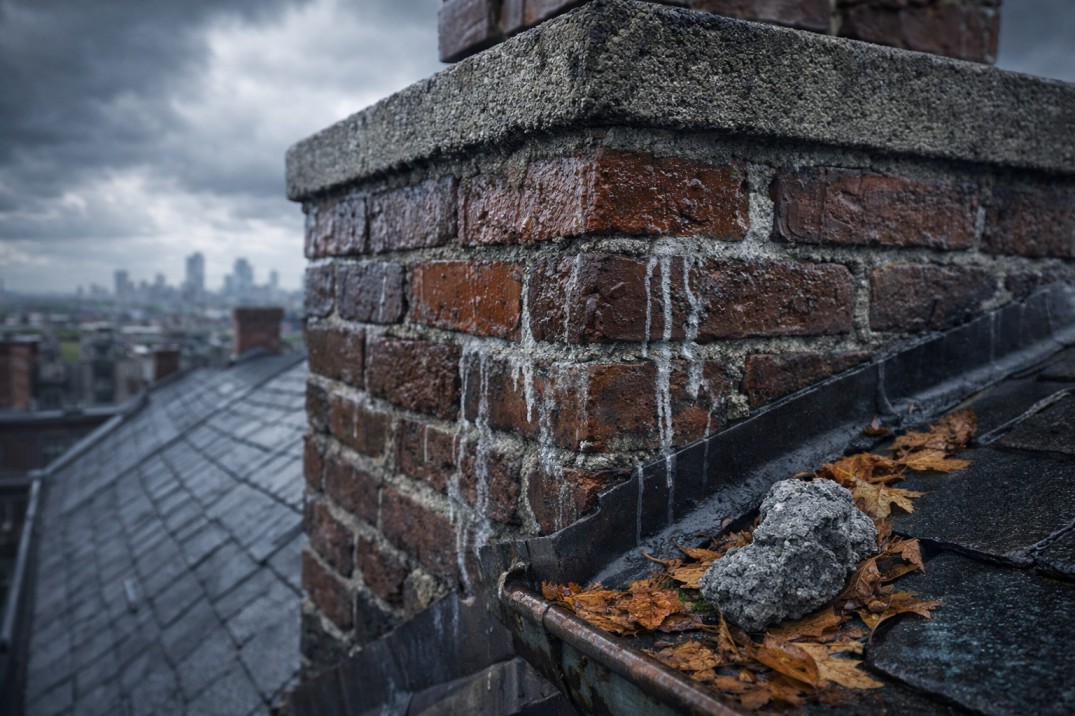
A chunk of mortar falls from your chimney and lands in the gutter. A few bricks near the crown look darker than the rest after it rains. You notice white streaks running down the chimney stack. These are not cosmetic problems. They are signs that your chimney masonry is failing and in Boston, the damage accelerates fast. Many homeowners first notice these issues after seeing cosmetic brick damage structural risk warning signs on the exterior masonry.
Masonry chimney repair is one of the most common calls we handle at Kings Masonry & Construction. Homeowners often wait too long because the chimney sits out of sight on the roof. By the time they notice a problem from ground level, the damage has usually been progressing for years.
This guide walks you through the warning signs of chimney deterioration, what repair work actually involves, and how much you should expect to pay in the Boston area.
Why Chimney Masonry Deteriorates in Boston's Climate
Boston averages 25 freeze-thaw cycles per winter. That single fact explains why chimneys here fail faster than almost anywhere else in the country.
Here is what happens. Water enters tiny pores in the mortar joints and brick faces. When the temperature drops below 32 degrees which happens roughly 100 nights per year in Greater Boston that water freezes and expands by about 9%. The expansion forces mortar and brick apart at a microscopic level. When temperatures rise, the ice melts and the water seeps deeper into the newly opened gaps. The next freeze pushes the damage further.
This cycle repeats dozens of times every winter. Over five to ten years, it turns solid mortar joints into crumbling sand.
Chimneys take the worst of it. Unlike walls protected by eaves and siding, chimneys stand fully exposed on all four sides. They catch wind-driven rain, absorb direct sunlight that accelerates thermal cycling, and sit at the highest point of your home where temperatures swing the widest.
Several factors specific to Boston make chimney masonry repair especially common:
Nor'easters drive rain horizontally into mortar joints that would stay dry in calmer climates.
Salt air from the harbor accelerates chemical deterioration of mortar, particularly in East Boston, South Boston, and waterfront neighborhoods.
Age of housing stock. Over 60% of homes in Boston were built before 1960. Many chimneys are original construction with lime-based mortar that has exceeded its expected lifespan.
Acidic flue gases. If your chimney vents a gas furnace, water heater, or oil boiler, combustion byproducts create acidic condensation inside the flue. That acid attacks mortar from the inside out while weather attacks from the outside.
The bottom line: if your chimney has not been inspected in three or more years, it almost certainly needs some level of masonry repair.
Warning Signs Your Chimney Needs Masonry Repair
Some chimney problems are obvious from the ground. Others require binoculars or a professional inspection. Here are the signs organized from easiest to spot to those that require closer examination. Many early chimney problems start as cracks in brick or mortar which allow water to penetrate the masonry.
Visible from the ground:
Crumbling or missing mortar joints. If you can see gaps between bricks from your yard, the deterioration is already significant. Mortar joints in good condition look uniform and flush with the brick face.
White staining (efflorescence). Those chalky white streaks running down your chimney mean water is migrating through the masonry and depositing mineral salts on the surface. The staining itself is harmless, but the water movement behind it is not.
Leaning or tilting chimney. Even a slight lean indicates structural failure. This is urgent. A leaning chimney can collapse. In some homes, structural movement creates stair step cracks foundation trouble patterns that appear along chimney masonry.
Brick fragments on the roof or in gutters. Spalling brick sheds pieces as water damage breaks apart the outer face.
Visible on closer inspection:
Damaged chimney crown. The concrete cap on top of your chimney should slope away from the flue liner to shed water. Cracks in the crown let water pour directly into the chimney structure. Most crown damage is invisible from ground level.
Missing or damaged chimney cap. The metal cap over the flue opening keeps rain, snow, and animals out. A rusted or missing cap allows direct water entry into the flue.
Deteriorated flashing. The metal seal where the chimney meets the roof is a common leak point. Failed flashing allows water to run down the chimney and into your home.
Interior signs. Water stains on the ceiling or walls near the chimney, a musty smell from the fireplace, or damp spots in the attic near the chimney base all indicate masonry failure you cannot see from outside.
The rule of thumb: if your chimney was built more than 30 years ago and has never been repointed, it needs masonry repair. If it was repainted more than 15 years ago, it likely needs attention again.
Chimney Repair Services: What's Involved?
Chimney masonry repair is not a single service. It is a category that includes several distinct procedures, each matched to a specific type of damage.

Chimney repointing (tuckpointing). This is the most common chimney repair. A mason grinds out deteriorated mortar joints to a depth of 3/4 inch to 1 inch, then fills them with fresh mortar matched to the original color and composition. For older Boston homes, this often means using a lime-based mortar rather than modern Portland cement. Using the wrong mortar type on pre-1920 brick can cause the bricks themselves to crack, since Portland cement is harder than the soft historic brick.
Repointing a typical residential chimney takes one to two days and dramatically extends the chimney's lifespan.
Chimney crown repair or replacement. The crown is the concrete or morite slab that caps the top of the chimney around the flue liner. Crowns crack from freeze-thaw cycling and thermal expansion. Small cracks can be sealed with a flexible crown coating. Crowns with major cracking or missing sections need to be demolished and recast.
A proper chimney crown should overhang the chimney walls by at least 2 inches on all sides, with a drip edge underneath to direct water away from the brick.
Chimney cap installation or replacement. A stainless steel or copper chimney cap costs $150 to $500 installed and prevents the single largest source of water entry: rain and snow falling directly into the open flue. If your chimney does not have a cap, installing one is the highest-return repair you can make.
Partial chimney rebuild. When the top several courses of brick have deteriorated beyond repair, a mason will dismantle the damaged section course by course and rebuild it with matching brick and mortar. Most partial rebuilds involve the top 2 to 4 feet of the chimney, which takes the most weather abuse.
Full chimney rebuild. In severe cases particularly chimneys that have been neglected for decades or have structural failure the entire chimney above the roofline (and sometimes below) must be dismantled and reconstructed. This is a major project requiring scaffolding, new flashing, and often a new flue liner.
How Much Does Chimney Masonry Repair Cost?
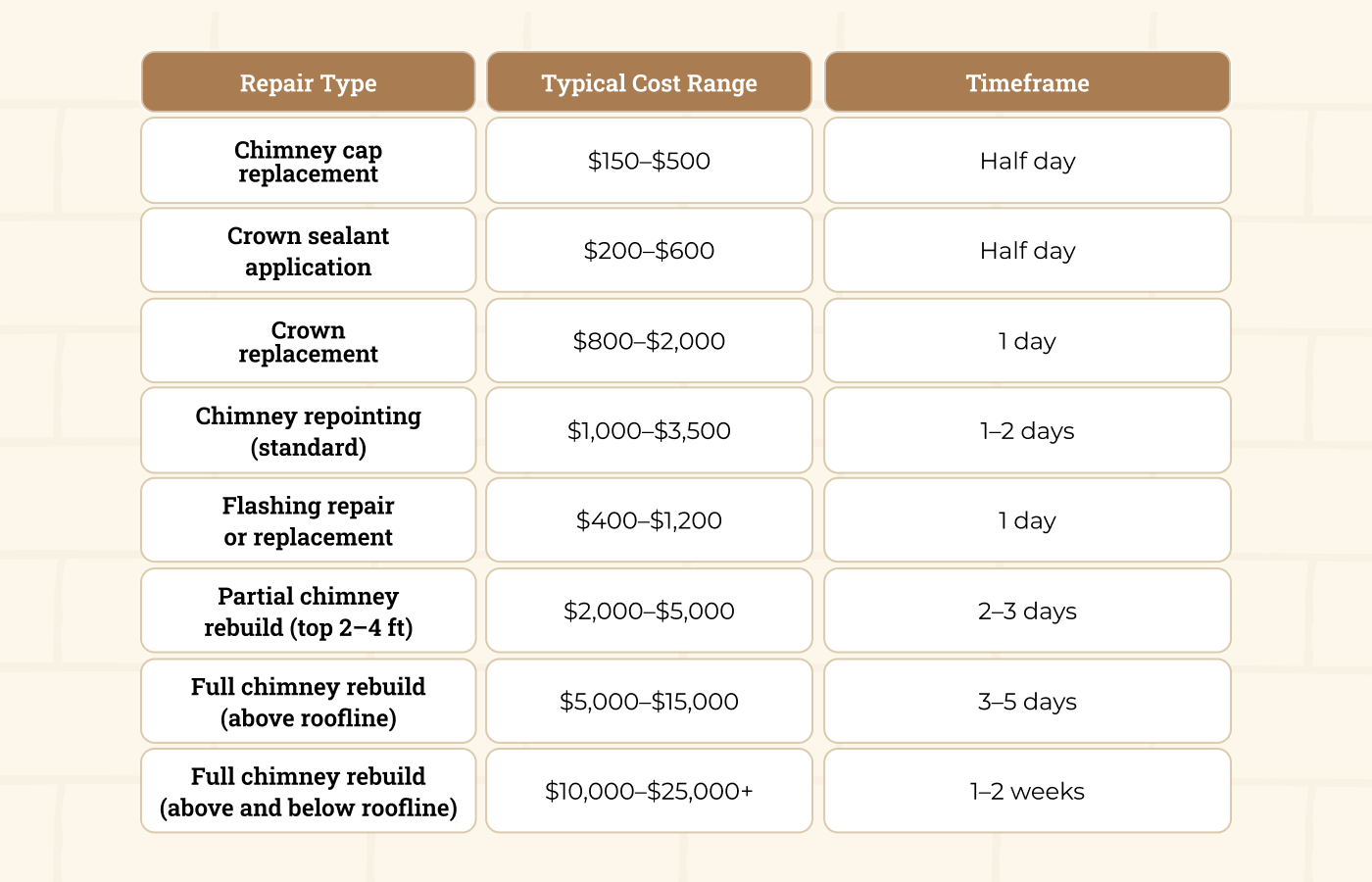
Cost is the first question homeowners ask, and the answer depends entirely on the type and extent of damage. Here are the typical price ranges for chimney masonry repair in the Greater Boston area as of 2026:
What drives costs higher in Boston:
Access difficulty. Steep roofs, three-story homes, and tight lot lines in neighborhoods like Beacon Hill, the North End, and Charlestown often require scaffolding or a boom lift, adding $500 to $2,000 to the project.
Historic matching. Homes in historic districts may require custom-matched brick and lime mortar, which cost two to three times more than standard materials.
Flue liner work. If the interior flue liner has failed, relining adds $1,500 to $5,000 depending on the method (stainless steel insert versus cast-in-place).
Permit and inspection fees. Boston building permits for chimney work typically run $100 to $300.
How to save money without cutting corners:
Catch it early. Repointing a chimney costs $1,000 to $3,500. Rebuilding one because you waited too long costs $5,000 to $15,000. Annual inspections pay for themselves.
Bundle work. If your chimney needs repointing, have the crown repaired and a new cap installed at the same time. The mason is already on the roof with materials staged the marginal cost of adding smaller repairs is much lower than scheduling them separately.
Schedule in the off-season. Late fall and early spring are slower periods for masonry contractors in Boston. You may find better availability and occasionally lower pricing between November and March, weather permitting.
Schedule a Chimney & Masonry Repair Consultation with Kings Masonry
Every chimney repair starts with a thorough inspection. At Kings Masonry & Construction, we inspect the full chimney system crown, cap, mortar joints, flashing, and flue before recommending any work. We photograph every deficiency so you can see exactly what we see.
We have been repairing and rebuilding chimneys across Greater Boston for years. Our crews specialize in matching historic mortar and sourcing period-appropriate brick for older homes. We carry full liability and workers' compensation insurance, pull all required permits, and guarantee our chimney masonry repair work.
Here is what to expect when you call us:
Phone consultation. We will ask about the age of your chimney, what symptoms you have noticed, and your address so we can view the chimney on satellite imagery before arriving.
On-site inspection. A mason will inspect the chimney from the roof, photograph all damage, and assess the chimney structure and flue condition.
Written estimate. You will receive a detailed scope of work with line-item pricing, not a lump-sum guess. We explain what needs to be done now versus what can wait.
Scheduled repair. We work around your schedule and Boston's weather. Most chimney repairs are completed in one to three days.
Don’t wait for a minor crack to become a costly structural failure. Whether you need historic repointing orprofessional chimney repair in Boston, acting early saves you thousands.
Book your free inspection online with Kings Masonry & Construction today.
Frequently Asked Questions (FAQ)
1. How often should I have my chimney masonry inspected in Boston?
Due to Boston’s harsh winters and frequent freeze-thaw cycles, you should have your chimney professionally inspected at least every 3 years. If you notice falling mortar, dark patches on bricks, or moisture inside your home, an immediate inspection is necessary.
2. What is the difference between repointing and rebuilding?
Repointing (or tuckpointing) is a maintenance procedure where damaged mortar is scraped out and replaced with fresh mortar to seal the joints. A rebuild is required when the bricks themselves are cracked, leaning, or structurally unstable, requiring the masonry to be dismantled and replaced entirely.
3. Are those white streaks (efflorescence) on my chimney dangerous?
The white powder itself is just salt mineral deposits and isn't harmful. However, it is a "warning light" that water is traveling through your masonry. If left unaddressed, that water will freeze and expand, eventually causing the bricks to "spall" or flake off.
4. Do I need a building permit for chimney repair in Boston?
Minor repairs like repointing or installing a cap typically do not require a permit. However, if you are performing a partial or full rebuild (structural work), the City of Boston generally requires a permit. Kings Masonry & Construction handles the permitting process for all our structural projects.
5. Can masonry repair be done in the winter?
Yes, but it requires specific "cold-weather masonry" techniques. We use heated water and sand, and sometimes thermal blankets, to ensure the mortar cures correctly if temperatures are near freezing. However, the most cost-effective time for repair is typically late spring through autumn.