
Tie-Rod Hole Leaks: Foundation Seepage Explained
If you've got a poured concrete foundation and you're seeing water or dampness coming from small, evenly spaced round holes in the wall — often in neat rows — you're not imagining a pattern. Those are tie-rod holes, and they're a surprisingly common and often-overlooked source of foundation seepage. They're easy to miss because they're small, and easy to misdiagnose because they don't look like a crack. This guide explains what they are, why they leak, and how they're properly sealed.
Key Takeaways
Tie-rod holes are leftover from construction. They mark where the metal rods that held the wall forms together passed through the poured concrete.
They're a known weak point. Each hole is a small void through the full thickness of the wall — a ready-made path for water under pressure.
The pattern is the giveaway. Small round holes in straight, evenly spaced rows point to tie rods, not random damage.
A quick surface plug isn't enough. To stop seepage for good, the hole needs to be sealed through its depth, not just capped on the inside.
It's a targeted, usually affordable fix. Compared with structural repairs, sealing tie-rod holes is one of the more contained jobs.
Quick Answer
Tie-rod holes are the small round holes left in a poured concrete foundation where the form ties — the rods that held the wall forms in place during the pour — passed through the wall. Each is a void through the full wall thickness, so under hydrostatic pressure they become a direct path for foundation seepage. The fix is sealing each hole through its depth (typically with hydraulic cement or polyurethane), not just a surface cap.
What Tie-Rod Holes Actually Are
When a poured concrete foundation wall is built, the wet concrete is poured between two parallel forms. To keep those forms from bowing apart under the weight of the concrete, they're held together by metal rods — called form ties or snap ties — that run straight through the space where the wall will be. Once the concrete cures and the forms come off, those rods are broken or cut off, leaving a series of small holes running clean through the wall at regular intervals, usually in tidy horizontal rows.
In a properly finished foundation, those holes get sealed during construction. But seals degrade, get missed, or were never done well in the first place — and decades later, that row of little holes becomes a row of little leaks.
Why They Leak
Each tie-rod hole is a void that passes through the entire thickness of the wall — from the soil side to your basement. That makes it fundamentally different from a surface blemish: there's a continuous path from the wet soil outside to the dry air inside. As long as the soil is dry, nothing happens. But when the soil around the foundation saturates after rain, snow melt, or a rising water table, hydrostatic pressure pushes water straight through that path. Because the holes sit low on the wall and pass all the way through, they're an efficient little conduit — which is why foundation seepage from tie-rod holes tracks so closely with wet weather.
The seepage is often slow — a damp ring, a bit of staining, a slow weep rather than a gush — which is part of why it gets ignored. But slow water is still water, and over time it brings the same efflorescence, dampness, and mold risk as any other leak.
How to Recognize a Tie-Rod Leak vs. Something Else
The pattern is your best clue. Here's how tie-rod seepage compares with the other things it gets confused for.
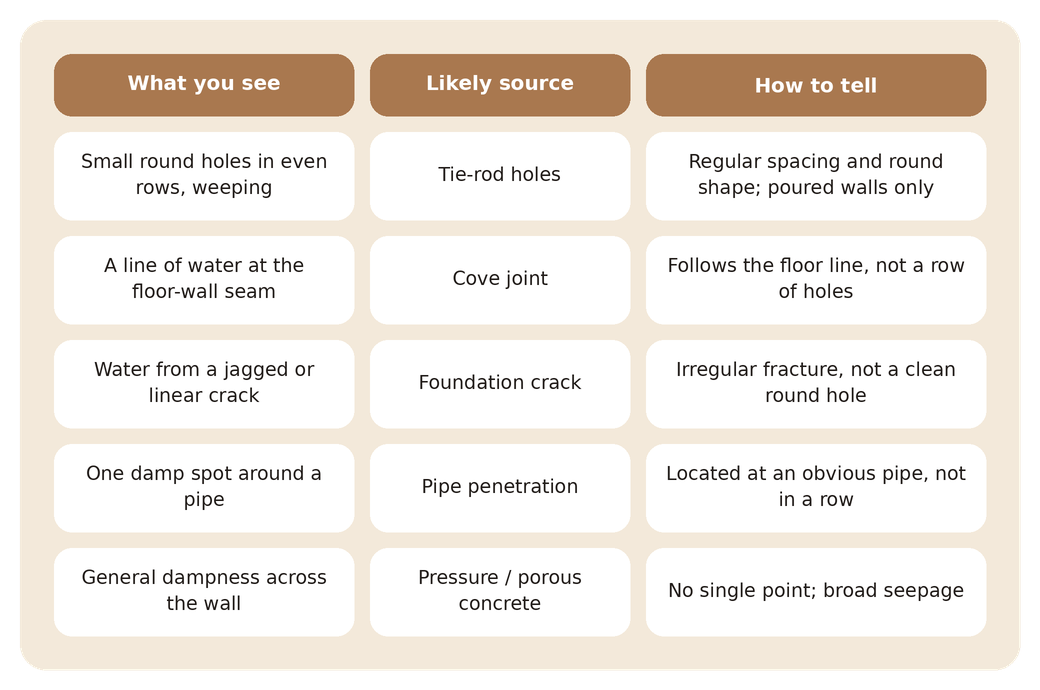
If it's poured concrete and the water comes from small round holes in a straight, repeating line, tie rods are the answer.
How Tie-Rod Holes Are Properly Sealed
This is where the difference between a real fix and a temporary one shows up. Because the leak path runs through the full depth of the wall, capping the inside opening alone often just relocates the problem — water builds up in the hole and finds the edge of the patch. A durable repair fills the hole through its depth so there's no continuous channel left for water to use.
In practice, that usually means cleaning and reaming out the old, failed material, then packing the hole with a non-shrink hydraulic cement designed to set even against moisture, or injecting polyurethane that expands to fill the full void and chases out the water as it cures. Hydraulic cement is common for a dry or lightly damp hole; polyurethane is favored when the hole is actively weeping, since it tolerates and seals against moisture. For a broader poured-wall water problem — many holes plus cracks plus pressure — tie-rod sealing is often done as part of a larger foundation leak repair plan rather than one hole at a time.
If the underlying driver is hydrostatic pressure — which it usually is — sealing the holes addresses the paths, and correcting drainage or adding interior drainage addresses the cause, so the holes aren't simply pressurized into failing again.
Why This One Gets Overlooked
Tie-rod leaks fly under the radar for a simple reason: they're small and unglamorous. A homeowner scanning for "the leak" is looking for a dramatic crack or a puddle, not a faint damp ring around a hole the size of a pencil. So the seepage gets wiped away, blamed on humidity, or missed entirely until efflorescence builds up or a musty smell sets in. The upside is that once you do recognize the pattern, it's one of the more contained and affordable leaks to fix — there's no structural work involved, just proper sealing of known, findable points.
What You Can Do vs. What Needs a Pro
You can identify the pattern, count and locate the leaking holes, note whether they weep with wet weather, and reduce the pressure feeding them by handling exterior water — gutters, downspouts, and grading. For a single dry hole, a homeowner-grade hydraulic cement patch can sometimes hold. Where a professional matters is an actively weeping hole, multiple holes, or seepage that keeps returning after patching — those need the hole sealed correctly through its depth and, usually, the underlying pressure addressed so the fix lasts. If the seepage is widespread or paired with other symptoms, it's worth a full look rather than a hole-by-hole patch.
Frequently Asked Questions
Why is water coming through small holes in my concrete foundation?
Those are almost certainly tie-rod holes voids left where the metal rods that held the wall forms passed through the concrete during construction. Each runs through the full thickness of the wall, so when soil outside saturates, hydrostatic pressure pushes water through them. Small round holes in even rows on a poured wall are the classic tie-rod signature.
Can I just plug a tie-rod hole with cement?
For a dry or lightly damp hole, a non-shrink hydraulic cement plug packed through the hole's depth can work. The mistake to avoid is a thin surface cap, which the pressure often pushes off. An actively weeping hole is usually better sealed with expanding polyurethane, which cures against moisture and if several holes leak, it's worth doing them correctly all at once.
Are tie-rod hole leaks serious?
They're rarely structural, but they're a genuine water-intrusion problem that won't resolve on its own. Left alone, the slow seepage brings efflorescence, dampness, mold risk, and that persistent musty basement smell. The good news is they're one of the more contained leaks to fix, since the entry points are known, findable, and don't involve any structural repair.
Do only poured concrete foundations have tie-rod holes?
Essentially yes. Tie rods are used to hold the forms for poured concrete walls, so tie-rod holes are specific to poured foundations. Block and stone foundations are built differently and don't have them. So if you have a block or fieldstone wall, small round holes in rows aren't your issue but a poured wall showing that pattern very likely is.
Why do my tie-rod holes only leak sometimes?
Because the leak is driven by pressure, which is driven by weather. When the soil around your foundation is dry, there's no pressure pushing water through the holes and they stay dry. After rain, snow melt, or during a high water table, the pressure rises and the holes weep. Seepage that comes and goes with wet weather is a textbook pressure-driven pattern.
Seeing Damp Spots or Little Holes in a Poured Wall? Let's Seal Them Right.
Tie-rod seepage is easy to overlook and easy to fix once it's spotted. King's Masonry & Construction offers free foundation leak assessments across Boston, the South Shore, and the South Coast Brookline, Newton, Quincy, Plymouth, New Bedford, Dartmouth, and nearby towns. We'll confirm the source and seal it properly so it stops for good.