
When Cosmetic Brick Damage Becomes a Structural Risk: 7 Warning Signs You Shouldn't Ignore
Most homeowners look at a crack in their brick wall and think, "It's just cosmetic - I'll deal with it later." Sometimes that's true. But sometimes, that hairline crack is the first sign of a much bigger problem quietly developing behind your walls.
Understanding when cosmetic brick damage crosses into structural risk can save you thousands of dollars - and keep your home safe. Here's what you need to know.
What's the Difference Between Cosmetic and Structural Brick Damage?
Before you can identify the warning signs, you need to understand what separates cosmetic damage from a structural problem - because the two can look surprisingly similar in their early stages.
Cosmetic brick damage is surface-level. Think hairline cracks less than 1/8 inch wide, minor mortar crumbling, small chips on individual bricks, or light staining on the face of a wall. These issues don't affect your home's stability or load-bearing capacity. In most cases, they can be addressed with routine masonry repair and repointing before they develop into something more serious.
Structural brick damage, on the other hand, means the integrity of your wall — or the foundation it sits on - is compromised. The bricks or mortar are no longer doing their job of bearing load and resisting movement. Left untreated, structural damage can lead to bowing walls, water intrusion into your home's interior, foundation shifting, and extremely costly emergency repairs down the line.
The critical thing to understand is this: cosmetic damage doesn't stay cosmetic forever. What begins as a minor surface crack can evolve into a structural risk over months or years, especially in climates like New England's, where freeze-thaw cycles are aggressive and moisture is constant.
How Cosmetic Damage Silently Becomes a Structural Risk
This is the part most homeowners never see coming - because it happens slowly, underneath the surface.
It starts simply enough. A small crack forms in the mortar joint, maybe from normal seasonal settling, a dry summer causing soil shrinkage, or minor thermal expansion. The crack is thin - barely noticeable. You make a mental note to deal with it someday.
Then water enters.
In the Boston area and across Greater Boston's South Shore communities, winters are unforgiving. That water freezes inside the crack, expands, and forces the crack slightly wider. It thaws. More water gets in. It freezes again. This freeze-thaw cycle repeats dozens of times each winter, each cycle pushing the crack a little further and weakening the surrounding mortar.
By spring, the crack is noticeably wider. The mortar joint around it has softened. Water is now finding its way deeper into the wall. If the wall is a veneer over a wood frame, that moisture is now sitting against wood — where rot and mold can begin.
By the following winter, what started as a hairline surface crack has become a pathway for significant water infiltration. The structural integrity of the wall is now genuinely at risk.
This progression is why early detection - and prompt professional assessment - is so important. The earlier you catch brick damage, the simpler and less expensive the fix. Kings Masonry's foundation and basement services and drainage and waterproofing solutions are designed specifically to stop this progression before it becomes a crisis.
7 Warning Signs Your Brick Damage Is No Longer Just Cosmetic

1. Cracks Wider Than 1/4 Inch
Width is one of the most reliable indicators of severity. Hairline cracks — those thinner than 1/8 inch - are generally harmless and considered cosmetic. But once a crack reaches 1/4 inch or wider, it's a sign that real movement has occurred in the structure, not just surface weathering.
Get a ruler. Measure the widest point of any crack you're concerned about. If it's approaching or exceeding 1/4 inch, schedule a professional inspection. Don't wait for it to keep growing.
2. Stair-Step Crack Patterns
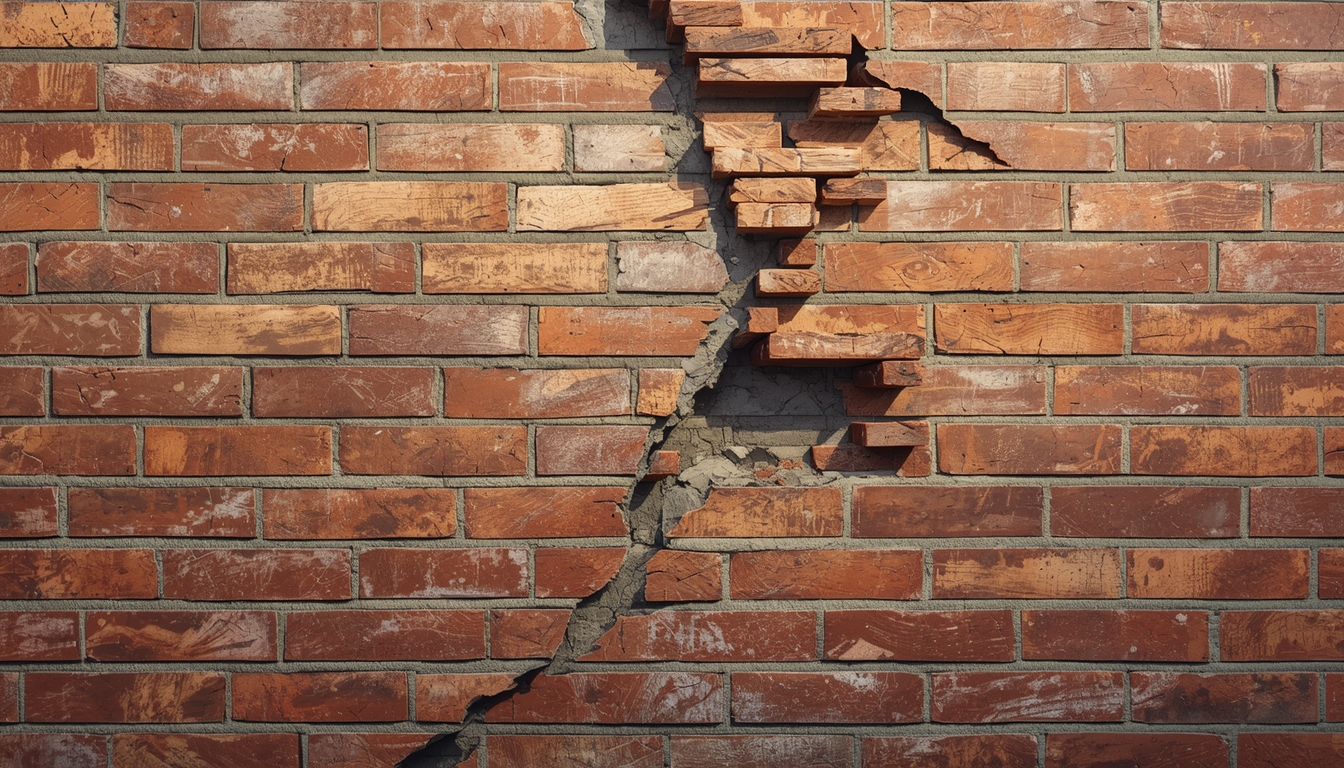
This is one of the most recognizable — and most serious — patterns in masonry. Stair-step cracks follow the mortar joints diagonally, creating a staircase-like pattern across the face of a brick wall. They almost always indicate differential settlement: different parts of your foundation are sinking or shifting at different rates, and the wall above is being pulled apart along its weakest points — the mortar joints.
Stair-step cracks near corners of the home, around windows, or along foundation walls should never be dismissed as cosmetic. They're a direct signal that the ground beneath your structure is moving.
3. Horizontal Cracks Along Foundation or Basement Walls
Of all crack types, horizontal cracks are the most urgent. They typically form when soil pressure — often from saturated or expansive clay soils — pushes inward against a foundation or retaining wall. The wall is being compressed from the outside and is beginning to bow inward as a result.
In many cases, the bowing is not yet visible to the naked eye when horizontal cracking first appears. But it's happening. If you see horizontal cracks in your basement walls or along your foundation, contact a masonry professional immediately. This is not a "monitor and wait" situation. Kings Masonry's foundation and basement repair team handles exactly this type of progressive structural damage.
4. Cracks That Are Wider at One End
A crack that tapers — wider at the top than the bottom, or vice versa — is different from a uniform crack. The tapered shape indicates that the wall is rotating or tilting, not just settling evenly. One end is moving more than the other, which is a sign of active, ongoing differential movement.
If you see a tapered crack, the key question isn't just "how wide is it" but "which direction is it opening?" A crack opening at the top suggests the bottom of the wall is anchored but the top is pushing outward. A crack opening at the bottom suggests the opposite. Either way, a structural engineer or experienced masonry contractor should evaluate it promptly.
5. Doors and Windows That Stick or No Longer Align
This warning sign surprises many homeowners because it seems unrelated to the brick exterior. But when a masonry structure shifts — whether due to foundation movement, soil settling, or wall displacement — it distorts the frames around doors and windows. Suddenly a door that opened smoothly for twenty years requires a hard shove. A window that always closed cleanly now has a visible gap at one corner.
If you're experiencing this alongside any visible brick cracking, don't assume it's a door or window problem. The root cause may be structural movement in your masonry. This symptom, combined with exterior cracking, is one of the clearest signs that cosmetic damage has progressed into a structural risk.
6. Visible Bowing, Bulging, or Leaning in the Wall
Stand back and look at your brick walls from a distance, then up close. A structurally sound wall should appear perfectly flat and plumb. If you notice any outward bulging, inward bowing, or a visible lean — even a subtle one — the wall has shifted beyond cosmetic damage territory.
You can also check for bowing by holding a long straightedge (or even a taut string) against the wall surface. Any deviation from flat is worth investigating. Bowing walls are a structural emergency that can worsen rapidly, especially if left through another winter. Kings Masonry's commercial and residential teams regularly handle bowing wall stabilization and repair across the Greater Boston area.
7. Efflorescence Combined With Active Cracking
Efflorescence — those white, chalky deposits that appear on brick surfaces — is caused by water moving through the masonry, dissolving salts within the material, and depositing them on the exterior face as it evaporates. On its own, efflorescence is cosmetic. It's unsightly but not dangerous.
However, when efflorescence appears alongside active cracking or deteriorating mortar joints, it tells a specific story: water is moving through your wall, consistently and in volume. That moisture isn't just staining the surface — it's working its way into the structure, potentially reaching the wall cavity, the structural backing, or the foundation below. At that point, the line between cosmetic and structural damage has already been crossed.
What Happens If You Wait?
It's worth being direct about the cost of inaction, because the difference between early and late intervention is dramatic.
A crack caught early — before water infiltration has set in — typically requires tuckpointing or minor masonry repair. It's a straightforward job. Caught late, after freeze-thaw cycles have widened the crack, saturated the wall, and compromised the mortar, the same wall may require partial or full rebuilding, waterproofing treatment, and potentially foundation repair. The cost difference between early and late intervention can be tenfold or more.
Routine inspections twice a year once in spring after the freeze-thaw season, once in fall before winter are the single most cost-effective thing you can do to protect your masonry investment.
When to Call a Professional
If you've identified one or more of the warning signs above, the next step is a professional on-site assessment. Don't try to diagnose structural brick damage from photos or internet guides alone — the difference between a crack that needs tuckpointing and one that signals foundation movement requires trained eyes and hands-on evaluation.
Kings Masonry serves homeowners and commercial property owners across Greater Boston, Brookline, Newton, Braintree, Hingham, and communities throughout the South Shore. Our licensed team offers free on-site estimates, clear and honest assessments, and the full range of masonry services — from minor repointing to full foundation repair — to address whatever we find.
The sooner you act, the simpler and less expensive the solution. Contact Kings Masonry today to schedule your free inspection.
Frequently Asked Questions
Can cosmetic brick damage really turn into a structural problem? Yes — and it happens more often than homeowners expect. Small cracks allow water to penetrate the wall. In cold climates like Massachusetts, repeated freeze-thaw cycles expand those cracks season after season, progressively weakening mortar joints and eventually compromising the wall's structural integrity.
How wide does a crack need to be before it becomes a structural concern? As a general guideline, cracks wider than 1/4 inch, or any crack displaying a stair-step or horizontal pattern, should be professionally evaluated regardless of width. Pattern and location matter as much as size.
Are stair-step cracks always a sign of structural damage? Not always - but they should always be assessed by a professional. Stair-step cracks are the most common indicator of differential foundation settlement and should never be assumed to be purely cosmetic without an expert evaluation.
How often should I inspect my brick exterior? Twice a year is the standard recommendation: once in spring after the freeze-thaw season ends, and once in fall before temperatures drop. These are the periods when damage from the prior season becomes visible and when upcoming conditions make early repair most valuable.
Does homeowner's insurance cover structural brick damage? Coverage depends on your specific policy and the cause of damage. Sudden structural failures caused by covered events (such as storm damage) are more likely to be covered than gradual deterioration from moisture or settling. Getting a professional damage assessment and documentation is an important first step in any insurance claim.
Kings Masonry and Construction is a licensed masonry contractor serving residential and commercial properties across Greater Boston and the South Shore. Contact us for a free on-site estimate.