
Water in Basement: Foundation Leak or Plumbing?
Finding water in a basement is stressful enough without the added confusion of not knowing who to call. Is this a foundation problem a job for a waterproofing or masonry contractor — or a plumbing problem for a plumber? Getting the answer wrong wastes time and money, and the two can look surprisingly similar at first glance. The good news is that water in a basement from a foundation leak and water from a plumbing leak leave different fingerprints, and once you know what to look for, you can usually tell them apart before anyone comes out.
This guide walks through the tells timing, location, water appearance, and a couple of simple at-home tests so you can point the right professional at the problem the first time.
Key Takeaways
If you find water in a basement when it rains or snow melts, it's the foundation. Weather-driven water is groundwater getting in from outside.
If it leaks when you use water or steadily, rain or shine it's plumbing. A pressurized pipe doesn't care about the weather.
Look at the water. Clean and clear points to a pipe. Dirty, musty, or leaving white chalky residue points to the foundation.
Do the meter test. Turn all water off; if the meter still moves, you have a plumbing leak. If it's still, it points to the foundation.
Foundation water shows up low; plumbing water can show up anywhere. Floor-wall seam and cracks are foundation; ceilings and spots near fixtures are plumbing.
Call the foundation/waterproofing contractor for the first two; a plumber for a pipe. When it's genuinely unclear, a quick professional inspection settles it.
Quick Answer
When you find water in a basement, here's the fastest way to tell the source: if the water shows up when it rains or the snow melts, it's a foundation leak; if it shows up when you're using water in the house, or drips steadily no matter the weather, it's a plumbing leak. Foundation water comes in low — at the seam where the floor meets the wall, or through a crack — and can look dirty or leave a white chalky residue. Plumbing water is usually clean and can appear anywhere, including ceilings. Not sure? Turn off all the water in the house and watch your meter: if it keeps moving, it's plumbing. If you still can't tell, that's exactly when it's worth having someone come take a look.
Water in a Basement: The Single Fastest Clue Is Timing
If you learn only one thing from this page, make it this. A foundation leak is driven by groundwater and weather. It shows up during or right after rain, during a thaw, or after a long wet stretch when the water table is high — and it's often dry the rest of the time. A plumbing leak is driven by your home's water system. It tends to track with usage (worse when the dishwasher runs, when someone showers, when a toilet is flushed) or, for a slow supply leak, it runs steadily regardless of weather because the pipe is always pressurized.
So the first question to ask yourself: does the water correlate with the sky, or with the plumbing? A leak that only appears after storms is almost certainly a foundation issue. A leak that appears on a dry week, or gets worse when you use water, is almost certainly plumbing.
The Second Clue: What the Water Looks Like
The water itself carries evidence.
Foundation water has usually traveled through soil to reach you. It may look slightly dirty or tinted, carry a musty, earthy smell, and the giveaway leave behind efflorescence, the white chalky mineral residue that appears on concrete after mineral-laden water evaporates. Efflorescence is a near-certain sign that water has been moving through the masonry from outside.
Plumbing water from a supply line is clean, clear, and odorless, because it never touched soil. The exception is a drain or sewer leak, which can smell foul and look dirty but that has its own obvious signature (odor near drains, waste water) that's hard to mistake for groundwater.
The Third Clue: Where It Shows Up
Location narrows it down further.
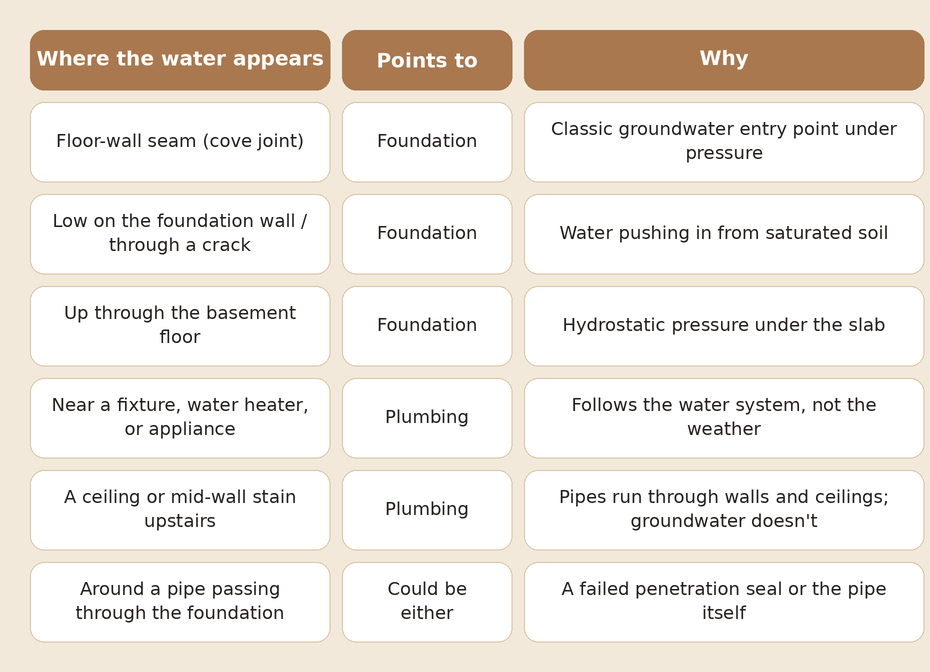
That last row is the tricky one a pipe passing through the foundation can leak because the seal around it failed (a foundation/waterproofing fix) or because the pipe itself is leaking (a plumbing fix). That's a common spot where a professional trace earns its keep.
Two Simple Tests You Can Do Yourself
The water meter test (for supply-line plumbing leaks). Turn off every water-using fixture and appliance in the house. Find your water meter and note the reading, or watch the leak-indicator dial. Wait an hour or two without using any water, then check again. If the meter moved, water is flowing somewhere with everything "off" — that's a plumbing supply leak, full stop. If it's perfectly still, you've effectively ruled out a pressurized plumbing leak, which points you back toward the foundation.
The dry-and-watch test (for foundation leaks). Thoroughly dry the wet area and tape a square of foil or plastic tightly over it. Wait through a dry spell and a rainy one. If moisture appears behind the foil (against the wall) after rain but not during dry weather, water is coming through the foundation from outside. If the surface stays dry through rain but wets up when you're using water inside, look at plumbing.
Diagnose Your Leak Below
Timing, location, and water clues together usually point clearly one way. Use the tool below to combine what you're seeing into a most-likely answer before you decide who to call.
When It's Actually Both or Neither
Occasionally the picture is muddy. A plumbing leak can saturate the soil around a foundation and create conditions that also let groundwater in, so you end up chasing two problems. And sometimes what looks like a leak is really condensation — warm, humid indoor air meeting cold foundation walls and pipes, leaving them "sweating." The foil test sorts that out: condensation forms on the room-facing side of the foil, while a real leak wets the side against the wall. If you've ruled out both plumbing and clear groundwater entry and the dampness is seasonal and surface-level, condensation is the likely answer, and the fix is ventilation, a dehumidifier, and insulation rather than waterproofing or a plumber our guide on getting rid of a musty basement smell covers the humidity side in more detail.
What Happens When We Come Out
If you'd rather not play detective — or you've looked and still can't tell — this is the part homeowners usually want to know: what actually happens when you call us. It's straightforward. A technician comes out and inspects the basement with you, walking the floor-wall seam, checking cracks, penetrations, and window wells inside, and looking at your gutters, downspouts, and grading outside. The goal of that visit is one thing: figure out where the water is really coming from. If it turns out to be plumbing, we'll tell you honestly and point you to a plumber rather than sell you a fix you don't need. If it's the foundation, we'll show you exactly where and how the water is getting in and walk you through what it takes to stop it. And when it's a straightforward foundation fix — sealing an active crack, for example — we can often take care of it on the spot once you've decided to go ahead. No pressure, no guesswork, and no charge for the assessment.
What You Can Check vs. What Needs a Pro
You can run the timing observation, the water-appearance check, the location review, and both simple tests above — that's often enough to know which trade to call. Where a professional is worth it: a leak around a foundation penetration where pipe-versus-seal is ambiguous, a leak you simply can't correlate to either weather or water use, or any situation where the water is significant and you need it stopped correctly the first time. A waterproofing or masonry contractor handles the foundation side — foundation leak repair covers what that involves — while a licensed plumber handles the pipe side. Calling the right one first is the whole point of this exercise.
Frequently Asked Questions
How do I know if my basement leak is from the foundation or a pipe? Watch the timing. Foundation leaks appear with rain, snow melt, or wet weather and are often dry otherwise; plumbing leaks track with water use or run steadily regardless of weather. Also check the water: foundation water may be dirty, musty, or leave white residue, while supply-line plumbing water is clean and clear.
Can a plumbing leak look like a foundation leak? Yes, which is exactly why people mix them up. A slow supply leak can pool on the floor and mimic groundwater. The tell is that plumbing leaks don't correlate with weather and often do correlate with water use. The water meter test settles it: if the meter moves with everything off, it's plumbing, not the foundation.
Will my water meter show a foundation leak? No — and that's useful. The water meter only measures water coming through your home's supply system. A foundation leak is groundwater from outside, so it never touches the meter. That's why a still meter (with everything off) effectively rules out a pressurized plumbing leak and points you toward a foundation source.
Who do I call for a foundation leak — a plumber or a waterproofing contractor? A waterproofing or foundation contractor, not a plumber. Foundation leaks are about groundwater and entry paths — cracks, the cove joint, drainage, and pressure — which is masonry and waterproofing work. A plumber is the right call only if the water is coming from your pipes. Telling the two apart first saves a wasted service call.
Could it be condensation instead of a leak? Possibly. Condensation is warm humid air meeting cold walls or pipes, and it looks like a leak but is a humidity issue. Tape foil to the damp spot: moisture on the room-facing side means condensation (fix with ventilation and a dehumidifier), while moisture behind the foil means water is coming through and needs waterproofing.