
The Story of Stones: A Time Travel Through Masonry History
Stone has always been more than a building material. Long before steel, concrete, or glass defined skylines, stone shaped civilization itself. When we look at how humans built their world, we're really tracing a story about learning to transform raw nature into shelter, authority, and permanence.
This is the journey of how stones moved from simple stacked walls to engineered structures that have stood for centuries and still outlast modern alternatives today.

The Earliest Roots: 10,000 Years of Building
The origins of stone construction stretch back over 10,000 years. Early humans discovered that stacking stones created stronger, more weather-resistant shelters than wood or mud alone could provide.
These early structures were crude but effective:
Dry-stacked stones without mortar
Walls built for protection and insulation
Foundations that outlasted temporary dwellings
Even without tools or formal engineering knowledge, early builders understood one fundamental principle that still defines masonry today: weight creates stability. A well-placed stone won't shift under pressure it distributes force to the stones beneath it. This insight, discovered through trial and error over millennia, remains the foundation of every stone wall ever built.
Ancient Civilizations: When Stone Became Mastery
As civilizations evolved, stone construction transformed from simple survival into sophisticated craft.
In ancient Egypt, massive stone blocks were cut and assembled with astonishing precision. The pyramids weren't just monuments—they were engineering achievements that demonstrated complete understanding of weight, balance, and structural load.

Greek civilization elevated stonework into an art form, developing principles of proportion and harmony that influenced architecture for the next 2,000 years. Roman engineers took it further, introducing arches, vaults, and early forms of concrete that allowed structures to span wider spaces and carry heavier loads than post-and-lintel systems permitted.
Across the world, independent civilizations like the Inca developed dry-stone masonry so precise that stones fit together without mortar, creating structures that survive earthquakes that modern buildings struggle to withstand. There was no communication between these cultures, yet they arrived at similar principles through the same discovery process.
Stone wasn't just material anymore. It had become technology.
Medieval Stone: Strength and Permanence
During the Middle Ages, stone took on a defensive role. Castles, city walls, cathedrals, and fortresses relied almost entirely on masonry for their existence.
Medieval builders developed:
Thicker load-bearing walls capable of supporting enormous heights
Stone vaults and flying buttresses that redistributed weight
Lime-based mortars that allowed walls to breathe and flex slightly with settling
Construction techniques refined through generations of practical experience
Medieval masons worked without modern machinery, power tools, or computer modeling. Yet their structures were designed with such durability that many remain intact today—not as ruins, but as functional buildings. A cathedral built in 1250 often requires less structural intervention than a building from 1950.
The Renaissance: Revival and Innovation
The Renaissance (14th to 17th centuries) brought renewed fascination with classical architecture. Masons and architects studied the works of ancient Greeks and Romans, seeking to understand and revive their techniques. This wasn't mere copying it was learning from the most durable structures that had survived the intervening centuries.
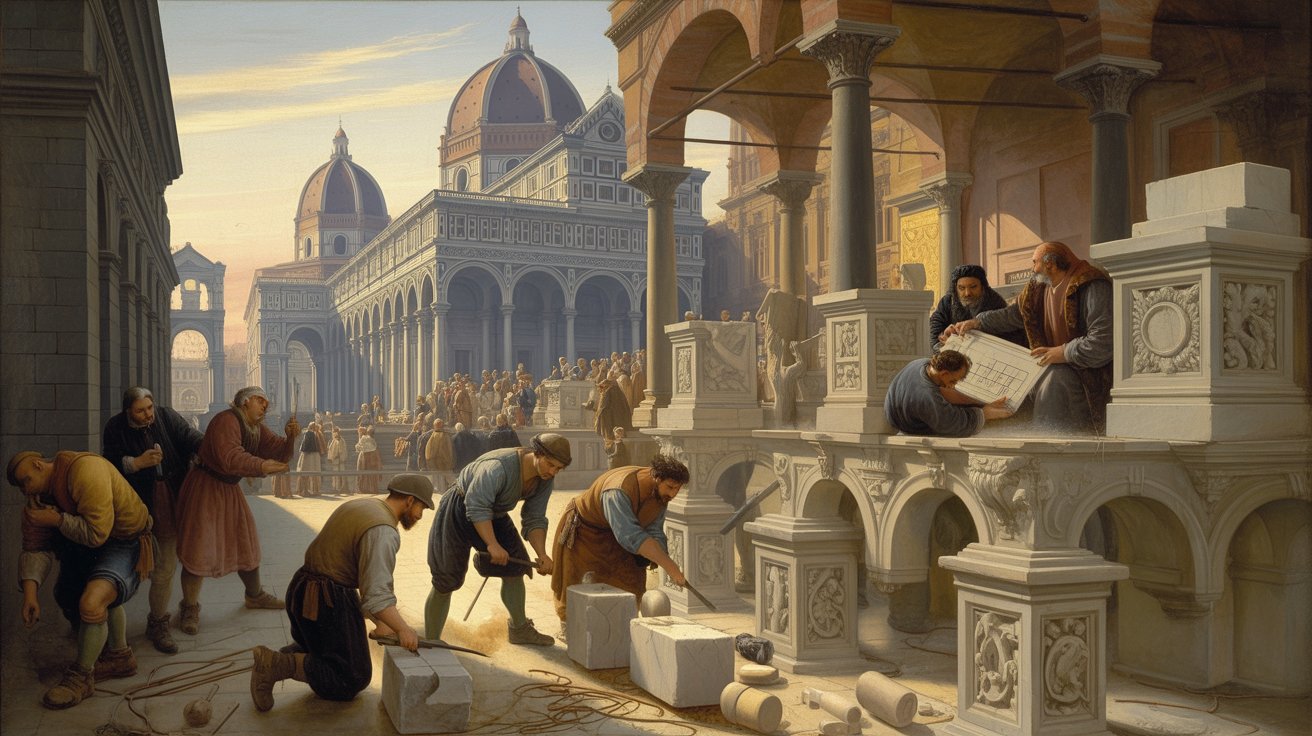
As cathedral-building declined in the late 14th century, Europe's emerging nation-states began competing with the church for architectural prominence. They looked to the Roman Empire as their model—adopting its forms as symbols of power and authority.
Nations incorporated Roman architectural elements: the round arch, the vault, and most significantly, the dome. This shift gave rise to architects as a distinct profession separate from master masons. Where master masons both designed and built their work, architects now envisioned the form and structure while builders executed the physical work.
Technical advances during this period included:
Keystone development, which distributed weight more evenly through arches
New materials like brick and terra cotta enabling intricate designs
Glass integration, transforming how light entered buildings
This period demonstrated that stonework wasn't static it evolved alongside power structures, artistic movements, and advancing knowledge. The level of craftsmanship demanded during the Renaissance continues to influence quality masonry work today.
The Industrial Revolution: Speed and Standardization
The Industrial Revolution marked a turning point in construction. Brick production became standardized. Stone cutting became faster and more precise through mechanization. Urban growth created enormous demand for durable, fire-resistant buildings that could be built quickly.

This era introduced:
Mass-produced bricks meeting consistent standards
Improved mortar formulations with predictable performance
Multi-story buildings constructed with speed previously impossible
Speed increased dramatically, but the most durable buildings from this era prove that craftsmanship remained important. Many 19th-century masonry buildings are structurally sound today because builders balanced rapid production with quality standards. The best Victorian-era brick buildings outlast mid-20th-century structures built with shortcuts.
Modern Construction: Where Tradition Meets Engineering
Today, stone and brick construction continues through combination of traditional materials and modern engineering. Contemporary approaches include:
Reinforced masonry systems that meet seismic codes
Engineered stone and concrete blocks with tested performance
Restoration techniques that preserve historic structures authentically
Digital planning and robotics in precision cutting and placement
Despite technological evolution, the core principles remain unchanged. Compression, balance, and durability the lessons learned over thousands of years still govern every well-built structure.
Why This History Matters Today
Understanding the evolution of stone construction explains why masonry remains trusted in modern building. Stone and brick structures:
Age better than many contemporary materials
Require less frequent replacement or maintenance
Perform reliably in harsh climates
Carry cultural and architectural significance
Build with intention toward longevity
Every brick wall and stone structure today carries embedded knowledge from thousands of years of building experience. If you're choosing a material for your own home, our comparison of brick vs block vs stone breaks down how each performs and which is right for a Boston property.
From Past to Present
The story of stone construction is fundamentally a story about patience. Stone teaches builders to think long-term, to respect the laws of physics, and to construct with intention rather than convenience.
As materials and tools change, traditional masonry continues to adapt without losing its essential identity. From ancient stone shelters to engineered modern walls, the progression proves one unchanging principle: what is built well outlasts time itself.
At Kings Masonry and Construction, we honor this legacy by combining centuries-old craftsmanship with modern building standards. Every project benefits from principles refined over millennia and techniques tested across generations. If you're planning a project and want to understand your options, our complete guide to stone masonry services in Boston walks through what each service involves.