
Brick vs. Block vs. Stone: Which Masonry Material Is Right for Your Boston Home?
If you're planning a masonry project — whether it's a new foundation, a retaining wall, a chimney rebuild, an addition, or a full exterior restoration — one of the first decisions you'll face is material selection. Brick, concrete block, and natural stone construction each have passionate advocates, and each has legitimate strengths. But the right answer for a home in Newton's historic district is not necessarily the right answer for a new construction project in suburban Boston or a commercial building in Brookline.
This guide gives you the honest, material-by-material breakdown — performance in New England's demanding climate, cost, maintenance requirements, aesthetic character, and the specific use cases where each material genuinely excels. By the end, you'll know which material — or combination of materials — makes the most sense for your project.
Understanding Masonry: What These Three Materials Have in Common
Before comparing them, it's worth understanding what brick, block, and stone share. All three are masonry materials — meaning they are unit-based construction systems where individual pieces are assembled with mortar to create walls, foundations, chimneys, and other structures. All three offer:
Thermal mass — the ability to absorb heat during the day and release it slowly at night, reducing heating and cooling loads
Fire resistance — masonry does not burn and provides excellent fire separation between building sections
Durability — properly installed and maintained masonry outlasts wood-frame construction by generations
Low long-term maintenance compared to wood, fiber cement, or vinyl cladding
But beyond these shared attributes, the three materials diverge significantly in ways that matter enormously to a Boston-area homeowner.
Brick: The Defining Material of Greater Boston
Walk through the Back Bay, Beacon Hill, the South End, or virtually any older neighborhood in Brookline and Newton, and you'll understand why brick is synonymous with Boston architecture. It is the dominant masonry material of Greater Boston's historic building stock — and for good reason.
What Brick Is
Brick is a manufactured unit, traditionally produced by firing clay or shale at high temperatures. The firing process determines the brick's density, absorption rate, color, and durability. Modern brick manufacturing has advanced considerably from the soft, high-absorption bricks used in 19th-century Boston construction — a distinction that matters enormously when selecting materials for historic restoration work.
Performance in New England's Climate
Brick performs exceptionally well in Greater Boston's climate — when the right brick is specified. The key variable is the brick's freeze-thaw rating, measured by its water absorption rate. Low-absorption, high-density brick (SW grade — Severe Weathering) is rated for New England's 30+ annual freeze-thaw cycles and will last for well over a century with proper maintenance. High-absorption, softer brick — including much of the original brick used in pre-1900 Boston construction — is more vulnerable to freeze-thaw spalling as it ages.
This distinction is critical for restoration work on historic Boston, Brookline, and Newton homes. Using a modern high-density brick to replace damaged units in a pre-1900 soft brick wall creates a mismatch in rigidity and absorption that can accelerate damage to the surrounding original brick. Material matching — both visually and physically — is one of the most technically demanding aspects of historic masonry restoration.
Maintenance Requirements
Brick requires less maintenance than wood but is not maintenance-free. The primary maintenance need is mortar joint repointing — replacing eroded or deteriorated mortar before moisture infiltration begins. In Greater Boston's climate, most brick masonry requires repointing every 25–50 years depending on original mortar quality, exposure conditions, and whether the correct mortar type was used in previous repointing work.
The most common maintenance mistake Boston homeowners make is allowing unlicensed contractors to repoint historic brick with modern Portland cement mortar. Portland cement is significantly harder and less flexible than the original lime mortar used in pre-1900 construction. When a rigid Portland cement joint is applied to soft historic brick, the mortar cannot accommodate the slight movement of the masonry — so instead of the joint cracking harmlessly, the brick itself cracks and spalls. This is an irreversible, expensive mistake.
Best Uses in Greater Boston
Exterior cladding for historic and traditional-style homes in Boston, Brookline, and Newton
Chimney construction and rebuilding
Retaining walls and garden walls where visual character matters
Front steps, stoops, and entrance features
Historic restoration and facade repair work
Fireplaces and interior feature walls
Brick: Pros and Cons Summary
Pros: Exceptional visual character; proven 100+ year durability in Boston's climate when properly maintained; excellent thermal mass; fire resistant; high property value contribution; wide range of colors and textures available; compatible with historic district requirements in Boston, Brookline, and Newton.
Cons: Higher installed cost than concrete block; requires skilled labor for quality work; historic restoration requires specialized knowledge and material matching; mortar maintenance required every generation; incorrect repointing can cause irreversible damage to historic brick.
Concrete Block: The Workhorse of 20th-Century Boston Construction
Concrete masonry units (CMU) — commonly called concrete block or cinder block — are the unsung workhorse of Greater Boston's building stock. Less glamorous than brick or stone construction, they built the region's mid-century housing, commercial buildings, and tens of thousands of basement foundations that are still in service today.
What Concrete Block Is
Concrete block is a manufactured masonry unit produced from Portland cement, aggregates, and water. Standard concrete block is 8x8x16 inches, though a wide range of sizes, shapes, and finishes exists. Lightweight block uses cinder or pumice aggregate (giving rise to the common name "cinder block"); standard block uses heavier sand and gravel aggregates for greater strength.
Performance in New England's Climate
Concrete block performs well structurally but has specific vulnerabilities in Greater Boston's climate that homeowners need to understand.
Moisture absorption is the primary concern. Standard concrete block is more porous than either brick or stone and absorbs moisture readily. In the presence of Greater Boston's freeze-thaw cycles and hydrostatic groundwater pressure, unprotected block foundations are susceptible to efflorescence, spalling at the face of units, and — most critically — horizontal cracking under lateral soil pressure.
Block foundations require active basement waterproofing management. A poured concrete foundation resists hydrostatic pressure better than a block foundation of equivalent thickness because it is a monolithic system without the mortar joints that block walls rely on. Block foundations in high water table areas of Greater Boston — Brookline's lower neighborhoods, Newton near the Charles River, parts of Boston's Allston-Brighton — warrant particular attention to waterproofing and drainage.
Cost
Concrete block is the most economical masonry option for structural applications. In Greater Boston:
Block foundation construction: $12–$22 per square foot installed
Block wall construction (above grade): $15–$25 per square foot installed
Block foundation crack repair: $400–$1,500 per crack for injection; $8,000–$20,000 for wall stabilization systems
The cost advantage of block over brick or stone construction is most significant in foundation and below-grade applications where visual appearance is less important than structural performance and economics.
Maintenance Requirements
Block construction requires less cosmetic maintenance than brick but more active moisture management. Key maintenance needs:
Waterproofing maintenance: Interior and exterior waterproof coatings require periodic reapplication; drainage systems require annual inspection and pump testing
Crack monitoring: Block walls are more susceptible to horizontal cracking under lateral soil pressure than poured concrete; annual inspection of basement walls is recommended for Greater Boston's clay soil conditions
Efflorescence management: The higher porosity of block makes it more prone to efflorescence than brick; persistent efflorescence indicates a moisture management problem that needs addressing
Best Uses in Greater Boston
Foundation walls (most common application in mid-century Boston-area construction)
Retaining walls where structural performance matters more than aesthetics
Below-grade construction where waterproofing will be applied
Commercial and light industrial construction
Interior structural walls
Concrete Block: Pros and Cons Summary
Pros: Lowest cost of the three materials for structural applications; strong compressive strength; fire resistant; versatile sizes and configurations; widely available in Greater Boston; suitable for DIY with proper guidance in non-structural applications.
Cons: Less aesthetically appealing than brick or stone construction; higher moisture absorption requires active waterproofing management; more vulnerable to horizontal cracking under lateral soil pressure than poured concrete; not appropriate for historic district applications in Boston, Brookline, or Newton; limited design flexibility compared to brick or stone.
Natural Stone Construction: The Premium Choice for Historic and Luxury Applications
Natural stone construction is the oldest building tradition in New England. The region's colonial-era foundations, dry stone walls, and historic public buildings were built from locally quarried granite, fieldstone, slate, and limestone — materials that, when properly laid, have endured for centuries.
Types of Stone Relevant to Greater Boston
Granite is the dominant New England building stone — dense, hard, and exceptionally resistant to weathering. The Quincy Granite quarried south of Boston supplied stone for some of the city's most iconic 19th-century buildings and remains available for restoration and new stone construction today. Granite's hardness makes it difficult to work but virtually impervious to freeze-thaw damage.
Fieldstone — the rounded or irregular stones collected from New England's glacially-deposited landscape — is the material of most pre-1800 foundations in the Boston area. Fieldstone construction is still found in considerable numbers in Newton, Brookline, and the western suburbs, where colonial-era farms and homes have been preserved or converted.
Limestone and bluestone are used extensively for steps, sills, caps, and decorative elements in Boston's historic architecture. Less common as structural wall material in the immediate Boston area, though more common in parts of western Massachusetts.
Brownstone is technically a sandstone — the reddish-brown Triassic sandstone that clads so many Boston and Brookline rowhouses. Brownstone is softer than granite and significantly more vulnerable to New England's freeze-thaw cycles; the spalling and erosion of Boston's brownstone facades is one of the region's most prevalent historic preservation challenges.
Performance in New England's Climate
Stone construction performance in Greater Boston's climate varies dramatically by stone type.
Granite: Exceptional. Its extremely low water absorption and high density make it essentially immune to freeze-thaw damage. Granite masonry from the 1800s remains structurally sound throughout Greater Boston.
Fieldstone foundations: Variable. The stone itself is typically durable, but the original lime mortar has often deteriorated significantly over 100–200+ years, creating moisture infiltration pathways. Repointing fieldstone construction with the correct lime-based mortar (not Portland cement) is a specialized skill and one of the most common restoration projects we undertake in Newton and the western suburbs.
Brownstone: Challenging. The material's relatively high porosity and layered structure make it vulnerable to freeze-thaw spalling, particularly on horizontal surfaces that collect water. Brownstone restoration requires specialized techniques and compatible repair materials; many past "repairs" with incompatible Portland cement-based products have accelerated deterioration.
Maintenance Requirements
Well-constructed natural stone masonry has lower long-term maintenance requirements than either brick or block, with one significant exception: mortar joint maintenance. Stone's durability outlasts the mortar that holds it together. Fieldstone and limestone construction with original lime mortar requires periodic repointing — and critically, must be repointed with lime-based mortar rather than modern Portland cement to avoid damaging the surrounding stone.
Brownstone requires the most active maintenance of the stone types, including periodic application of breathable consolidants and water repellents to slow ongoing surface erosion.
Best Uses in Greater Boston
Historic foundation repair and waterproofing in Newton, Brookline, and Boston's older neighborhoods
Premium retaining walls, garden walls, and landscape features
Chimneys in historic or high-end residential applications
Steps, sills, caps, and decorative accents
New stone construction in historic districts where stone is the architecturally contextual material
Brownstone facade restoration in Boston's rowhouse neighborhoods
Natural Stone Construction: Pros and Cons Summary
Pros: Unmatched visual character and prestige; exceptional longevity (granite stone construction literally lasts centuries); high property value contribution particularly in Newton and Brookline's premium markets; appropriate for historic district applications; unique — no two stone walls look identical.
Cons: Highest cost of the three materials by a significant margin; requires the most specialized labor; brownstone is vulnerable to freeze-thaw damage and requires ongoing maintenance; fieldstone and limestone repointing requires lime mortar expertise that is not universally available; slower to construct than brick or block.
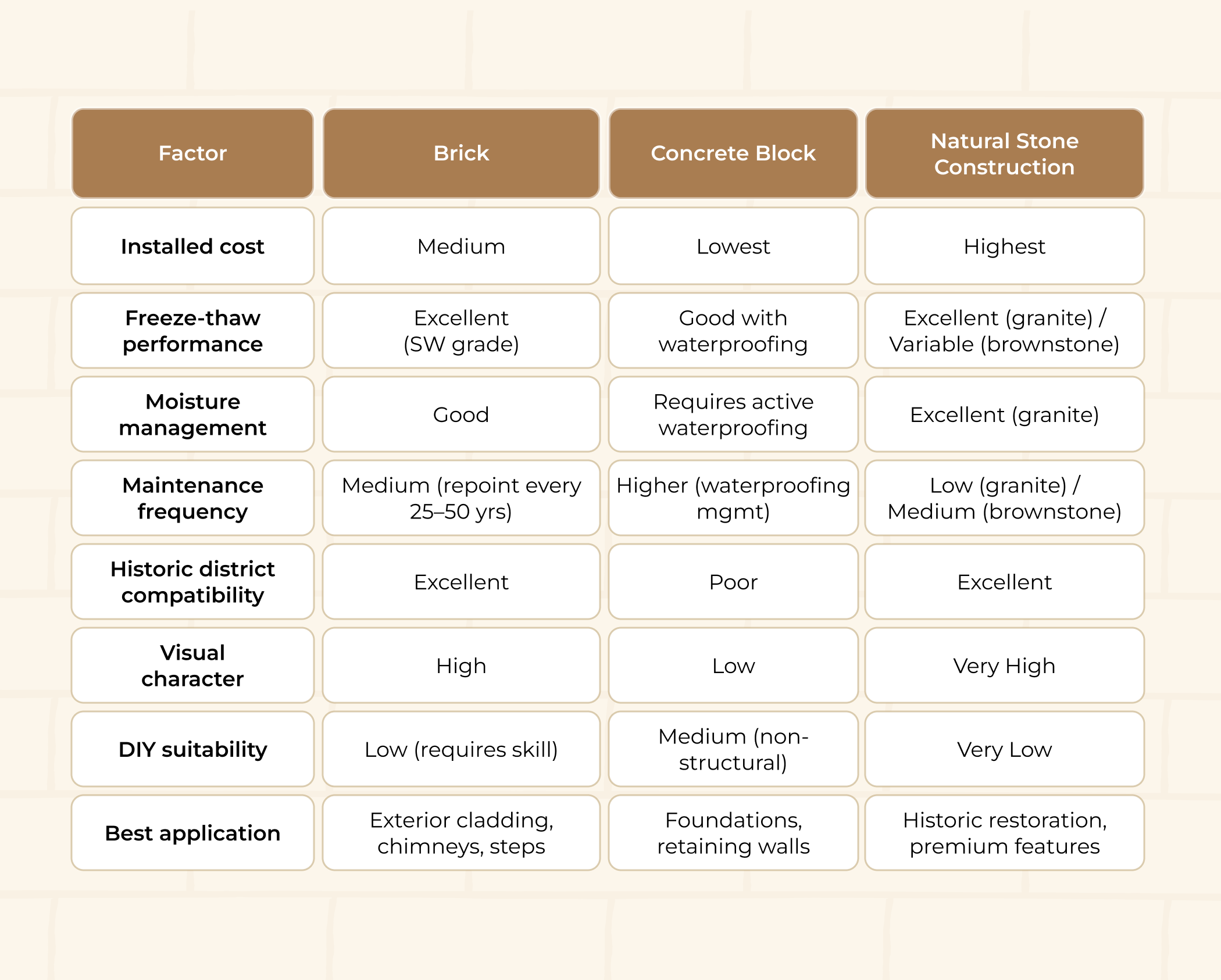
Side-by-Side Comparison: Brick vs. Block vs. Stone Construction for Boston Homeowners
Which Material Is Right for Your Project?
Choose brick if: You are building or restoring an exterior wall, chimney, front steps, or any visible masonry feature on a traditional or historic-style Greater Boston home. Brick is the contextually correct material for Boston, Brookline, and Newton's architectural character, it performs exceptionally in our climate, and it provides the best combination of durability, maintenance requirements, and property value contribution for above-grade residential applications.
Choose concrete block if: You are building a foundation, a below-grade retaining wall, or any structural masonry application where economy and structural performance matter more than aesthetics. Block is the cost-effective workhorse for applications that will be waterproofed, buried, or not visually prominent. If you have a block foundation that is performing well, there is no reason to replace it with another material — focus on waterproofing management and crack monitoring.
Choose natural stone construction if: You are restoring a historic fieldstone or granite foundation, repairing brownstone facade elements, building a premium landscape feature, or constructing a new project in an area where stone is the architecturally contextual material. Stone construction's cost premium is justified by its unmatched longevity and character — but only when specified for applications that can take advantage of those qualities.
Consider a combination: Many of Greater Boston's finest homes use all three. Stone or block foundations support brick cladding above grade, with granite sills, steps, and lintels providing accents. Understanding the strengths of each material lets you deploy them where they perform best.
The Most Important Variable: The Quality of the Masonry Contractor
Here is the honest truth that material comparisons often understate: the quality of the masonry contractor executing the work matters more than the material choice for almost any residential project.
A skilled mason can make concrete block look dignified and perform reliably for generations. An unskilled mason can install premium stone construction in a way that fails within a decade. The mortar selection, joint profiling, material preparation, drainage detailing, and quality control during construction determine the longevity of any masonry system far more than the specification sheet of the material itself.
In Greater Boston specifically, where historic masonry restoration requires specialized knowledge of lime mortars, soft brick behavior, and period-appropriate techniques, the gap between skilled and unskilled masonry contractors is enormous — and the consequences of choosing wrong can be permanent and expensive.
Frequently Asked Questions
Is brick or stone construction better for a Boston home?
Both perform excellently in Greater Boston's climate. Brick is generally more cost-effective for large wall areas and offers a wider range of colors and textures. Stone construction provides unmatched prestige and longevity but at significantly higher cost. For most residential projects in Boston, Brookline, and Newton, brick offers the best combination of performance, cost, and contextual appropriateness.
How long does brick construction last in Massachusetts?
Properly installed SW-grade brick with appropriate mortar and periodic repointing will last 100+ years in New England's climate. Many brick buildings in Boston's historic districts have been standing for 150–200 years with no end in sight.
Is concrete block as strong as brick?
Concrete block has higher compressive strength than most brick on a unit-by-unit basis. However, block walls are generally more vulnerable to lateral (horizontal) forces — particularly hydrostatic soil pressure — than equivalent brick or poured concrete construction. For above-grade applications where lateral loads are minimal, block and brick offer comparable structural performance.
Can I mix brick and stone construction on the same project?
Absolutely, and it is a traditional New England approach. Stone foundations supporting brick walls, granite sills and lintels in brick facades, and brownstone accents in brick buildings are all historically common in Greater Boston's architecture. The key is ensuring that the transition details are correctly executed and that the different materials' movement characteristics are accommodated.
What masonry material adds the most value to a Boston home?
In Greater Boston's premium real estate markets — particularly in Brookline and Newton — high-quality natural stone construction features (granite steps, stone retaining walls, fieldstone foundation restoration) add significant value and curb appeal. For overall exterior cladding, brick is the contextually expected material and a well-maintained brick exterior is a strong selling point. Concrete block, while structurally valuable in foundations, does not contribute positive visual value above grade.
Ready to Choose the Right Material for Your Project?
Whether you're planning a new chimney, restoring a historic facade, rebuilding a retaining wall, or addressing a foundation repair, Kings Masonry & Construction can help you make the right material decision for your specific project, budget, and architectural context.
We've worked with all three masonry services — brick, block, and stone construction — across Boston, Brookline, and Newton for years — from historic brownstone restoration in the South End to granite step installation in Newton to block foundation waterproofing in Brookline's Coolidge Corner. We know which materials perform in Greater Boston's climate and which combinations produce the best long-term results.
Call us today at (857) 249-5127