
Stair-Step Cracks in Brick Walls: What Brookline and Boston Homeowners Must Do Before It Gets Worse
That diagonal crack running up your brick wall — the one that follows the mortar joints in a stair-step pattern — is one of the most recognizable warning signs in residential masonry. It also happens to be one of the most misunderstood.
Some homeowners patch the mortar and consider the job done. Others assume it's cosmetic and leave it alone for years. In Brookline and Boston, where a large portion of the housing stock is over a century old and sits on fill material or glacial clay soils, neither approach is usually right.
Stair step cracks in brick walls almost always point to differential foundation settlement — and in this region's climate, a crack that's ignored through one or two winters rarely stays the same size.
This guide covers what causes stair step cracks, how serious they actually are, and exactly what to do before the problem gets worse.
What Stair Step Cracks Actually Are
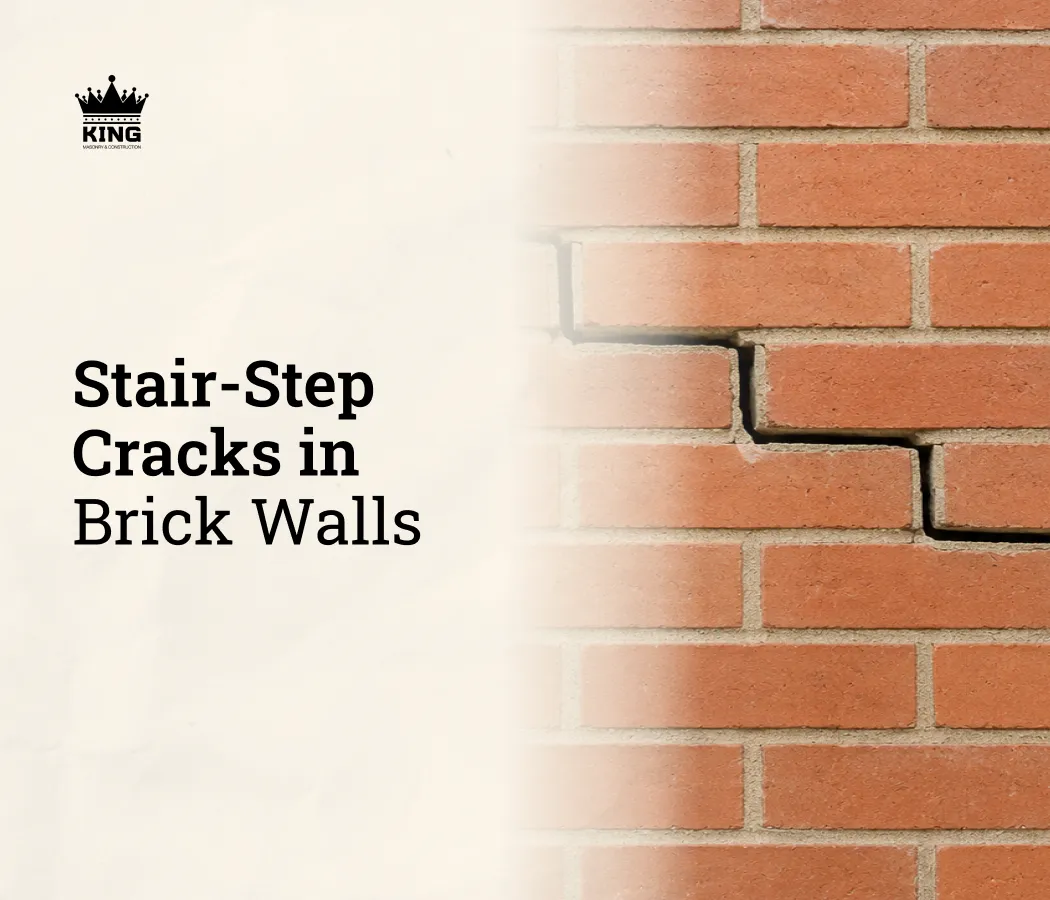
A stair step crack follows the mortar joints in a brick or concrete block wall, alternating between vertical and horizontal joints as it travels diagonally up or down the wall. The result looks like a staircase — hence the name.
The crack follows the mortar rather than cutting through the brick itself because mortar is the weakest point in the assembly. When stress is applied to the wall, it finds that path of least resistance.
Stair step cracks are distinct from:
Horizontal cracks — which run straight across a wall and indicate lateral soil pressure
Vertical cracks — which run straight up and down and typically indicate concrete shrinkage or tension
Diagonal cracks from openings — which start at the corner of a window or door and run at roughly 45 degrees through the brick face, not just along mortar joints
The stair step crack pattern is specific to brick and concrete block construction. You won't see it in poured concrete walls because there are no mortar joints to follow.
What Causes Stair Step Cracks
Differential Foundation Settlement
The primary cause of stair step cracks is differential settlement — one section of the foundation dropping or shifting more than the adjacent section. As the foundation moves unevenly, the masonry wall above it is forced to flex. The stress concentrates in the mortar joints, producing the characteristic stair step crack pattern.
In Brookline and Boston, differential settlement is accelerated by several local factors:
Filled land. Significant portions of Boston were built on fill material deposited over tidal flats and marshes beginning in the mid-1800s. Back Bay, the South End, parts of Charlestown, and East Boston all sit on this fill. Fill material settles unevenly over generations — often continuing to move more than 150 years after it was deposited.
Deteriorating wood pilings. Many older Boston foundations were built on wood pilings driven into the fill. These pilings can last indefinitely when permanently submerged — but when water table levels fluctuate due to drought, nearby construction, or changing drainage patterns, the exposed sections of the piling rot. When a piling fails, the section of foundation above it drops, producing sudden differential settlement and stair step cracking.
Glacial clay soils. The clay-heavy glacial soils underlying most of Brookline and the surrounding communities expand when wet and contract when dry. This seasonal movement — repeated over decades — slowly destabilizes footings and produces cumulative differential settlement.
Failed or Undersized Lintels
A lintel is the structural element — steel angle, stone, or wood — that spans above a window or door opening and carries the weight of the masonry above it. When a lintel corrodes, deflects, or fails, the masonry above the opening loses its support and cracks diagonally at the corners in a stair step pattern.
In Boston's older housing stock, original steel shelf angles and lintels have been corroding for 80 to 120 years in many cases. A lintel failure looks similar to settlement cracking but is localized above a single opening rather than running across a broad section of wall.
Freeze-Thaw Deterioration
Even without settlement, freeze-thaw cycles damage mortar joints over time. Water enters small gaps in the mortar, freezes, expands, and widens the joint. Over many seasons, this process loosens the bond between brick and mortar. When combined with any minor foundation movement, weakened mortar joints produce stair step cracks far more readily than sound, well-bonded joints would.
How Serious Are Stair Step Cracks?
The answer depends on four factors:
1. Width. A stair step crack under 1/8 inch wide that has been stable for years is a different situation from a crack that has grown to 1/4 inch or wider. Width alone isn't the only indicator, but it's the first thing to measure.
2. Displacement. Run your finger across the crack. Does one side sit higher than the other? Displacement — where one section of masonry has shifted relative to the adjacent section — indicates active structural movement, not just mortar deterioration.
3. Change over time. A stair step crack that has not changed in five years is a historic crack. A stair step crack that has grown noticeably in the last six months is an active crack. These require entirely different responses.
4. Accompanying symptoms. Stair step cracks accompanied by sticking doors or windows, sloping floors, gaps between walls and ceilings, or water infiltration suggest that the underlying foundation movement is affecting the structure more broadly. See our full guide on Signs of Foundation Problems for a complete list of what to check.
The Mistake Most Homeowners Make
The most common mistake with stair step cracks is repointing the mortar without diagnosing or addressing the underlying cause.
Repointing — removing deteriorated mortar and replacing it with fresh mortar — is the correct long-term maintenance for brick walls. But it is not a structural repair. If the foundation is still settling, or if a lintel is still deflecting, new mortar will crack again within one to two seasons. The homeowner has spent money on a repair that has accomplished nothing except delaying a proper fix.
The correct sequence is:
Diagnose the cause — settlement, lintel failure, or freeze-thaw deterioration
Stabilize the cause — address the foundation movement or replace the lintel
Repair the masonry — repoint the affected joints and replace any cracked or spalled brick
Skipping step one or step two makes step three a temporary cosmetic fix.
How to Monitor Stair Step Cracks at Home
Before calling a contractor, gather information that will help them assess the situation accurately:
Mark both ends of the stair step crack with a pencil line and date. Check monthly to see if it has extended.
Measure the width at the widest point with a ruler or a crack gauge if you have one. Record the measurement and date.
Check for displacement by running your finger perpendicular across the crack. Note whether one side is higher than the other and by how much.
Photograph everything with a ruler or coin in the frame for scale.
Three months of documented measurements gives a contractor exactly the information they need to determine whether the stair step crack is active or historic — and that distinction changes both the repair approach and the cost.
What a Professional Assessment Covers
When Kings Masonry and Construction inspects stair step cracks, the assessment goes beyond the crack itself:
Foundation condition at the base of the affected wall section
Evidence of differential settlement — floor slopes, door and window alignment, gaps in trim
Lintel condition above any nearby openings
Mortar joint condition across the broader wall
Water infiltration through the cracked section
Grading and drainage conditions that may be contributing to settlement
The goal is to identify the cause, not just describe the symptom. A repair recommendation that doesn't account for the cause is a repair that will need to be done again.
Repair Options for Stair Step Cracks in Boston and Brookline
The right repair depends on what is causing the cracking.
If the Cause Is Foundation Settlement
Settlement that is still active requires stabilization before any masonry work is done. Depending on the severity and cause, this may involve underpinning with helical piers, drainage correction to reduce soil movement, or addressing a deteriorated wood piling. Once movement has stopped, the stair step cracks can be properly repaired.
For walls where settlement has caused broader structural concerns, see our Foundation and Basement services page for a full overview of structural repair options.
If the Cause Is a Failed Lintel
A failed or corroded lintel needs to be replaced before the masonry above it is repointed. A masonry contractor will temporarily support the masonry above the opening, remove the failed lintel, install a new steel angle of the correct size, and then repoint the affected joints. Attempting to repoint stair step cracks first — and then discover the lintel is the issue — means opening the wall twice.
If the Cause Is Freeze-Thaw Deterioration on a Stable Foundation
If the foundation is sound and the stair step cracking is the result of long-term mortar deterioration, repointing is the correct repair. Deteriorated mortar is raked out to a depth of approximately 3/4 inch and replaced with new mortar matched to the original in composition, color, and joint profile.
In Boston's older housing stock — particularly homes with soft historic brick — mortar mix selection matters significantly. Modern Portland cement mortars are harder than historic brick and can cause the brick face to spall if used for repointing. A contractor experienced in historic masonry will select a mortar that matches the original in both strength and flexibility. Our Brick Repointing services cover what proper mortar matching involves for Boston-area homes.
Replacing Cracked or Displaced Brick
Where bricks themselves have cracked, shifted, or lost their bond, replacement is necessary. A skilled mason will remove the affected units, prepare the bed joints, and install matching replacement brick. In historic Boston neighborhoods, matching the original brick color and texture requires sourcing from salvage yards or specialty suppliers a step that is often skipped by less experienced contractors.
Boston and Brookline: Why Stair Step Cracks Are So Common Here
Greater Boston has a higher concentration of stair step cracks than most comparable American cities for reasons that are structural, geological, and climatic:
Age of housing stock. Most homes in Brookline, the South End, Back Bay, and Jamaica Plain were built between 1860 and 1930. That's 90 to 160 years of freeze-thaw cycles acting on mortar joints, and 90 to 160 years of foundation movement accumulating in the masonry above.
Fill land settlement. Boston's filled neighborhoods are still settling. The process is slow — measured in millimeters per year in most cases — but it is continuous, and it is additive. A home that showed no stair step cracks at 50 years may develop them at 80 or 100 years as cumulative settlement reaches the threshold that mortar joints can no longer absorb.
Water table fluctuation. Boston's water table has fluctuated significantly over the past several decades due to drought, increased impervious surface coverage, and changes in drainage infrastructure. This fluctuation is one of the primary drivers of wood piling deterioration in the city's older neighborhoods.
Brick quality variation. Not all historic Boston brick was created equal. Brick produced in the late 19th and early 20th centuries varied significantly in density and absorption rate. Softer, more porous brick absorbs more water, freezes more readily, and deteriorates faster accelerating mortar joint failure and stair step cracking in buildings that used lower-quality units.
When to Call a Contractor: Decision Guide
Call today if you see:
Stair step cracks with visible displacement between the two sides
Cracks wider than 1/4 inch
A stair step crack that has grown noticeably in the last 30 to 60 days
Stair step cracking accompanied by sticking doors, sloping floors, or interior wall cracks
Call within a few weeks if you see:
Stair step cracks between 1/8 and 1/4 inch with no displacement
Localized cracking above a window or door opening that may indicate a lintel issue
Stair step cracks with water staining or efflorescence
Monitor with measurements if you see:
Stair step cracks under 1/8 inch with no displacement and no accompanying symptoms
Cracks that appear stable and unchanged — document and check monthly
Frequently Asked Questions
Are stair step cracks in brick serious? They can be. A small stair step crack that has been stable for years may only need repointing. A crack that is growing, shows displacement, or is accompanied by other signs of foundation movement is a structural concern that requires professional evaluation.
Can I repoint stair step cracks myself? Repointing is a skilled trade, and in Boston's older housing stock it requires mortar matched to the original in composition and strength. Mismatched mortar — particularly modern Portland cement mixes used on soft historic brick — can cause brick spalling and accelerate deterioration. More importantly, repointing stair step cracks caused by active settlement or a failed lintel will not hold. The cause must be addressed first.
How much does stair step crack repair cost in Boston? Repointing repair for a localized stair step crack typically runs $500 to $2,000 depending on the extent of the damage and accessibility. Lintel replacement adds $1,500 to $4,000. Foundation stabilization, if required, is priced separately based on the method and scope. See our Foundation Crack Repair Cost guide for current Massachusetts pricing.
Will stair step cracks come back after repointing? They will if the underlying cause has not been addressed. Repointing stair step cracks on a still-settling foundation or above a failing lintel will crack again within one to two seasons. The repair sequence must start with diagnosing and stabilizing the cause.
Do stair step cracks affect home value in Massachusetts? Yes, particularly if they show displacement or are accompanied by other foundation symptoms. A disclosed stair step crack with no repair history raises buyer concerns about ongoing settlement. A repaired crack with documentation and a transferable warranty is a far better position. See our post on Foundation Crack Repair and Home Value for how buyers and inspectors typically view foundation cracks at sale.
Is stair step cracking covered by homeowners insurance? Most standard policies exclude damage from settling, soil movement, or gradual deterioration. Coverage may apply if the stair step crack was caused by a sudden covered event. Review your specific policy and document the damage thoroughly before any repair work begins.
Get a Professional Assessment Before the Next Winter
Stair step cracks in Boston and Brookline brick walls rarely improve on their own. Freeze-thaw cycles widen them every winter. Settlement, if it's still active, keeps moving. And a stair step crack that was borderline this fall can cross into structural territory by spring.
Kings Masonry and Construction inspects and repairs stair step cracks throughout Boston, Brookline, Newton, and the South Shore. Every assessment includes a written diagnosis of the cause — not just the crack — and a repair recommendation that addresses the source of the movement, not just the masonry above it.
Call (857) 249-5127