
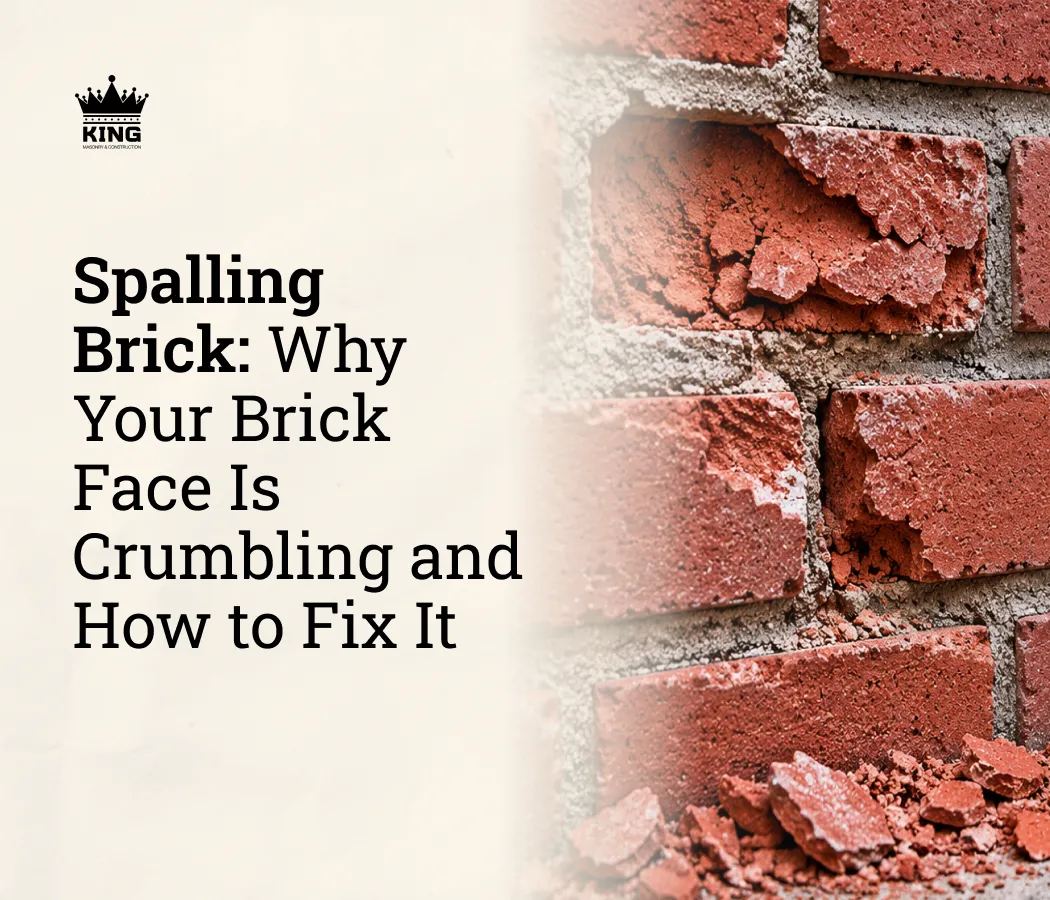
Spalling Brick: Why Your Brick Face Is Crumbling and How to Fix It
If the face of your brick is flaking off in chips, peeling away in layers, or crumbling at the surface, you're dealing with spalling — and in Greater Boston's climate, it's one of the most common masonry problems we see.
The good news: caught early, spalling brick is a manageable repair. Left alone, it spreads — and what started as a few damaged units can compromise an entire wall's structural integrity within a few New England winters.
What Is Spalling Brick?
Spalling is the deterioration of the outer face of a brick — the hard, fired outer layer — which chips, flakes, or breaks away from the body of the unit. Once the protective outer face is gone, the softer inner material of the brick is exposed directly to moisture and freeze-thaw cycles, and deterioration accelerates rapidly.
You'll recognize it by: brick faces that look pitted or layered, loose chips of brick on the ground at the base of a wall, a rough or powdery surface where the brick once had a smooth finish, or in advanced cases, entire sections of brick face missing to reveal the softer interior.
What Causes Spalling Brick in Boston and Brookline?
1. Freeze-Thaw Cycles — The Primary Culprit
This is the dominant cause of spalling in Greater Boston, where communities like Brookline experience 30+ freeze-thaw cycles per year. When water penetrates the porous surface of a brick and then freezes, it expands by approximately 9%. That expansion exerts internal pressure on the brick from within — pressure that the fired outer layer eventually cannot resist. The face fractures and separates.
Each cycle repeats the process, widening existing fractures and introducing water deeper into the brick. Over multiple winters, even a small amount of moisture infiltration produces visible spalling.
2. Incorrect Mortar in Previous Repairs
This is the most preventable cause of spalling — and unfortunately one of the most common in Greater Boston's older housing stock. When a contractor repoints historic brick with modern Portland cement mortar, the mortar is significantly harder and less flexible than the original lime-based mortar. Instead of the joint absorbing the slight seasonal movement of the masonry, the rigid mortar transfers stress directly into the softer brick face — which then cracks and spalls.
Many of the worst spalling cases we see in Newton and Brookline's pre-1900 homes were directly caused by well-intentioned but incorrect repointing repairs done decades ago.
3. Water Infiltration from Above
Horizontal masonry surfaces — chimney crowns, parapet caps, window sills, and the tops of retaining walls — collect standing water. Without proper drainage, water saturates the brick below these surfaces and accelerates freeze-thaw damage. Chimney spalling in Boston is almost always traceable to a failed crown or cap allowing water to pool at the top courses.
4. Painted or Sealed Masonry
Applying an impermeable coating — paint, epoxy sealer, or film-forming waterproofer — to brick traps moisture inside the wall rather than allowing it to evaporate. When that trapped moisture freezes, it has nowhere to go but outward — through the brick face. Painted brick that was not originally painted is one of the most reliable predictors of spalling problems in Greater Boston.
5. Age and Original Brick Quality
Pre-1900 Boston-area brick was often softer and more porous than modern SW-grade brick. It was designed to work with flexible lime mortar and breathable wall systems. As these bricks age and absorb decades of moisture, their resistance to freeze-thaw damage decreases. Some degree of spalling in very old brick is simply the material reaching the end of its serviceable life — at which point replacement with matched units is the only solution.
How to Fix Spalling Brick
Step 1: Stop the Water Source First
Repairing spalled brick without addressing the moisture that caused it is a temporary fix at best. Before any repair work begins, identify and correct the water source: repair failed mortar joints, fix damaged chimney crowns or caps, improve drainage away from the wall, and replace impermeable coatings with breathable penetrating sealers.
Step 2: Assess the Extent of Damage
Not all spalling requires the same response. Isolated spalling on a handful of units can often be addressed with individual brick replacement. Widespread spalling across large sections of a wall may require more extensive restoration — and in severe cases, structural evaluation to determine whether the wall's integrity has been compromised.
Step 3: Replace Damaged Units
Spalled brick units that have lost significant face material or are structurally compromised need to be carefully removed and replaced. This requires sourcing matching brick — a critical step for historic Boston and Brookline homes where the original brick has a specific color, texture, and size that may not match off-the-shelf modern brick. Kings Masonry specializes in matching historic brick for restoration projects throughout Greater Boston.
Step 4: Repoint with the Correct Mortar
Any repair work must use mortar matched to the original in composition, hardness, and color. For pre-1900 brick — which is the majority of the housing stock in Boston's historic neighborhoods — this means a lime-based mortar, not Portland cement. Using the wrong mortar will cause new spalling within a few years.
Step 5: Apply a Breathable Water Repellent
Once repairs are complete and the masonry is fully dry, applying a penetrating silane-siloxane water repellent significantly reduces future moisture absorption without trapping internal vapor. This is the one sealer type appropriate for historic brick — it reduces water entry while allowing the wall to breathe.
When to Call a Professional
Minor surface spalling on a few isolated bricks is something a handy homeowner can monitor. But call a masonry contractor when:
Spalling affects more than a handful of units or is spreading
You see spalling on a chimney (height and structural risk make this a professional job)
The underlying brick body — not just the face — is crumbling or soft
Spalling is accompanied by visible cracks, bowing, or mortar joint failure
Your home was built before 1920 (historic brick requires specialized repair knowledge)
Don't Let One Season's Damage Become Ten Seasons' Problem
Spalling brick follows a compounding curve: the more face material that's lost, the faster the remaining brick deteriorates. A repair that costs a few hundred dollars today can become a $10,000–$20,000 wall restoration project if ignored through several more New England winters.
Kings Masonry & Construction provides free spalling assessments throughout Boston, Brookline, and Newton. Call us at (857) 249-5127