
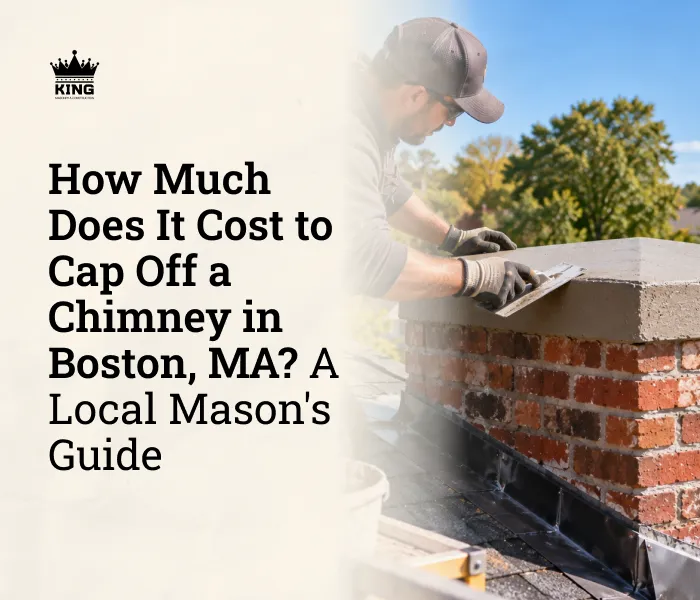
How Much to Cap Off a Chimney in Boston, MA?
Quick answer:
Capping off an unused chimney in Boston and the South Shore usually costs:
Low hundreds for a simple top seal that keeps the chimney vented.
Low-to-mid 4 figures if the chimney is taken down to the roofline and the roof is patched.
More for full removal.
The price depends on whether you're only sealing the chimney or taking brick down, how hard the roof is to reach, and whether the work has to keep moisture from getting trapped inside. Every job needs an on-site look. These are ranges, not quotes.
"Capping off" a chimney is one of the most misunderstood jobs I get called for, and the confusion costs people money. It does not mean putting a working cap on a chimney you still use. It means permanently closing a chimney you no longer need. Usually 1 of 2 things happened:
The fireplace is gone.
The heating system was switched to one that doesn't use the chimney.
Either way, the chimney is now just a hole in your roof collecting rain and squirrels.
Still using your fireplace or chimney? You need a working cap, not a cap-off. See our guide to how much it costs to install a chimney cap in Boston.
I've sealed a lot of abandoned chimneys in Boston, Quincy, Weymouth, Hingham, and across the South Shore. The goal is always the same: close it off without trapping moisture inside. A badly capped-off chimney rots quietly from within. Here's what it costs and what drives the number.
How much does it cost to cap off a chimney?
Short answer: It ranges from the low hundreds for a top seal to the low-to-mid 4 figures if the chimney comes down to the roofline and the roof is closed up. Full removal costs more.
Which approach you need sets the price:
Approach | What's involved | Typical cost band* |
|---|---|---|
Top-seal cap-off | Cap and weatherproof the flue at the top, keep it vented so it can breathe | Low hundreds |
Remove to roofline + cap | Take the chimney down to the roof, cap the stub, patch the roof | Low-to-mid 4 figures |
Full removal | Demolish the chimney through the structure and repair all affected areas | Highest — priced per job |
*Planning ranges only. Roof access, chimney size, and interior work all move the number, so an on-site assessment is required.
Why does capping off a chimney cost what it does?
Short answer: Four things drive the price: how much brick comes down (if any), roof access and height, whether the inside needs sealing and venting, and any water damage already there.
Seal vs. remove. Sealing the top is inexpensive. Every row of brick that comes down adds labor, disposal, and roof repair.
Roof access. A low, walkable roof is quick. A steep or 3-story slate roof, common on older Boston homes, needs more setup and safety gear.
Moisture control. This is the one people miss. A chimney sealed airtight traps condensation and can grow mold or rot the wood framing around it. A proper cap-off includes controlled venting so the masonry can breathe. Our post on water damage inside a chimney shows why trapped moisture is the real enemy.
Existing damage. A chimney that sat open through a few New England winters may already have a cracked concrete top or brick that's flaking apart. We find that once we're on the roof, repairing it adds to the job.
Is it cheaper to cap off a chimney or remove it entirely?
Short answer: Sealing is almost always cheaper. Capping off leaves the chimney in place and closes it. Full removal means tearing it out and rebuilding everything it passed through.
Most homeowners I meet don't need a full teardown. A properly vented top seal solves the water and animal problem for a fraction of the cost.
Removal makes sense when:
The chimney is already falling apart
It's in the way of a renovation, like an attic conversion or kitchen remodel
You never want to deal with it again
If yours is crumbling rather than just unused, our guide to chimney rebuilding covers the bigger structural options.
Before you cap off: the safety check
Short answer: Make sure nothing still vents through the chimney. Never cap off a chimney that a furnace, boiler, or water heater still uses.
This is the most important step, and it gets skipped more than you'd think. Many Boston-area homes switched from oil to gas or electric heat, but some older appliances still send their exhaust up the old chimney. Capping it off would push that exhaust, including carbon monoxide, back into the house.
Before any cap-off, we confirm:
No appliance is connected. We check the furnace, boiler, water heater, and any wood or pellet stove.
No shared chimney. Some chimneys have more than 1 flue, the channel smoke travels up. One may be unused while another is still active.
Old connections are sealed. Any openings where an appliance used to connect get closed properly.
If you're not sure what's connected, don't guess. Have it checked before anything gets sealed.
What happens inside the house?
Short answer: Capping the top doesn't close the fireplace or openings inside. Those usually get sealed too, and the cost depends on what you want to keep.
Common interior options:
Seal the fireplace opening. Close it with a panel or masonry, often with a small vent so air still moves through.
Keep the fireplace as decoration. Seal the damper and leave the look.
Remove the chimney through the attic. Popular in renovations for the space it frees up. It adds framing, patching, and finish work.
Do I still need to worry about a chimney I've capped off?
Short answer: Yes, a little. A capped-off chimney should be vented, watertight, and checked occasionally. It's still masonry exposed to our freeze-thaw winters. Seal it wrong and you trade a visible problem for a hidden one.
The failure I see most is a solid cap with no ventilation. Here's what happens:
Warm, moist air from the house rises into the cold chimney.
It condenses and has nowhere to go.
The water soaks the masonry from the inside.
A correct cap-off manages that airflow. It's a small detail that separates a job that lasts from one that quietly causes damage.
"The worst cap-offs I see were sealed airtight years ago. From the outside they look fine. Inside, the brick is soaked and the framing around the chimney is soft." — Jonathan Odriscoll
Worth a look after the September 2026 nor'easter: if your unused chimney was left open, check for water stains on the ceiling or walls around it. Check for a damp smell near the old fireplace, too. Both mean rain is getting in.
Frequently asked questions
How much does it cost to cap off a chimney in Boston, MA?
Expect the low hundreds for a simple, vented top seal. It's the low-to-mid 4 figures if the chimney is removed to the roofline and the roof is patched, and more for full removal. Roof access, chimney size, and any existing water damage set the final price, so an on-site look is needed.
Do I need to vent a chimney after capping it off?
Generally, yes. A completely airtight cap can trap condensation and rot the masonry or framing. A correct cap-off includes controlled venting so the chimney can breathe while staying watertight.
Do I need a permit to remove a chimney in Massachusetts?
Removing a chimney, especially through the roof or the house, usually requires a building permit from your town. A simple top seal often doesn't. Rules vary by town, so check with your local building department before work starts.
Can I cap off a chimney myself?
It's not recommended. Working on a roof is dangerous, and the 2 most common DIY mistakes are sealing it airtight and capping a chimney an appliance still uses. The first rots the masonry. The second can push carbon monoxide into the house.
Will capping off my chimney affect a home inspection or sale?
A properly sealed and vented chimney is usually a non-issue, and it's better than an open, leaking one. Keep the paperwork from the job. Inspectors and buyers will want to know it was closed off correctly and that no appliance vents into it.
How long does it take to cap off a chimney?
A top seal is usually done in a few hours. Removing a chimney to the roofline and patching the roof typically takes a day or 2. Full removal through the house takes longer, depending on the interior repairs.
The bottom line
Capping off a chimney is one of the more affordable masonry jobs when it's just a vented top seal. It's a much bigger job if the chimney comes down. There are 2 mistakes to avoid:
Sealing it airtight. This trades a visible chimney problem for hidden rot.
Capping a chimney an appliance still uses. This is a safety hazard, not just a repair problem.
Get an honest answer on your unused chimney. Kings Masonry & Construction is a licensed, insured team with 15-plus years of local experience and a 4.9-star rating. We'll get on the roof, confirm nothing still vents through the chimney, and tell you honestly whether you need a seal or a removal. Free, no-obligation on-site assessments across Boston and the South Shore, 7 days a week. Book a free assessment.