
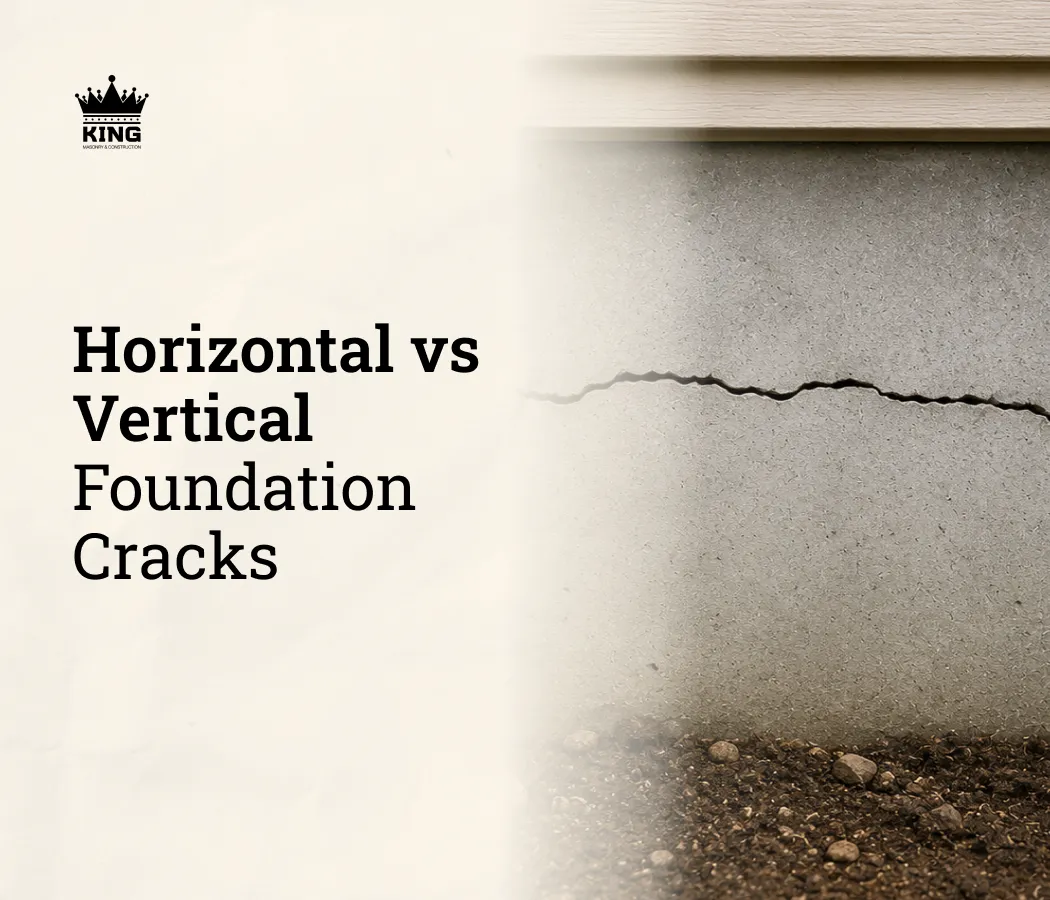
Horizontal vs Vertical Foundation Cracks: What Brookline Homeowners Must Know
Not every crack in your foundation means the same thing. A vertical hairline crack along a poured concrete wall behaves completely differently from a horizontal crack running across the middle of your basement wall and the gap between "monitor it" and "call a contractor today" often comes down to which one you're looking at.
For Brookline homeowners specifically, this distinction matters more than most. Brookline's combination of aging Victorian and Colonial housing stock, glacial clay soils, and 30+ annual freeze-thaw cycles creates exactly the conditions that turn small foundation cracks into serious structural problems faster than in many other parts of the country.
This guide breaks down what horizontal and vertical foundation cracks each mean, how to tell them apart, and what to do next.
Why Crack Direction Matters So Much
A foundation wall has one primary job: hold back the soil and the weight of the structure above it. Different forces produce different crack patterns, and the pattern tells you which force is at work.
Vertical cracks are typically caused by tension — the concrete being pulled apart as the soil beneath it settles or shifts
Horizontal cracks are caused by lateral pressure — the soil outside pushing inward against the wall
Diagonal cracks usually indicate differential settlement — one section of the foundation dropping faster than another
The direction isn't just diagnostic. It also determines the urgency of the repair and which method a contractor will use to fix it.
Horizontal Foundation Cracks
What They Look Like
A horizontal crack runs roughly parallel to the ground across a basement or foundation wall. It may appear as a single continuous crack or as a series of horizontal lines stacked above each other. In concrete block walls, horizontal cracks often follow the mortar joint between two courses of block.
What Causes Them
Horizontal cracks are caused by lateral soil pressure — the force of saturated, heavy soil pushing inward against your foundation wall. In Brookline, this pressure is amplified by:
Glacial clay soils that retain water for extended periods after rainfall, increasing the load against foundation walls
Spring thaw cycles when frozen ground releases large volumes of moisture all at once
Poor grading or drainage that directs water toward the foundation rather than away from it
The wall is not designed to resist this kind of bending force. It is built to handle the vertical weight of the house above — not the horizontal push of thousands of pounds of wet soil.
Why Horizontal Cracks Are the Most Serious Type
Of all foundation crack patterns, horizontal cracks carry the highest structural risk. When the wall begins to crack horizontally, it is already bending inward. Left unaddressed, that bending progresses — slowly at first, then accelerating — until the wall can no longer support the structure above it.
In Brookline's climate, a horizontal crack that goes unrepaired through one or two winters can go from a manageable reinforcement job to a full wall replacement situation. The freeze-thaw cycle forces water deeper into the crack with each season, widening it and weakening the surrounding concrete or block.
What to do: Place a long straightedge against the wall. Any inward bow — even slight — means the wall is actively moving. Do not wait for a second opinion. Call a foundation contractor immediately.
For a full breakdown of what happens when these cracks are left too long, see our guide on Signs of Foundation Problems.
Vertical Foundation Cracks
What They Look Like
A vertical crack runs up and down a foundation wall, roughly perpendicular to the ground. It may be straight or slightly irregular. In poured concrete walls, vertical cracks are extremely common. In block walls, they typically run through the face of the block rather than along the mortar joint.
What Causes Them
Vertical cracks have two main causes:
1. Concrete shrinkage during curing When concrete is poured and cures, it shrinks slightly as it loses moisture. This shrinkage creates tension that can produce vertical cracks, typically within the first few years after construction. These cracks are usually uniform in width, hairline to 1/8 inch, and do not grow or change over time.
2. Settlement As soil beneath the foundation compresses or shifts unevenly, sections of the wall are pulled apart horizontally. The crack appears vertical and is typically wider at the top or bottom depending on which part of the foundation is moving.
How Serious Are Vertical Cracks?
This depends entirely on whether the crack is stable or active.
Stable vertical crack: Has not changed in width or length over months of monitoring. Under 1/8 inch wide. No displacement between the two sides. No water infiltration. This is likely a historic shrinkage crack and may only need sealing to prevent moisture entry.
Active vertical crack: Is measurably wider or longer than it was 60 to 90 days ago. Shows displacement — one side of the crack sits higher than the other. Is accompanied by sticking doors, sloping floors, or other signs of ongoing movement. This requires professional evaluation.
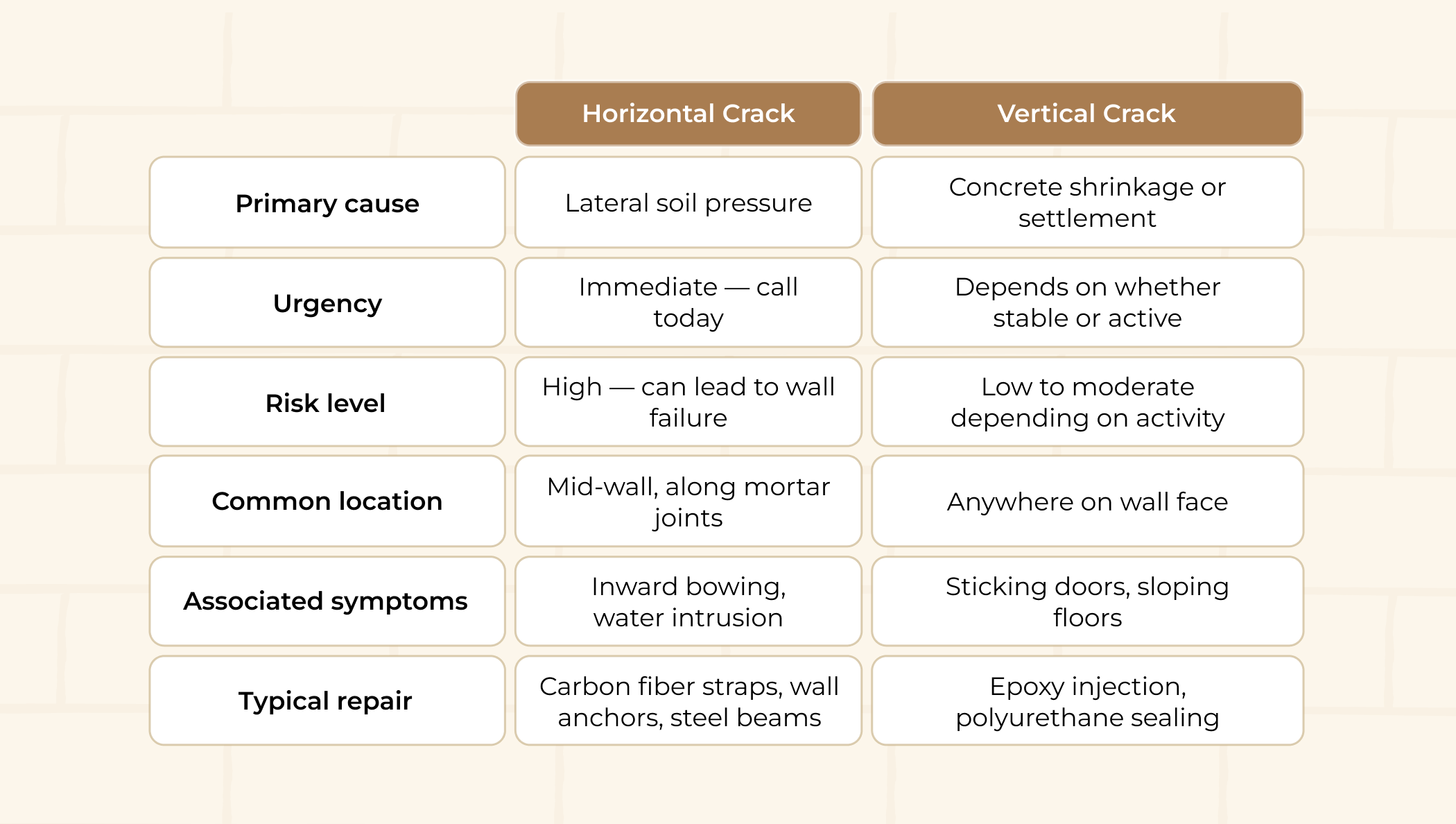
Side-by-Side Comparison
What About Diagonal Cracks?
Diagonal cracks — particularly those that run at roughly 45 degrees from the corners of windows or door openings are worth mentioning because homeowners frequently confuse them with vertical cracks.
Diagonal cracks from openings usually indicate differential settlement. They are common in older Brookline homes where one section of the foundation has settled more than another due to uneven soil conditions beneath the footing.
A single diagonal crack under 1/8 inch wide that has been stable for years is not usually an emergency. Multiple diagonal cracks, or cracks that are growing or showing displacement, warrant the same level of concern as active vertical cracks.
How to Monitor a Foundation Crack at Home
Before calling a contractor, you can get useful information by monitoring the crack yourself:
Mark both ends of the crack with a pencil line and write the date
Apply a small dab of plaster or joint compound across the widest point of the crack
Photograph everything with a ruler or coin for scale
Check monthly — if the pencil marks are farther apart or the plaster has cracked, the underlying crack is still moving
This information is exactly what a foundation contractor will ask for. Three months of monitoring data helps a professional determine whether the crack is a historic issue or an active one.
Brookline's Specific Risk Factors
Brookline homeowners face a set of local conditions that make foundation cracking more common and faster-moving than in many other areas:
Building age. Most of Brookline's residential housing stock was built between 1880 and 1950. Many of these foundations were constructed with materials — soft brick, rubble stone, unreinforced concrete — that are more susceptible to cracking than modern construction.
Glacial clay soils. The clay-heavy glacial till underlying most of Brookline retains moisture for extended periods, creating sustained hydrostatic pressure against foundation walls that sandy soils would not.
Freeze-thaw intensity. Brookline averages 30+ freeze-thaw cycles per year. Each cycle pushes water a little deeper into existing cracks and widens them slightly — a compounding process that accelerates damage in older masonry over time.
Mature tree roots. Many of Brookline's older neighborhoods have large, mature trees whose root systems can exert significant pressure against foundations and drainage systems.
When to Call a Contractor: A Simple Decision Guide
Call today if you see:
Any horizontal crack in a basement or foundation wall
Visible inward bowing of any wall
A crack that has grown measurably in the last 30 days
Active water seeping through any crack
Call within a few weeks if you see:
A vertical crack wider than 1/8 inch
Diagonal cracks at door or window corners showing displacement
Any crack accompanied by sticking doors, sloping floors, or separating trim
Monitor with the plaster method if you see:
Hairline vertical cracks under 1/16 inch in poured concrete
Stable, unchanged cracks with no water infiltration
Repair Options for Brookline Homeowners
The repair method depends on the crack type and how far the damage has progressed.
Epoxy injection is used for stable structural cracks in poured concrete that need to be sealed and bonded. It restores tensile strength across the crack.
Polyurethane foam injection is used for cracks with active water infiltration. It expands to fill the void and stops moisture entry.
Carbon fiber straps are the standard repair for horizontally cracked walls showing early-stage inward bowing. They are bonded to the wall surface and anchored to the floor and rim joist, preventing further movement without excavation.
Wall anchors are used when greater restraint is needed, typically for walls with more significant bowing. Anchors are driven into the soil outside and connected to a plate on the interior wall face.
Steel I-beam reinforcement is used for the most severe cases of wall bowing where carbon fiber alone is insufficient.
For walls that have failed entirely, full replacement is necessary — which is why early intervention matters. See our Foundation and Basement services page for a full overview of what each repair involves.
Frequently Asked Questions
Is a vertical crack in my foundation serious?
It depends on whether it's stable or active. A hairline vertical crack that hasn't changed in years is likely a historic shrinkage crack. A vertical crack that is widening, showing displacement, or accompanied by other symptoms of movement needs professional evaluation.
How do I know if my horizontal crack is an emergency?
Any horizontal crack in a load-bearing foundation wall should be treated as urgent. If the wall shows any inward bow — even slight — do not wait. The repair becomes significantly more expensive and complex once the wall has moved more than 2 inches from plumb.
Can I seal a foundation crack myself?
Surface sealants are appropriate for stable, minor shrinkage cracks where the goal is simply to prevent moisture entry. Structural cracks — any horizontal crack, any crack showing movement or displacement — require professional repair. Sealing a structural crack without addressing the underlying cause masks the problem and leads to worse damage.
Does homeowners insurance cover foundation cracks in Massachusetts?
Most standard policies exclude foundation damage from settling, soil movement, or hydrostatic pressure. Coverage may apply if the damage was caused by a sudden covered event such as a burst pipe. Review your specific policy and document the damage with photographs before any repair work begins.
Get a Professional Assessment
Kings Masonry and Construction provides foundation crack inspections throughout Brookline, Boston, and the South Shore. Every inspection includes a written assessment of the cause, not just the crack, and honest repair recommendations.
Call (857) 249-5127