
Brick Pointing vs. Repointing: What Boston Homeowners Need to Know Kings Masonry
If you've noticed crumbling mortar between your bricks, you've probably come across terms like pointing, repointing, and tuckpointing often used interchangeably, but with important differences. Knowing which one your home actually needs saves you from overpaying for work you don't need or underpaying for work that won't last.
Here's a clear breakdown of what each term means and what Boston homes actually require.
What Is Brick Pointing?
Pointing refers to the finishing of mortar joints during original construction the process of applying and shaping mortar between bricks as a wall is being built. When a mason points a wall, they are forming the mortar joint for the first time, tooling it into the correct profile to shed water away from the wall face.
In everyday conversation, pointing is sometimes used loosely to mean any mortar joint work but technically, it refers to new construction, not repair.
What Is Brick Repointing?
Repointing is the repair process removing deteriorated mortar from existing joints and replacing it with fresh mortar. It is the correct term for the maintenance work that most Boston homeowners actually need.
The process involves:
Removing deteriorated mortar to a minimum depth of ¾ inch
Cleaning the joint thoroughly
Dampening surrounding masonry before application
Packing fresh mortar in layers matched to the original composition
Tooling the finished joint to match the existing wall profile
Repointing does not replace bricks it restores the mortar joints between them. When done correctly with the right mortar, repointing extends the life of a brick wall by decades.
What Is Tuckpointing?
Tuckpointing is a specific finishing technique not a structural repair method. It involves applying two contrasting colors of mortar: a base coat that matches the brick color, and a narrow contrasting line (the "tuck") that creates the illusion of very fine, precise joints.
Tuckpointing is primarily an aesthetic technique used in historic masonry restoration. It is sometimes used incorrectly as a general term for repointing which causes confusion when homeowners compare quotes from different contractors.
Pointing vs. Repointing vs. Tuckpointing: Key Differences
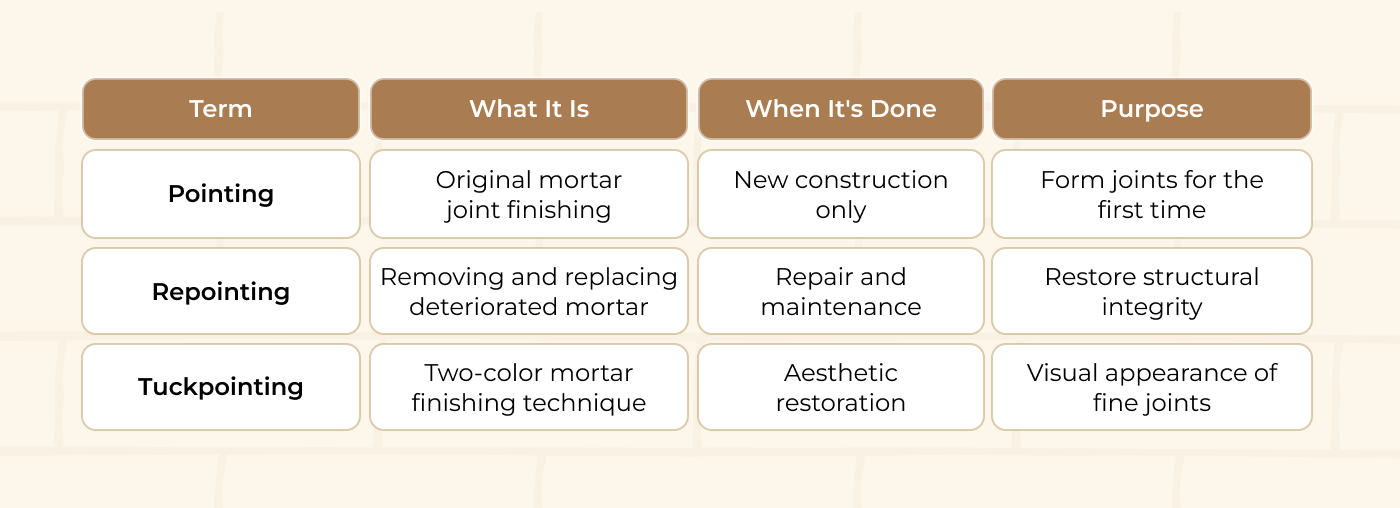
For most Boston homeowners with an older brick home showing crumbling or receding mortar repointing is what you need.
Why Mortar Deteriorates in Boston
Boston's climate is particularly hard on brick mortar. Understanding why helps you make smarter maintenance decisions.
Freeze-thaw cycling Boston experiences 130+ freeze-thaw cycles per year. Water absorbed into mortar joints freezes, expands by 9%, and contracts again gradually breaking mortar apart from the inside out.
Age Lime-based mortar used in most pre-1950 Boston homes has a natural lifespan of 50–100 years. Many Boston homes have never been repointed since original construction.
Wrong mortar in previous repairs Portland cement repointing on historic lime-mortar masonry is one of the most common causes of accelerated brick damage in Boston. Cement is harder than the surrounding brick stress that mortar should absorb transfers into the brick face instead, causing spalling.
Water infiltration Failed chimney caps, cracked crowns, and missing flashing allow water to saturate mortar directly, accelerating deterioration in specific areas.
Signs Your Brick Needs Repointing
Mortar crumbles at the touch run a screwdriver across joints; if mortar falls away easily, repointing is overdue
Mortar receded more than ¼ inch below the brick face an open water entry path
Stair-step cracks following mortar joints diagonally may indicate foundation settlement
Efflorescence white deposits indicating water moving through the masonry
Loose or displaced bricks mortar bond has failed completely in affected areas
Dark staining on joints repeated water saturation and drying cycles
The Critical Importance of Mortar Matching in Boston
This is where repointing jobs succeed or fail and where the difference between a knowledgeable masonry contractor and an inexperienced one is most apparent.
Historic Boston homes (pre-1950) were built with soft, flexible lime-based mortar. This mortar is intentionally softer than the surrounding brick it is the sacrificial element, designed to absorb stress and allow moisture to escape while protecting the brick.
Modern Portland cement mortar is significantly harder than lime mortar and harder than the brick in most historic Boston homes. When Portland cement is used to repoint a lime-mortar wall, the brick becomes the weakest element. Thermal movement, freeze-thaw cycling, and structural stress that the soft mortar used to absorb now crack and spall the brick face instead.
Mortar lifespan comparison:
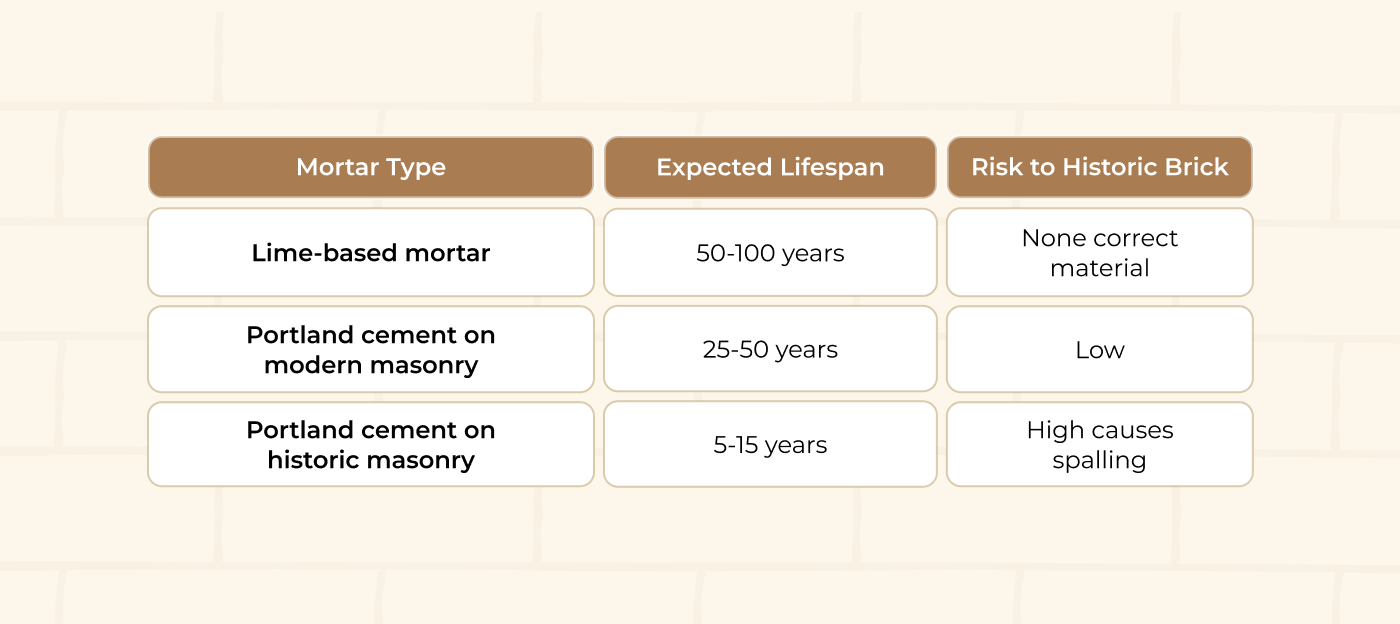
For any Boston home built before 1950, insist on lime-compatible mortar matched to the original composition. This is not a preference it is a structural requirement.
Kings Masonry & Construction provides professional brick repointing and masonry repair Get a free on-site estimate and mortar assessment before the summer window closes.
FAQ
How long does brick repointing take?
A typical chimney repointing job takes 1-2 days. A single wall section takes 1–3 days. Full exterior repointing of a Boston home takes 1-3 weeks depending on size, scaffold requirements, and extent of deterioration.
What time of year is best for brick repointing in Boston?
June through September is ideal warm, dry conditions allow fresh mortar to cure fully before freeze-thaw cycling begins. Repointing done in October or later risks inadequate curing before the first frost, which significantly reduces longevity.
How do I find a qualified brick repointing contractor in Boston?
Look for contractors who specifically ask about your home's age and existing mortar composition before recommending a mortar type. Any contractor who recommends Portland cement for a pre-1950 Boston home without first assessing the existing mortar is a red flag. Ask for references on similar historic masonry projects in the area.
Does repointing waterproof my brick wall?
Repointing eliminates one of the primary water entry paths deteriorated mortar joints but it is not a complete waterproofing solution. After repointing, applying a breathable siloxane-based penetrating sealer provides an additional layer of water resistance without trapping moisture inside the wall.
Can repointing fix structural cracks in brick?
Repointing restores mortar joints it does not address the underlying movement that caused structural cracks. Stair-step cracks indicating foundation settlement, horizontal cracks indicating lateral pressure, and any crack that is actively widening require structural evaluation before or alongside repointing.